
From Lara to Google Translate: a short guide to translators using Ai
Translating soon, better, cheaper. That is the promise, but will it really be so?
3' min read
3' min read
Translating sooner, better, at lower cost. This is the promise of artificial intelligence-based translators. But one is quick to say 'AI translator': there is a world of difference behind this category of solutions. There are the generic services, such as ChatGpt and Gemini, which translate but are not their speciality. But also the consumer ones, free, from Google and Microsoft (Bing). Finally, the paid, more professional ones, which also have limited free versions. And even among the latter there are differences in specialisation and various levels of 'customisation' possible by companies using them.
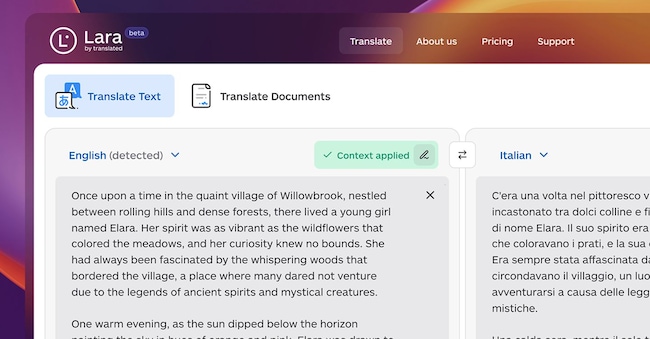
In this product category, there is also a long-standing Italian player, Translated, which in November launched a new translator, Lara, for the first time also aimed at a consumer and professional audience (whereas previously it only sold services to large companies).
Let us look at some of the most popular text translators. Although some of these services also do audio/video translation (real-time or not), there are other more specialised services to consider for these functions.
Deepl
The first service name dedicated to AI translation is probably Deepl, in the world. In 33 languages, which is less than some competitors; but it manages to be faster and more accurate. It also supports attachments in various formats, has apps and browser extensions. It has a version with limited daily usage and rates from EUR 7.99 per user per month. All the paid ones have unlimited text translation and increasing limits for attachable files. Those that pay more have more glossaries (allow translations of words and short phrases to be specified) and the possibility of integration with Cat tools (computer-aided translation software).
Lara of Traslated
Lara is free up to 5,000 characters per day, then you pay $9 or $29 per month depending on usage. 'Compared to competitors, we have trained the AI model on the ability to reason and understand the context of the translation,' explains founder Marco Trombetti. It understands when the translation is uncertain and asks the user for clarification. Understanding the context makes it possible to avoid translation mistakes "such as translating the Italian words 'red earth' for a text about tennis". "It has been trained with entire documents (instead of, classically, short sentences) so that it translates better by understanding the context. It is designed to collaborate with the human translator. To optimise it, we have also trained it with texts from discussions between translators and text editors,' Trombetti summarises.

