Novel

From Vallortigara a metaphysical thriller on the capacity to consolidate memories

The neuroresearcher and well-known essayist makes his debut with his first novel, 'Desiderare'. In the background, studies on the nature of memory and consciousness

4' min read

4' min read

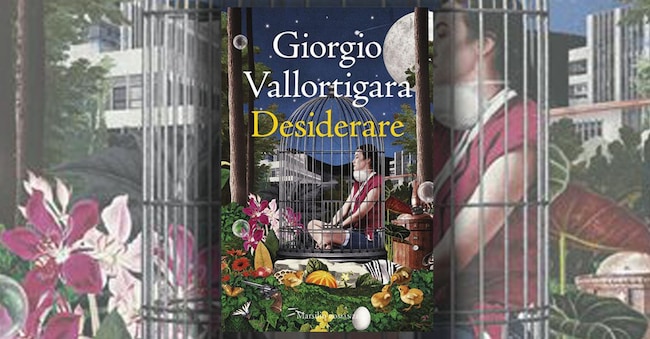
Giorgio Vallortigara, a neuroric researcher at the Centre for Minc/Brain sciences at the University of Trento as well as a populariser known for his original flair, after having published several essays - the latest is A spasso con il cane Luna (Adelphi) - returns to bookshops with his first novel: Desiderare (Marsilio, pp. 240, euro 18), previewed at Pordenonelegge.

What are you talking about?

Loading...

The story takes place on a parallel plane, there is a scholar, a scientist who has left active research to deal with those characters left in the interstices of science: he is writing a novel about Douglas Spalding, the true discoverer of imprinting, although the discovery is attributed to Konrad Lorenz. His story is also interesting because he was the guardian of the Amberley family, and in particular of Bertrand Russell's older brother. He was also his mother's lover: Bertrand Russell mentions him in his autobiography. He speaks of Spalding as the Darwinian who studied the instincts of chickens and was also aware of his mother's affair with the tutor, which was also approved by his father. Itzhak, this is the name of the protagonist, is therefore writing this novel, which is a romantic story and also an account of his life in Victorian times. At the same time, he is also trying to understand the reasons for the death of a friend of his, Vittorio, who died by suicide. He was a scientist who worked on memory and the critical periods of the brain, that is, the same kind of phenomenon linked to imprinting, that is, the fact that young organisms have a phase in which the brain is superplastic and can learn anything with great ease. The friend wanted to find out if it was possible to obtain this brain, which he calls 'soft' in adulthood. Other friends and scientists revolve around Itzhak, for example a man from Vicenza who had emigrated to Great Britain, an avid reader of Meneghello, a very ironic and disenchanted scholar, and then another figure, Patrick de Gray, a very successful scientist who was Vittorio's collaborator in his studies on the soft brain. Then there is a love story between Itzhak and a young former mathematician called Sylvia.

It is a metaphysical thriller centred on the themes of memory and the possibility of reconsolidating memories, of avoiding their erasure, as well as the possibility of having superplastic brains, like those of a new-born chick, even in adulthood.

How come, after so many essays, you decided to write a novel?

I worked on it for many years, mostly in the summer, I thought about leaving it in the drawer, then I showed it to some writers to get an expert opinion and they encouraged me. The reason I wrote it is mentioned in my last essay,Walking the Dog Luna: I try to do my job as well as I can. An essayist, however, has a hard time touching the readers' hearts the way a true storyteller can, he does not have the same possibility of arousing emotions. So I wrote a science book disguised as a novel. A book that I hope will not be didactic: the characters talk about science, my hope is that the reader will be entertained by the tram, but will be surreptitiously introduced to some topics that are central to us who study the brain, in particular the nature of memory and the nature of consciousness.

Then it is also a way to talk about the books I liked, many direct and indirect quotations to authors I loved: Meneghello, Borges, Daniele Del Giudice, Athanasius Kircher. The woman, for those who are passionate about literature, is clearly inspired by Sylvia Plath, so much so that there is a moment when she bites her ear, just as she did with her future husband when she met him.

You said that novels speak to the heart. But do they only speak to the heart in your opinion?

I use the expression heart to indicate speaking to the intelligence but in a way that is able to excite, I am not saying that it does not happen in non-fiction, of course it does, but doing it through a narrative and a story gives added value because you are talking about people. For me there is no real caesura, even when I talked about science I tried to do it in a personal way. That's kind of what I've always done. Once Borges said: what I want to say tonight to all of you, then he corrected himself: no to each one of you, because "all" is an abstraction while "each one" is real, I find that storytelling allows you to speak to each one.

With all the risks involved, because of course one sees what one believes.

Do novels succeed in saying things that essays fail to say? 

In the novel there is this aspect of allusion. Like Heraclitus' god, who does not say but only hints. This characterises poetic language, artistic language, there are things that can be said clearly, explicitly, scientific knowledge is intersubjective, it can be shared entirely. If I did not lie, the experiment I did can be shared and redone by someone else. But then there are things that pertain to personal experience, they can be communicated to others, but you don't have the certainty that others will understand them, because they pertain to something personal, and these you try to communicate with literature.

It is said that many years ago, when progenitors stood around the fire there were those who fed it and those who told stories, the former being the scientists and the latter the poets. I don't believe this, I think that from the very beginning science has been linked to storytelling, experiment is not enough, you have to convince your peers, you have to persuade, you have to tell a story, even scientific theories even if they are expressed in the form of a mathematical language are narratives, they are meant to be perspicuous, convincing.

Copyright reserved ©
Loading...

Brand connect

Loading...

Newsletter

Notizie e approfondimenti sugli avvenimenti politici, economici e finanziari.

Iscriviti