
Byd Dolphin G DM-i: the first plug-in hybrid city car makes its debut. What is the Chinese model, which is targeting the European market, like, and how does it perform?
The Chinese manufacturer is making a bold move into the B-segment – a market neglected and subsequently abandoned by many traditional carmakers – with a model designed specifically for Europe. The car, suitable for corporate fleets, boasts a super hybrid with an EV range of between 40 and 100 km, which in practice has no real competitors because the Renault Clio and Toyota Yaris are full hybrids (non-plug-in), whilst the Stellantis models are only mild hybrids
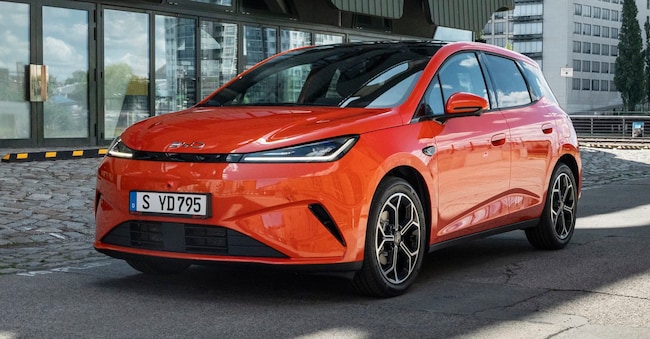
BYD is making a push into the B-segment and, naturally, is aiming to strike at the heart of this market’s traditional core: compact five-door saloons suited to city driving and medium-range journeys. In fact, with the new Dolphin G DM-i, the Chinese manufacturer is able to offer a model that is essentially unrivalled, because not only is it a hybrid but it is also a plug-in hybrid, whilst the only three possible competitors – the Toyota Yaris, Renault Clio and Dacia Sandero, are full hybrids only, whilst other manufacturers, such as Stellantis, offer mild hybrid models or even manual-gearbox versions without electrification, or very lightweight 12-volt hybrids.
And whilst the name of the new Chinese compact car – a variant of the all-electric version – is complicated and hard to remember, its mission is much clearer: to dominate the ‘classic’ B-segment, currently dominated by the Dacia Sandero and abandoned by major players such as Ford with the Fiesta – which is set to return as an electric model – and cloned by the Renault 5 e-tech.
But there’s more: with its plug-in hybrid model, BYD is also entering the fleet segment, where electric and PHEV vehicles enjoy tax incentives. And behind the DM-i designation lies an innovative technology already seen in BYD and other Chinese models identified as super hybrids, thanks to their long range in pure electric mode, where the new BYD varies between 40 and over 100 km depending on the configuration.
The acronym DM-i stands for Dual Mode Intelligence, a system that coordinates an internal combustion engine and two electric motors (one for propulsion and one acting as a generator) to optimise fuel economy and performance. The digital control system switches the flow of power between two main configurations: EV mode, when the car runs exclusively on electric power using the battery and energy recovery during braking, whilst in hybrid mode (HEV) the car’s control unit combines the different power sources to balance efficiency according to driving conditions.
BYD’s DM architecture differs from traditional plug-in hybrid systems in that it prioritises electric propulsion, relying primarily on the battery-powered motor to deliver a quiet and responsive driving experience. The 1.5-litre petrol engine, a classic 4-cylinder capacity made in China, acts instead as a generator and traction support, activating to recharge the Blade Battery and operate at maximum efficiency. In hybrid mode (HEV), activated by the driver or the system when the charge is low, the car automatically selects five different configurations to optimise efficiency. At high speeds, the electric motor drives the wheels using energy from the battery alongside that produced by the generator, which is powered by the petrol engine. If the demand for power drops and the battery is low, the flow changes: part of the generator’s power drives the car, whilst the rest recharges the battery. The system also includes a clutch that connects the internal combustion engine directly to the wheels to manage the other three configurations.

