Made in China

Byd expands the Atto2 range with new plug-in hybrid versions

In Europe, Chinese manufacturer Bud is recording impressive numbers, tripling its sales compared to the same period last year and reaching 81,000 vehicles in the first nine months of 2025, also thanks to an ever-expanding range

BYD ATTO2 Comfort: ora è più potente e con maggiore autonomia

5' min read

Translated by AI
Versione italiana

5' min read

Translated by AI
Versione italiana

We had the opportunity to test-drive the new versions of the Atto2 compact suv around Barcelona: the Confort, which is the top of the range among the 100% electric versions, and the DM-i, which uses Super Hybrid technology with Dual Mode that gives it an autonomy of no less than 1,000 kilometres on a full tank.

Byd Atto2 DM-i: la versione plug-in del suv compatto cinese


Loading...

Atto2 DM-i, the plug-in hybrid with a range of 1,000 km

As with the 100 per cent electric version, the Atto2 DM-i plug-in hybrid is available in two versions, Active and Boost, which differ mainly in terms of power output (166 hp the former and 212 hp the latter), battery capacity (7.8 kWh the Active and 18 kWh the Boost), maximum charging power and certain standard features such as wireless charging and heated seats and steering wheel, which are only available on the Boost version.

The highlight of the solution proposed by Byd with the new Atto2 DM-i is the Super Hybrid system with Dual Mode, already adopted on the Chinese manufacturer's Seal U DM-i and Seal 6. This technology makes the electric motor work together with a particularly slim battery integrated in the floorpan (Battery Blade) and a 1.5-litre Xiaoyun petrol engine. In addition to the Ev mode, two different hybrid modes (Hev) are available: in the first, the combustion engine only intervenes to recharge the battery, while in the second, it acts directly on the traction to provide additional boost if necessary. The result is a system that functions most of the time as an electric car, allowing up to 90 km of zero-emission range (40 km for the Active version), a combined weighted average consumption of 1.8 L/100 km, and 1,000 km of combined range with a 45-litre fuel tank. In terms of performance, 100 km/h is reached in 7.5 seconds (9.1 sec. for the Active version) and the top speed is 180 km/h.

The sore point is the maximum AC recharging power: 6.6 kW for the Boost version and just 3.3 kW for the Active version, resulting in recharging times close to 3 hours (from 15 to 100 per cent): a bit too much for a latest generation car. Direct current charging is not supported.
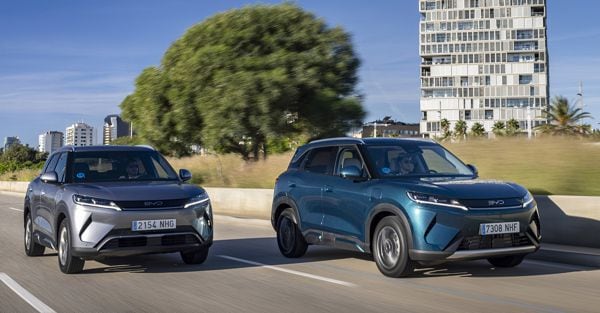
This compact suv is 4.3 metres long (20 centimetres longer than the electric version), 1.8 metres wide, 1.7 metres high and has a wheelbase of 2.6 metres, which allows for a fair amount of space inside, both at the front and at the rear, also thanks to the absence of a central tunnel: in fact, traction is entirely front wheel drive.

Le nuove versioni del sul compatto elettrico BYD Atto2, il top di gamma Comfort (a sinistra) e l’ibrida plug-in DM-i (a destra)

The front end adopts full LED headlights and subtle daytime running lights, while the bumper with sharp lines and vertical air intakes is designed to improve aerodynamic efficiency. The sides are sculpted, with retractable door handles and black pillars giving a 'floating' roof feel, while the rear features a small spoiler at the top and knot-shaped headlamps joined by a horizontal light line. It can be recognised from the 100 per cent electric version only by a few details: the lower grille in the larger front bumper shield, the petrol tank cover on the left rear mudguard in addition to the charging socket on the right front mudguard and the DM-i lettering on the tailgate.

The interior is well cared for, with quality materials and an essential supply of physical buttons, as has become customary in Chinese cars: controls are via the 12.8-inch infotainment display (for the first time it does not rotate 90°). Well defined, it displays a proprietary system that is rather complex in the management of all possible options but fortunately, thanks to an agreement with Google, directly supports apps from the Store and Apple Carplay and Android Auto solutions.

In front of the driver is a second 8.8-inch display, but it is far too packed with information, displaying driving, adas, infotainment and range information so that it is difficult to focus on what really matters.

There is no shortage of goodies such as the double-height bridge, the 15 W wireless charging cradle, the touch control of the panoramic roof cover and the glasses holder fixed above the driver's door. There is also an rfid sensor on the outside rear-view mirror for opening doors via smartphone or key-card. While this is a technologically impressive option, it could perhaps have been placed in a spot less prone to knocks.

The Boost version also supports the Vehicle-to-Load function that allows powering external devices (such as refrigerators and camping equipment) up to 3.3 kW.

The adas equipment is good, with adaptive cruise control, automatic emergency braking, blind spot detection, lane keeping and traffic sign recognition all standard on all versions.

The ride is pleasant and fluid, with an extremely quiet cabin, a brilliant powertrain despite the fact that the power involved is not extremely high, precise steering and well-tuned suspension (something rare on cars made in China), while the brakes could be improved. There are four driving modes available (Eco, Normal, Sport and Snow, where there is little grip) and two levels of energy recovery under braking. There are no paddles behind the steering wheel, so it is necessary to use the central screen to make the choice.

The new Atto2 DM-i Boost is already available online (first deliveries beginning 2026), with a list price of EUR 29,800. The DM-i Active version will be available later.


Atto2 Comfort, the top of the range that was missing

With a larger battery, an extended range and even more equipment, the Atto 2 Comfort is at the top of the range of 100 per cent electric versions (Active and Boost versions have already been available since the beginning of the year).

Aesthetics and dimensions remain unchanged: 4,310 mm in length, 1,830 mm in width, 1,675 mm in height, with a wheelbase of 2,620 mm to maximise interior space.

Despite this, boot capacity gains 50 litres to 450 and 1,370 litres respectively with the rear seats in place or folded down (60-40%).

Although engine power is 150 kW, i.e. 20 kW more than the versions already on the market, the 64.8 kWh battery brings the range up to 430 km (WLTP combined). Acceleration 0-100 km/h and top speed are the same for all versions, at 7.9 seconds and 160 km/h respectively, while maximum torque is increased by 20 Nm (from 290 Nm to 310 Nm) to the benefit of brilliance in driving response.

The maximum recharging power supported also increases: the 155 kW enables a 10 to 80 per cent charge in 25 minutes. Safety equipment includes seven airbags, adaptive cruise control, traffic sign recognition, fatigue monitoring and automatic emergency braking. There is also Vehicle-to-Load technology that allows external devices to be powered up to 3.3 kW.

The ride is rather brilliant, with good cabin soundproofing and better ergonomics than many Chinese competitors, although the driving position remains surprisingly low. The suspension suffers a little from the weight of the battery, although Byd has opted for a multi-link solution at the rear, but the steering is nevertheless precise.

The Atto2 Comfort is already available online with a list price of 33,200 euro.

Copyright reserved ©
Loading...

Brand connect

Loading...

Newsletter

Notizie e approfondimenti sugli avvenimenti politici, economici e finanziari.

Iscriviti