
BYD relaunches price war and shakes up the Chinese market
Drops of up to 34% The stock lost 8.6% in Monday's session, dragging Geely (-9.5%), Li Auto (-3.2%), Xpeng (-4.4%) and other industry players down with it

3' min read
3' min read
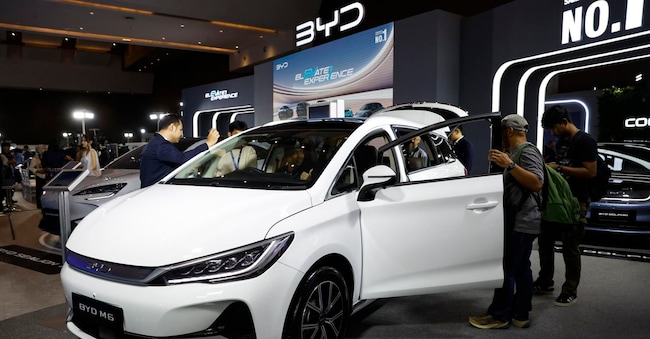
The shake-up starts in Hong Kong, but its repercussions are felt far beyond local borders, shaking up the entire global electric car landscape. BYD, the Chinese giant and Tesla's number one rival, announced a drastic price cut of up to 34% on more than 20 models including electrics and plug-in hybrids. A move that triggered a chain of declines, even among the sector's main competitors. The BYD share lost 8.6% in Monday's session, dragging Geely (-9.5%), Li Auto (-3.2%), Xpeng (-4.4%) and other industry players down with it. Although the capitalisation, exceeding $170 billion, remains at an all-time high after a long rally. Since the beginning of the year, the share price has risen by 60 per cent.
At the heart of the manoeuvre is a clear logic: defend and indeed expand market share, even at the cost of sacrificing margins. The Ebit margin, in fact, fluctuates around 6% even though volumes are clearly growing (+47% between January and April). A choice that reflects a precise strategy in the world's largest car market, which is now less dynamic and increasingly competitive. Among the new prices is the Seagull, an electric saloon now offered at 55,800 yuan, just under EUR 6,800. Even more marked is the drop on the Seal 07 plug-in, which drops 53,000 yuan, over 30%.
Citi estimates an ambitious target: to increase deliveries by 20-30% in the second quarter compared to the first. However, the net margin per vehicle, at around 9,000 yuan, remains below the 10,000 forecast by management only a few weeks ago. The choice may not be without risk for China's queen of the electric car, which sees the volume race starting to weigh on its accounts as well.
The domino effect was not long in coming. Changan and Leapmotor immediately responded with similar promotions, demonstrating the strong 'pricing power' wielded by BYD over the entire industry. As Li Yanwei of the China Automobile Dealers Association noted, each wave of discounts forces others to follow, raising the level of competition. And it is here that the first warning signs emerge.
Last week, China's National Development and Reform Commission (NDRC) expressed concern about what it called a realrat race, a race to the bottom without economic rationality, where some manufacturers even end up selling at a loss (Nio and Xpeng, for example, have negative margins). Spokesman Li Chao stated that these practices go beyond the limits of healthy competition, announcing forthcoming regulatory interventions.


