
Byd Seal U Dm-i, a differently plug-in hybrid SUV. Here's what it looks like and how it goes
After a string of five full-electric models, the Chinese brand drops the plug-in hybrid suv card in Italy, which moves its wheels almost always under the impetus of electricity. The range consists of three versions.

4' min read
Key points
4' min read
Not only electric cars but also plug-in hybrids which, all together, give China's Byd leadership in the Nev, or new energy, car sector and propel it to ninth place in the world's top ten car manufacturers by 2023. The brief identity card serves to understand why after having landed in Italy with five full-electric models including the battery-powered Seal U, which like those of other brands are struggling to establish themselves in Europe, it is now offering a plug-in hybrid version of the large Seal U SUV. The newcomer is called Dm-i, an acronym combining the definition dual motor and the letter i to convey the fact that the system is intelligent. In fact, Byd's plug-in hybrid is peculiar and, if you like, yet another demonstration of how some Asian manufacturers interpret hybrid technology, regardless of whether it plugs in or not. In the case of this Seal U, this philosophy is expressed in three different ways, giving rise to the front-wheel-drive Boost and Comfort versions, as well as the all-wheel-drive Design.
Byd Seal U Dm-i, the X-ray
.In practice, Byd's hybrid system works both in a serial and parallel manner since the petrol engine is essentially a current generator since only in certain cases evaluated by the electronics, depending on the remaining battery charge, which in any case never falls below 25%, and on the stresses of the accelerator as well as the use of Ev or Hev mode as well as car configurations ranging from Eco to Sport, does it move the wheels. The Boost and Comfort under the bonnet have a 1.5-litre naturally aspirated engine with 96 horsepower and 122 Nm of torque, which is combined with an electric motor with 197 horsepower. The system offers a total output of 214 horsepower, but in the Boost it is combined with an 18.3 kWh lithium-iron-phosphate battery pack that promises zero-emission mileage of 80 kilometres, while in the Comfort the battery pack is 26.6 kWh and moves the zero-emission range to 125 kilometres. The Design's powertrain, on the other hand, consists of a 1.5-litre petrol engine but turbocharged with 128 horsepower and two electric units with 204 and 163 horsepower. Altogether it develops 313 horsepower and is coupled to the 18.3 kWh battery, which in this case promises electric mileage of 70 kilometres. The 18.3 kWh batteries can be recharged in two hours with 11 kW alternating current and in just over half an hour from 30 to 80 per cent with 18 kW direct current. The intertwining of the various solutions and the fact that the petrol engine fed by a 60-litre tank only sporadically acts on the drive allow the Boost to promise an overall range of almost 1,100 kilometres.
Byd Seal U Dm-i, recognisable by a few details
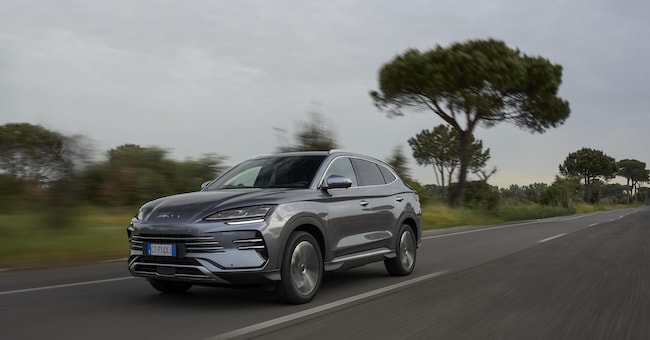
.With a length of 4.78 metres, a width of 1.89 metres, a height of 1.67 metres and a wheelbase of 2.76 metres like the other Seal U, but with a slightly smaller boot capacity ranging from 425 to 1,440 litres, the Dm-i is aesthetically recognisable only by its front end with a traditional grille and the petrol filler housing on the left side. The interior only offers as a novelty the control to switch the operating mode from Ev to Hev. So, there is the same abundance of space, the same neat presentation and the same level of digitisation that rests on the 12.3-inch cluster, the head-up display where, however, navigation cannot yet be displayed, and the classic 15.6-inch Byd rotating infotainment screen. Following the rampant trend that is not at all in line with the dictates of ergonomics brought to the fore by Tesla, on the Seal U most of the car's functions and services are operated solely from the central touchscreen. The Dm-i introduces wireless connection for Android Auto and Apple CarPlay to the range.
Byd Seal U Dm-i, how's the four-wheel-drive design
The more powerful Dm-i, which touches 180 km/h and reaches 100 km/h in 5"9 on the road, is comfortable thanks also to the silent and linear performance of the powertrain even when the heat engine intervenes. The temperament is rather calm and, on the whole, appropriate for an SUV that is at ease above all on not very winding roads, since between tight bends the overly soft calibration of the set-up and steering proves to be ill-suited to the situation. As far as consumption is concerned, at the end of the test on mainly fast roads we noted an average petrol consumption of 5.7 l/100km, calculated by the on-board computer by adding the 6.1 kWh electricity consumption and the 4 l/100km of petrol used to tackle it.
Byd Seal U Dm-i, versions, prices and equipment
Sales of the Dm-i start with the Boost versions selling for less than 40,000 euros and Design which costs almost 48,000 euros; the Comfort will be marketed in a few months. Standard equipment is very comprehensive and includes, among other things, level 2 driver assistance systems, electrically adjustable seats and an electrically opening panoramic roof.

