
C2C Festival, Turin out of the comfort zone
From 30 October to 2 November, the electronic music and arts festival confirmed its bolder identity. A journey through sounds, visions and experimentation.
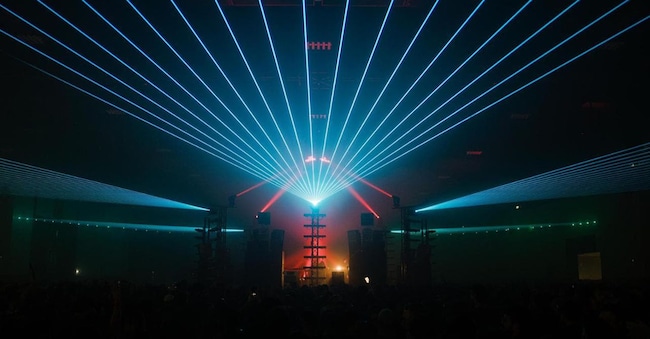
You may like it or not. It can confuse you with its eclecticism, or clear your head about where the musical avant-garde is going. It can involve you to the point of losing all sense of time, or inject you with a sense of alienation. It is difficult to define the C2C Festival in Turin as perhaps one of the most daring musical events on the Italian scene. But I think it can be said that its greatest merit is that it takes the spectators out of their comfort zone: you do not come here to see prearranged sets, to follow a crescendo - as happens in almost all festivals - from the minor groups to the grand finale. Rather, it is an inconstant flow, which proceeds between techno peaks and ethereal notes, between big names in electronica and new researchers in pop, between guitars and synthesisers, in which you have to immerse yourself and let the music take its course: to excite you, make you dance, intrigue you or even annoy you a little. This edition, the twenty-third, staged in Turin from 30 October to 2 November, the first orphan of its founder Sergio Ricciardone (who passed away in March), confirmed the direction that had been chosen for some time: starting with the timing, which saw C2C staged on the same days as Artissima, the contemporary art fair. Both spread throughout the city, but at the same time with their beating heart in the Lingotto area, as if to tell - between artistic installations and musical performances - that Turin's industrial soul was capable of evolving into something culturally relevant. Thus the two events talk to each other, sometimes share an audience, and both try to look beyond the state of the art, towards new evolutions and experimentations.
The entire programme - this year particularly impressive, enriched by musical events at the OGR, another heritage of industrial Turin, and conversations on music at the Teatro Regio (among the guests was Andrea Laszlo De Simone) - made up a sound mosaic that found its maximum expression at the Lingotto Fiere: two dense evenings, the second entrusted to the protagonists of world electronics such as A.G. Cook, Four Tet and Floating Points. Cook, Four Tet and Floating Points; but already from the first evening on 31 October, the festival's identity was clearly revealed - an experience that is at once concert, ritual and sound investigation. Among the performances that left their mark was that of Chilean composer Nicolas Jaar together with Ali Sethi, a singer and novelist born in Pakistan: the duo, for the first time in Italy, gave life to a layered performance, in which Jaar's electronic textures merged with Sethi's singing, inspired by an ancient poetic form, the ghazal, brought by Arab mystics to the Indian subcontinent. The result was a dreamy, suspended opening, almost an invitation to surrender: get comfortable, let yourself be crossed by the sounds, prepare to explore new worlds.
The other worlds then arrived, and took on dissonant and surprising forms: the most unexpected show, that of the young Japanese-Canadian singer Saya Gray, who brought guitars and drums onto the stage, in the old-fashioned way, and opened the dances with a sort of slightly unbalanced avant-garde country, then modulated her falsettos between folk, r'n'b and flashes of hard rock. Surreal, funny and amused, Saya drew much applause, perhaps because of that absence of stylistic linearity that has become, today, a form of freedom, and certainly gave a taste of the many directions pop can take, beyond chart conquerors like Chappell Roan or Sabrina Carpenter. It turned to sweeter and more melancholic atmospheres with Blood Orange, an artistic project by English musician and composer Devonté Hynes (Grammy-nominated for his classical music project Fields): as the hours grew short (around 1am), the artist lit up the aisles of the Lingotto with jazz-contaminated melodies, also giving space to his latest record (Essex Honey) entirely dedicated to his recently deceased mother.

