The debut

Ca’ Foscari: Marco Sgarbi takes up his post as rector today: “Our first measure is to raise the threshold for the ‘no tax area’ to 30,000 euros”

“No talented individual should be prevented from enrolling on the grounds of income. The annual budget allocation for this measure is over 650,000 euros.”

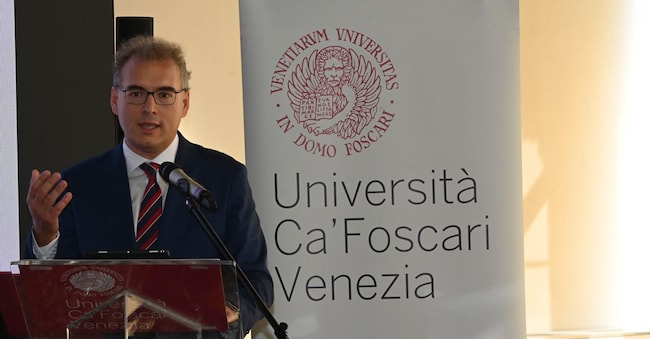
Venezia, 01/10/26 - nuovo rettore a Ca'Foscari, il rettore Marco Sgarbi - conferenza stampa con i nuovi prorettori
©Marco Sabadin/Vision ©Marco Sabadin/Vision

6' min read

Translated by AI
Versione italiana

6' min read

Translated by AI
Versione italiana

Marco Sgarbi’s term as rector begins today – Thursday 1 October. For the six-year term 2026–2032, he will lead the University of Venice, of which he is the 24th and youngest rector. Earlier this morning, the symbolic handover took place with the outgoing Rector, Tiziana Lippiello: “I would like to express my gratitude to Tiziana Lippiello, who over recent months has always shown great willingness to ensure that the handover process was as smooth and straightforward as possible. She has led Ca’ Foscari with profound dedication and achieved significant results, promoting our university throughout the world. It is with great emotion and a sense of responsibility that I today embark on this journey at the helm of the university, offering my experience and commitment. I will do everything I can to contribute to its future.” The Rector then introduced his governing team (16 Vice-Rectors and 33 Delegates) and outlined the objectives and initial measures of his term of office.

Students

One of the first measures is to raise the ISEE threshold for the ‘no tax area’ to 30,000 euros: “No talented student should have to give up enrolling because of their income,” said the Rector, adding that “the investment for this measure amounts to over 650,000 euros a year from Ca’ Foscari’s budget. We will put this before the University’s governing bodies at the next available meeting.”
For students, the Rector also announced the establishment of a single support and guidance service, covering everything from career guidance through to their first employment contract, capable of recognising signs of difficulty before they lead to students dropping out. No one should be left to cope alone: personalised services for working students, those with learning difficulties, international students, student carers and those in vulnerable circumstances.
“What our students make of their journey and what they learn at Ca’ Foscari will shape the future of our country and of Europe. That is why,” said the Rector, “we are putting ‘students at the centre’, for a better future.”

Loading...

Making the most of spaces

The Rector’s plans also include the enhancement of the University’s facilities, starting with its libraries, which are spread across nine locations in the historic city centre and on the mainland: “Our libraries are public spaces that I envisage becoming increasingly integrated into the city,” says the Rector. “Everyone has the right to access a public study space, which is why one of my plans is to enhance and promote their use by opening them up to the city.”


An institute for future studies

An Institute for Future Studies and Strategic Foresight where, as the Vice-Chancellor explains, “interdisciplinary research tackles the major transformations of our time. Not just another department, but the intellectual infrastructure that embodies our mission — not to be passive in the face of the future, but to study it and help shape it. A project already underway: we have established a specific unit dedicated to Future & Foresight Studies”.

The multi-campus model

Venice as a hub of identity and internationalism; Mestre as a centre for science and technology; Treviso as a centre for entrepreneurial training. Not three competing sites, but a single project in which the diversity of locations reinforces the University’s unity. This summarises the Rector’s multi-campus vision, according to which there is not just ‘one city’. Venice, Mestre and Treviso represent different urban contexts, each with its own specific social, cultural and economic dynamics. A university that brings the city to life must be able to embrace this diversity not in a piecemeal way, but through a differentiated and coordinated strategy, capable of recognising the unique characteristics of each area and linking them together. In each area, the University must implement specific programmes, but under a unified framework, so that the multi-campus model is not merely a distribution of activities, but rather an integrated civic strategy.”

The Mestre office

According to the Rector, particular attention must be paid to the Mestre campus, which represents an urban context that is profoundly different from Venice and is therefore of strategic importance. “In a context characterised by a strong residential component, urban transformation dynamics and a growing young and multicultural population, the university can play a decisive role in processes of regeneration, social innovation and the creation of spaces for cultural participation. The university’s presence in Mestre can become a stable point of reference for public initiatives, partnerships with schools, associations and third-sector organisations, as well as for projects linked to urban sustainability, the ecological transition, technological innovation and dialogue with the metropolitan business sector. Strengthening the cultural identity of the Mestre campus means making a tangible contribution to the vitality of the mainland and consolidating Ca’ Foscari’s role as a key metropolitan player.”

Building infrastructure

We have received a significant building plan from the previous university administration, which places particular emphasis on student facilities and accommodation; we will continue along this path by completing the projects currently under way: the New Multifunctional Building at the Science Campus in Via Torino, which will complete the Science Campus project; the refurbishment of the former Pepe and Bellemo Barracks at the Lido to create a new student residence; the refurbishment of Palazzo Rio Novo to house the humanities centre, providing suitable spaces for the humanities departments; the new Treviso Campus site, with lecture theatres and student spaces designed to support a comprehensive student experience; the ‘Ai Frari’ complex, in partnership with ESU Venezia, which will provide social spaces for students as well as new lecture theatres; and, finally, the restoration of the Church of the Holy Spirit, set to become a multi-purpose space open to the city. Spaces for studying, living and sharing the university experience, to which new investments will be added to address the issue of student accommodation in Treviso and to find a permanent home for our Challenge School.


Relations with the local community

The Rector: “I would like to forge a lasting civic partnership with the local area — the City of Venice, the City of Treviso, the Veneto Region and all the municipalities within our territory — with shared priorities and objectives that are periodically reaffirmed. And also systematic agreements with businesses, to support the local area, which will build on the legacy of the major PNRR projects and permanent infrastructure.”

Loading...

High-quality teaching

“If artificial intelligence – the vice-chancellor continues – makes access to content virtually free, those who will survive are those who understand that the value of a university has never been about imparting knowledge, but about transforming people through the experience of thinking together, in person. Let us not chase after online learning for its own sake: let us double our investment in what makes face-to-face learning irreplaceable.”
A principle that the Vice-Chancellor plans to set out in the following objectives:
In-person learning as a competitive advantage: studying art history in front of Titian’s work at the Frari, environmental sciences by observing the lagoon as a living system, and economics within a real-world urban laboratory. No platform will ever be able to replicate this.
Active teaching and challenge-based learning, using real-world problems provided by businesses and institutions such as museums or public authorities, to make the classroom a place for generating ideas rather than merely receiving information.
Establishment of a Centre for Teaching and Learning, focusing on advanced and innovative methodologies, because learning methods and technologies are changing at a rapid pace and we must lead that change, not simply endure it.

Research for the future

“Ca’ Foscari has all the expertise, talent and drive to play a leading role in this transition. The quality of its research, its international outlook and the diversity of its academic disciplines form a solid foundation that must, first and foremost, be recognised and supported. The aim is not to redefine research priorities from above, but to create conditions in which all lines of research – from established to emerging ones – can develop to their full potential, with equal standing and adequate support. With this in mind, alongside strengthening basic research and existing research trajectories, it is also important to encourage openness towards new and as yet evolving fields: the interactions between artificial intelligence, language and society; the redefinition of economic models in the context of the climate crisis; new global geographies, characterised by hybrid conflicts and complex mobility; the relationship between environmental transition and social transformations; the evolution of democratic institutions in the digital age; and the circulation and transformation of cultural heritage in an interconnected world. The aim is to broaden the scope of research by bringing together different areas of expertise and supporting approaches that transcend disciplinary boundaries.”


Scuola, tutti gli approfondimenti

La newsletter di Scuola+

Professionisti, dirigenti, docenti e non docenti, amministratori pubblici, operatori ma anche studenti e le loro famiglie possono informarsi attraverso Scuola+, la newsletter settimanale de Il Sole 24 Ore che mette al centro del sistema d'istruzione i suoi reali fruitori. La ricevi, ogni lunedì nel tuo inbox. Ecco come abbonarsi

Le guide e i data base

Come scegliere l’Università e i master? Ecco le guide a disposizione degli abbonati a Scuola+ o a 24+. Qui la guida all’università con le lauree del futuro e il database con tutti i corsi di laura

Lo speciale ITS

Il viaggio del Sole 24 Ore negli Its per scoprire come intrecciare al meglio la formazione con le opportunità di lavoro nei distretti produttivi delle eccellenze del made in Italy. Tutti i servizi

Copyright reserved ©
Loading...

Brand connect

Loading...

Newsletter Scuola+

La newsletter premium dedicata al mondo della scuola con approfondimenti normativi, analisi e guide operative

Abbonati