
Cavo Dragone: 'Nato considers more aggressive response to Moscow's hybrid war'. The League attacks him
Carroccio: 'While the US, Ukraine and Russia seek mediation, throwing petrol on the fire with bellicose tones or evoking 'pre-emptive strikes' is fuelling escalation'

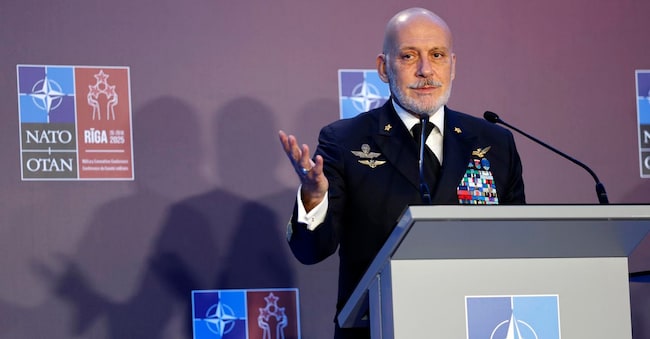
Nato is considering being 'more aggressive' in its response to cyber attacks, sabotage and violations of Russian airspace. This was said by Admiral Giuseppe Cavo Dragone, chairman of the Atlantic Alliance's military committee in an interview with Ft. 'We are studying everything,' he said, 'on the cyber front, we are in a sense reactive. Being more aggressive or proactive instead of reactive is something we are thinking about." Dragone said that a 'pre-emptive attack' could be considered 'defensive action', but warned: 'It is further from our normal way of thinking.
Lega v Cavo Dragone: Responsibility is needed, not provocation
"While the US, Ukraine and Russia seek mediation, throwing petrol on the fire with warlike tones or evoking 'pre-emptive strikes' is fuelling escalation. It does not bring the end of the conflict any closer: it pushes it further away. Responsibility is needed, not provocations'. So wrote the League on social media, commenting on the interview to the 'Financial Times' by Admiral Giuseppe Cavo Dragone, head of Nato's Military Committee.
The Words of Cavo Dragone
'Being more aggressive than our counterpart,' added Cavo Dragone, 'could be an option. [The issues are] the legal framework, the jurisdictional framework, who will do it?" Cavo Dragone admitted that NATO and its members had 'many more limitations than our counterpart for ethical, legal, jurisdictional reasons. It is a problem. I do not want to say it is a losing position, but it is a more difficult position than that of our counterpart'. Some diplomats, particularly those from Eastern European countries, urged NATO to stop merely reacting and to counterattack. Such a response would be easier in the case of cyber attacks, where many countries have offensive capabilities, but would be less easy in the case of sabotage or drone intrusions.
Cavo Dragone stated that a 'pre-emptive strike' could be considered a 'defensive action', but added: 'It is further from our normal way of thinking and behaving'. According to Cavo Dragone, NATO has succeeded in deterring Russian aggression with its Baltic Sentry mission. "Since the beginning of Baltic Sentry, nothing has happened. So,' he noted, 'it means that this deterrence is working.'While the US, Ukraine, and Russia seek mediation, throwing petrol on the fire with belligerent tones or evoking 'pre-emptive strikes' is fuelling escalation. It does not bring the end of the conflict any closer: it pushes it further away. Responsibility is needed, not provocations'. So wrote the League on social media, commenting on the interview to the 'Financial Times' by Admiral Giuseppe Cavo Dragone, head of Nato's Military Committee.

