
Calabria, clash over hospitals
Health policies. From Praia a Mare to Polistena, mayors in the front line against downsizing. Reprogramming of health building resources goes ahead: 557 million euro in interventions planned

3' min read
3' min read
Hospitals closed, depowered, suspended. Reopened on a narrow gauge. Some facilities without wards and without staff. And 'tokenists' and Cuban doctors to breathe new life into a hospital network that is asphyxiated in many cases.
Taking back the reins of the Calabrian health system has not been easy: with the disastrous legacy of 12 years of commissariatship and a structural debt approaching one billion, governor Roberto Occhiuto, in his capacity as health commissioner ad acta, knew he was embarking on an impossible mission. On the one hand, the reorganisation of the hospital network, recently approved by the Ministries of the Economy and Health ("An excellent result for Calabria", according to Occhiuto), displaces or cancels structures, wards and beds, fuelling concern and controversy; on the other hand, the reprogramming of resources for healthcare construction proceeds at a rapid pace. And it draws a new map of the facilities, with interventions committing a total of about 557 million.
But there is friction between the region and the territories: from Praia a Mare to Polistena, the mayors are in the front line to guarantee citizens' right to health, defending the hospitals. Thus, if in Praia a Mare, upper Tyrrhenian coast of Cosenza - an area that registers a million presences in summer - mayor Antonino De Lorenzo is worried because 'the hospital, without surgery, without health management, is not taking shape', exactly on the other side, on the upper Ionian Sea, the Sibaritide hospital is being built, within the municipality of Corigliano Rossano. Existing facilities will be converted into community hospitals. But in the meantime, De Lorenzo continues with legal appeals to demand the expansion of the Praia a Mare hospital, which has been dismantled and reopened over the years, with so many rulings by the Council of State. And now it is also demanding that, in concrete terms, in compliance with the so-called 'Sciabica decree' (named after Eugenio Sciabica, the commissioner who enforced the Council of State's ruling that redesigned the hospital), Praia's hospital should become an emergency room hospital, with 62 beds, an autonomous medical directorate, and eight new managerial positions, three of which for complex operational structures. A radical reorganisation: suffice it to say that currently, radiology, with its technologically advanced equipment, is managed by a single radiologist.
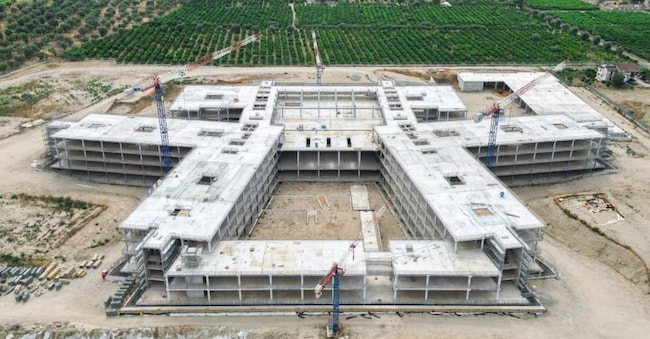
The new Sibaritide hospital, on the other hand, will be 'a spoke, a poly-specialist facility for acute cases with a medium level of care, for a catchment area of 180 thousand people and with 340 beds,' explains Pasquale Gidaro, an engineer, manager of the autonomous organisational unit of the Health and Welfare department that deals with healthcare construction. "The total cost, financed through a public-private partnership, will be 293 million euro.
Partnership is the same formula adopted for the new hospital in Vibo Valentia (a 20-year-long project), on which work has just begun. Or that of the Piana di Gioia Tauro, in Palmi, with 345 beds. The final project is currently being verified. But it is alarming the mayor of Polistena, Michele Tripodi, who has made the defence of the hospital the focus of his political action.

