Towards the CoM

Mountains, Calderoli: 'Regions can support excluded municipalities'

On the agreement on how to implement the new unanimity criteria for territorial authorities

by Michela Finizio

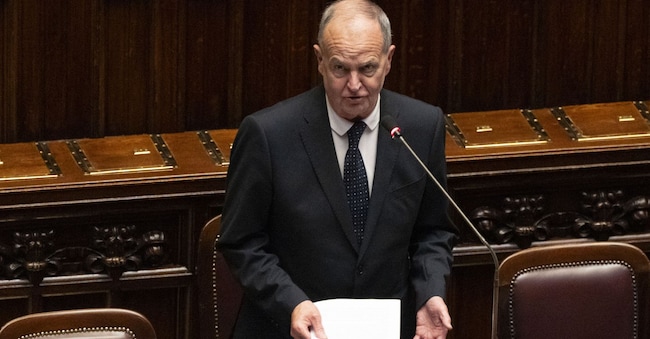
Roberto Calderoli, ministro per gli Affari Regionali e le Autonomie della Repubblica. (Imagoeconomica)

3' min read

Translated by AI
Versione italiana

3' min read

Translated by AI
Versione italiana

"We managed to find a reasonable solution that respects the principles of the law and the Constitution and the specificities of the territories. Behind this proposal there has been a great work of synthesis and balance'. This was stated by the Minister for Regional Affairs and Autonomies, Roberto Calderoli, emphasising that the agreement on the modalities for implementing the new criteria was unanimous among the territorial authorities.

When will the decree be officially approved?

Loading...

We are working to bring this decree to the first useful Council of Ministers. The previous classification referred to a law of 1952 and among the parameters taken into consideration were even the bombings suffered during the world conflict. I emphasise this to give an idea of how outdated it was and how far removed from current reality. Action could, and should, have been taken to update this list, which included, for example, obvious distortions such as Rome and Bologna, with average heights of 67 metres for Rome and 82 metres for Bologna respectively.

The new criteria are geomorphological. Why were socio-economic fragilities not also taken into account?

The socio-economic issues will be taken into consideration by a second decree that we are already preparing and which will further detail who, among the municipalities recognised as mountainous, is entitled to receive the contributions provided for by law. In the list there are lands that experience real difficulties and lands that do not. Let me give a concrete and highly topical example: living in Cortina is certainly not comparable to living in a small municipality in the Val di Scalve. There are very different service guarantees and much more obvious depopulation problems. We are working to reduce the gaps and guarantee the right to essential services.

The new list is causing controversy from North to South among the excluded. What do you reply?

I am aware of the controversy and I understand the bitterness of those excluded, just as I understand the bitterness of those high mountain municipalities that have also seen the inclusion of realities close to 300 metres. It was necessary to find a balancing act between even distant interests. The new parameters are the end of a path that we shared as much as possible with the territorial authorities. So much so that everyone accepted in the Unified Conference the possibility of going ahead, although making some distinctions. Moreover, there is no 'cut-and-dried', since part of the resources will still go to the regions and they will be able to use them in full autonomy.

So the Dpcm will also provide for some exemptions to mitigate the impact on the excluded in the hands of the regions, is that so?

Exactly. Thanks to an amendment presented by the League under the first signature of Molinari and accepted with a favourable opinion by the government, the regions will be able to allocate the regional share of Fosmit also to municipalities excluded from the national list. This opportunity was also reiterated in the agreement approved in the Unified Conference.

What consequences will the new classification now have?

The objective is to ensure that the resources earmarked for the mountains are used in the mountains and, trivial as it may seem, this has not always been the case in the past. We must ensure that citizens who want to live in the mountains have a different quality of life, one that respects work ambitions and family needs.

What are the next steps to implement the Mountain Law?

Now, as I have already said, it is up to us to work to identify those parameters that will identify the mountain realities that really need support, to reduce the gaps with other areas of the country. Once this is done, it will be the turn of the subsequent decrees, to make the law fully operational.

In relation to resources, don't you think that a little more effort should be made to support inland areas?

Until 2021 there was practically no euro in Fosmit, whereas with the centre-right in government there are as many as 200 million every year. You can always do better, true, but it is equally true that there are many more resources than in the past. And this is an objective fact, beyond political polemics.

Copyright reserved ©
Loading...

Brand connect

Loading...

Newsletter

Notizie e approfondimenti sugli avvenimenti politici, economici e finanziari.

Iscriviti