
California sues Trump: 'Illegal to send military forces'
For the prosecutor, deploying the National Guard violates state sovereignty. Governor Newsom in crosshairs: immigration czar suggests arresting him, president says 'I would do it'

3' min read
3' min read
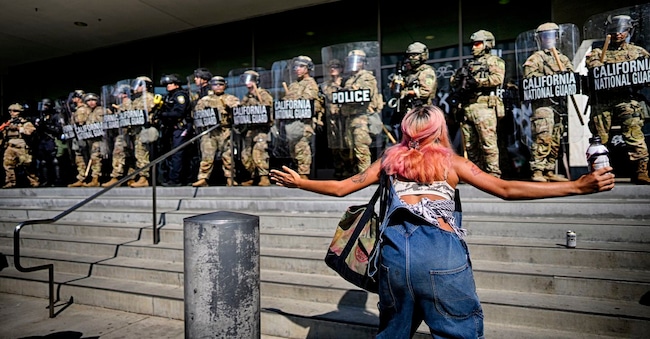
California is appealing to the courts against Donald Trump and his decision to send thousands of National Guard soldiers to guard Los Angeles, an action that Democratic Governor Gavin Newsom condemned as 'illegal and immoral', an illegality also supported by the California Attorney General, who spoke of a violation of state sovereignty.
But Trump does not give up, pointing to the ongoing escalation of the political, legal and institutional confrontation in the US: 'It was a good decision to send the National Guard to deal with the riots in California, had we not done so Los Angeles would have been forgotten'. Not only that, he ventilated the possibility of Newsom's arrest.
Demonstrations and riots have been going on for four days in America's second largest metropolis, a crescendo of protests initially triggered by dramatic anti-immigrant raids by the White House, with heavily armed federal agents and armoured vehicles in working-class neighbourhoods and department store car parks. Demonstrations yesterday spread to over a dozen American cities, from New York to Chicago. In Los Angeles alone at least 150 arrests have taken place since Friday, over 60 took place in San Francisco. In the state capital of Sacramento the union demonstrated against the arrest of one of the main local leaders.
The climate remained tense in the streets, marked by hours of peaceful demonstrations but also scuffles, clashes, blocked highways, vehicles such as robotaxis on fire, tear gas and rubber bullets from the police. Several journalists were injured, with an Australian reporter shot by officers with non-lethal ammunition.
Just as much shock in the centres of politics, amidst exchanges of accusations between the Republican administration and the Democratic opposition. "Requisitioning the National Guard without consulting the state governor is unlawful," Newsom declared. Trump appears committed, as often in his second term, to pushing for expansions of White House powers, dismissing criticism of authoritarian drift: specifically, state National Guard troops answer to both their governors and the president, but traditionally their mobilisation is by agreement. Dispatch by the White House for domestic purposes is permitted in the face of rebellion, insurrection, serious disturbances and the inability to enforce federal laws. The last time a president took command of these state troops without the governor's consent was in 1965, when Lyndon Johnson intervened to protect civil rights demonstrators in Alabama governed by the segregationist George Wallace.


