Use

California, Trump calls out the National Guard: all the times the body has intervened

Four thousand National Guard soldiers are deployed in the City of Angels because of protests against Trump-ordered immigrant arrests. California Governor Gavin Newsom announces a legal battle against the Trump administration. The last time the military was called out without the consent of a state's governor was in 1965 to protect Martin Luther King's march.

 REUTERS/Joel Angel Juarez     TPX IMAGES OF THE DAY

4' min read

4' min read

It was an excellent decision,' US President Donald Trump said on Tuesday about the deployment of National Guard troops in Los Angeles to quell the protests. He added: 'If the administration had not done that, the city would have been completely destroyed'.

Meanwhile, protests against the arrests made by Immigration and Customs Enforcement (ICE) agents spread to many other US cities, from New York to Austin via Chicago.

Loading...

What happened in Los Angeles

.

In the City of Angels on Friday, 6 June, protests broke out against the arrests of 118 people suspected of not having their residence documents in order. Ice agents intervened to take them away.

From the outset Trump threatened to field National Guard forces and on Saturday 7 June he did so. He ordered two thousand Army Corps reservists to the streets of California's main city and on Sunday morning some 300 troops took up positions in the city.

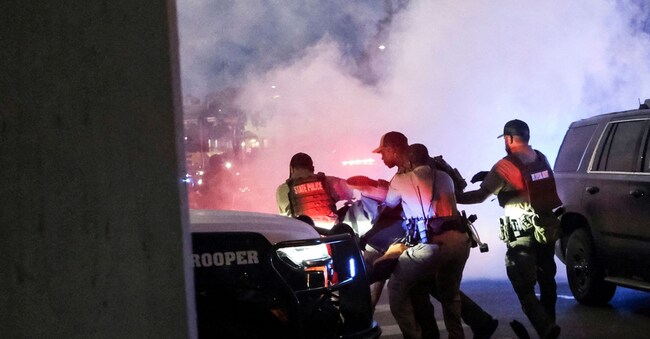
Until then, the protests had been mostly peaceful, but the arrival of the police forces caused tensions with the demonstrators. Firecrackers were thrown at the police, cars set on fire, to which the officers responded with tear gas, stun grenades and rubber bullets, which also hit and injured journalists.

On Monday 9 June, Trump ordered the deployment of four thousand National Guard troops and 700 marines. Prior to their arrival on Monday evening, there were about 1,700 soldiers in the city.

The controversy between Newsom and Trump

The mobilisation of the National Guard caused a clash between the Democratic governor of California, Gavin Newsom, and the Trump administration.

Newsom announced that the State of California will file a lawsuit against the US federal government over both the deployment of the National Guard and the deployment of marines. He called the Trump administration's action 'immoral' and 'unconstitutional'.

On social X, the governor wrote: 'We had no problems until Trump intervened'. He then shared a letter addressed to the Secretary of Defence, Pete Hegseth, asking him to withdraw the order by which the California National Guard was federated.

On Monday, Trump said the protesters 'are insurrectionists', creating the pretext to invoke the 1807 Act of Insurrection and use the active-duty military to manage the protests.

What is the National Guard?

.

The National Guard is a reservist corps of the US Army and has more than 430,000 soldiers, divided between ground troops (more than 320,000) and Air National Guard airmen (almost 105,000).

The military corps began in 1636 as a citizen-soldier militia in Massachusetts, when the state was still an English colony. In 1903 it became an organised defence corps and participated in both world wars.

Many of its members serve part-time while doing other civic work or attending university.

Those in the military must undergo basic training, then regular participation in exercises is required.

When does the National Guard intervene?

National Guard troops intervene, called by the state governor or the president, in the event of a national emergency or to participate in overseas missions.

For example, the military corps acted during the fires that devastated California last January. In 2005, when Hurricane Katrina hit several states in the country, 50,000 National Guard members were deployed.

In 1992, from 29 April to 5 May, Los Angeles was put to the sword by a civil riot. Sixty-three people died, more than 1,500 were injured and damage to private property was estimated at $500 million. What triggered the violence was the acquittal of four police officers, who had savagely beaten an African-American motorist, Rodney King.

The president at the time, George W. Bush Senior, called in the National Guard at the request of the governor of California, Republican Pete Wilson, and the city's Democratic mayor, Tom Bradley.

The difference between this episode and the National Guard's intervention in recent days lies in the fact that Trump ordered the mobilisation without Governor Newsom calling for his intervention.

The interventions of the 'federated' National Guard

.

Rarely have US presidents decided to federate this military corps to intervene against protests on American soil.

In 1794, President George Washington decided to deploy the National Guard to quell the whiskey insurrection that had broken out in western Pennsylvania against the federal liquor tax.

In the nineteenth century, presidents chose to handle civil protests by relying on the police forces of individual states, instead of calling in the military.

In 1957, President Dwight D. Eisenhower federated the Arkansas Army Corps against racial segregation in public schools after the Supreme Court ruled that separation of blacks and whites in classrooms was illegal.

According to New York University's Brennan Center for Justice, the last time a president invoked the Insurrection Act (the same one called into question by Trump) was 1965.

President Lyndon B. Johnson ordered the intervention of the Alabama National Guard to protect civil rights activists, led by the Reverend Martin Luther King, during their march from the city of Selma to Montgomery. Johnson used the military corps against the wishes of the state governor, George Wallace, a supporter of segregationism.

The activists travelled 50 miles, just over 50 kilometres, escorted by 1800 National Guard members and 2000 soldiers. Arriving in Montgomery, the Reverend gave a speech, which has gone down in history as 'How long? Not long', which marked a pivotal moment in the battle for civil rights.

Copyright reserved ©
Loading...

Brand connect

Loading...

Newsletter

Notizie e approfondimenti sugli avvenimenti politici, economici e finanziari.

Iscriviti