
Campania farmers against wind turbines and solar panels
Cia: they reduce arable land and disturb cattle farms
2' min read
2' min read
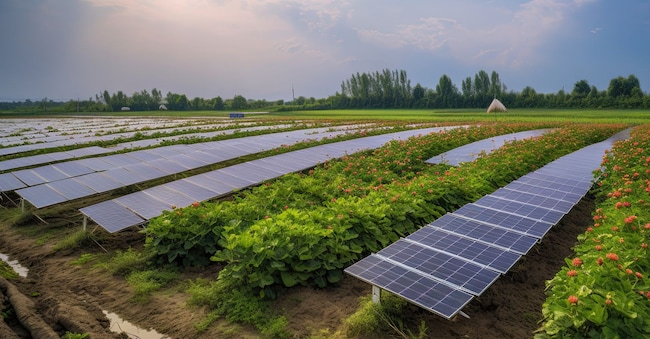
Agricultural land must remain agricultural land. This is the message launched by Cia Campania, concerned about the out-of-control growth of photovoltaic and wind farms in the region, which are taking precious space away from agriculture and creating increasing difficulties for farmers as well. Even the United States has done an about face, says the association: 'In the USA,' explains the regional commissioner of the Cia, Carmine Fusco, 'they have finally understood that land used to produce food cannot be sacrificed to produce energy. The US Department of Agriculture has thus decided to no longer finance ground-mounted solar installations on productive agricultural fields'.
The CIA rattles off the figures: in the state of Tennessee alone, 1.2 million acres of farmland have been lost in the last 30 years, and another 2 million acres will be lost in the coming years. Nationally, on the other hand, the agricultural area occupied by solar panels in the US has grown by 50 per cent since 2012. 'If we do not intervene now,' says Fusco, 'we risk finding ourselves in the same situation. In Italy in recent decades we have already lost about 2 million hectares of agricultural land due to urbanisation and improper conversion'. In Campania in particular, according to Ispra, hundreds of hectares of fertile fields disappear every year, especially in the areas of the Campania plain and the upper Casertano area, where industrial and energy projects are concentrated.
Loading...
'Campania,' stresses Fusco, 'is one of the most fertile regions in Europe. Here we produce wheat, fruit, vegetables, wine, oil, milk. Every hectare subtracted from agriculture is not only an economic loss, but a loss of food sovereignty and future. If today a young person wants to start an agricultural enterprise, the first difficulty he or she faces is finding land. And if the land is occupied by ground solar panels, access will be even more difficult and expensive'.
It is not only arable land that is at risk, livestock farms are also affected by the expansion of renewables: 'Wind turbines,' Fusco further explains, 'create noise and vibrations that, according to several studies, can disturb farm animals, especially dairy animals. Stressed cattle produce less and worse milk'. Cia Campania, however, does not say it is against renewable energies, 'but intelligent planning is needed,' says the regional manager. 'Photovoltaic and wind power plants should be placed where there is no conflict with agriculture: on the roofs of sheds and stables, on public and private buildings, in disused industrial areas, in abandoned quarries and on marginal land that cannot be cultivated. The choice is political and strategic, the real mistake would be to be guided by speculation: large energy companies paying to occupy the fields, promising immediate returns to the owners, but taking away the ability to produce food from the community'.
Copyright reserved ©


Brand connect
Loading...
