
Campiello Prize finalists land at the Unione Industriali Torino
The national contemporary Italian fiction competition makes a stop in the Piedmontese capital as part of the events for Turin Capital of Business Culture 2024
by Martina Soligo
 Aggiungi Il Sole 24 Ore
ai preferiti su Google
4' min read
4' min read
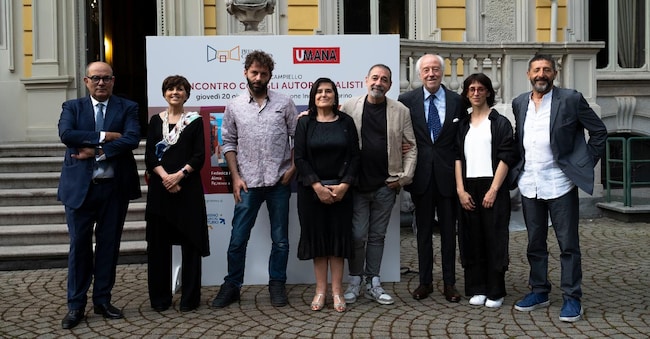
(Il Sole 24 Ore Radiocor) - Culture and fiction arrive in Turin thanks to the 62nd edition of the Campiello Prize, the prestigious national competition of contemporary Italian fiction promoted by the Fondazione il Campiello of Confindustria Veneto. The event, that took place at the Congress Centre of the Unione Industriali Torino in the context of Torino Capitale della cultura d'impresa 2024 , was organised by Umana, one of the main employment agencies in Italy, in collaboration with the Unione Industriali and represented one of the stages of the presentation tour of the five finalists that will touch the main Italian cities until the proclamation of the winner, on 21 September, in Venice. "The combination of culture and business is in our DNA," commented the president of Unione Industriali Torino Giorgio Marsiaj, who said he was pleased to "host an event that concerns one of the most important literary prizes in the country". "Works of a narrative nature," continued the president, "of which the Campiello finalists represent excellence, allow us to look at reality from other perspectives, offering original points of view that help us better understand ourselves both as citizens and in our role as social actors. A precious contribution, for those who live the corporate world as protagonists, to make their own vision, as well as the idea of business itself, deeper and more aware,' Marsiaj concluded.
Satisfaction was also expressed by Maria Raffaella Caprioglio, president of Umana, who emphasised how the agency "wanted to share the Fondazione il Campiello's path with this extraordinary city because it believes in the powerful engine of culture, capable of building bridges, generating relationships and lasting friendships, transferring knowledge and excellence". The Campiello Prize, according to Enrico Carraro, president of the Campiello Foundation and Confindustria Veneto, "represents a unique initiative of synergy between business and culture, a living testimony of the commitment of the industrialists of Veneto who, since 1962, have contributed in a decisive way to the dissemination of literature in our country. The spirit of the Campiello has always been to bring books among people, and through the summer tour we take literature all over the boot, aware that with culture one feeds the territories and contributes to their development'.
The five finalist works
.The five finalist authors of this 62nd edition are: Antonio Franchini with "Il fuoco che ti porti dentro" (Marsilio); Federica Manzon with "Alma" (Feltrinelli); Michele Mari with "Locus desperatus" (Einaudi); Vanni Santoni with "Dilaga ovunque" (Laterza); Emanuele Trevi with "La casa del mago" (Ponte alle Grazie).
That of Antonio Franchini's novel is a 'very simple' plot, according to the author. It is 'about the life and death of a woman called Angela, who had an impossible character and who happened to be my mother'. The desire to tell this story arose because 'in Angela there are a whole series of characteristics that make her typical: she was typical as a Neapolitan, as a woman from the South and as an Italian, and she had a whole series of characteristics, mostly negative but some also positive, truly typical of the city, the region and in a broader sense of the nation,' the author explains.
The novel by Federica Manzon, on the other hand, 'stems from a border, which is that of Trieste, and from an idea of identity' that is based on the author's conviction that everyone has a complex identity, formed of 'many different parts'. The novel, therefore, is the story of a woman 'who returns to Trieste after being away for a while to receive her father's inheritance, which will force her to come to terms with all the parts of her', which intertwine with all the souls of a border city.

