
Candriam, growth in sustainable investments will not suffer
Marie Niemczyk, head of Esg client portfolio management, starts from returns to explain how a step backwards is not possible in this segment


4' min read
4' min read
"The data show that, in the medium to long term, integrating sustainability considerations into investment decisions does not necessarily lead to a decline in financial performance. If we compare, for example, the performance of indices such as the Msci Sri with that of broader equivalent Msci indices in regions such as Europe and the US, the former tend to perform at least in line with, if not better than, the latter over the medium to long term." Marie Niemczyk, head of Esg client portfolio management at Candriam, data in hand, clarifies how sustainable investments are by no means outdated, despite the headwinds blowing in from the US with the Trump administration's decisions. "The Msci Sri Europe index," he points out, "has generated net annualised returns of 6.27% over the past 10 years, compared to 5.61% for the Msci Europe index. Even over the past 15 years, the Msci Sri Europe index has generated higher annualised net returns than the Msci Europe index, with a return of 8.62% versus 7.50% for its non-ESG counterpart. And even on an annualised basis, in the period from 2015 to 2024, only in three calendar years did the Msci Sri Europe and US indices underperform their respective broad Msci indices (2016, 2022 and 2024 for Europe and 2015, 2022 and 2024 for the US)'.
The relative resilience of the performance of sustainability-conscious investment strategies is reflected in sales and assets under management: 'Since 2015, for example, annual net sales of Esg products in Europe have tended to be positive. Even in 2022, it is interesting to note that while 'light green' funds recorded outflows in Europe, 'dark green' Esg funds recorded positive net inflows. More importantly, over the long term, the assets under management of Esg products and market share have steadily increased over the last ten years'.
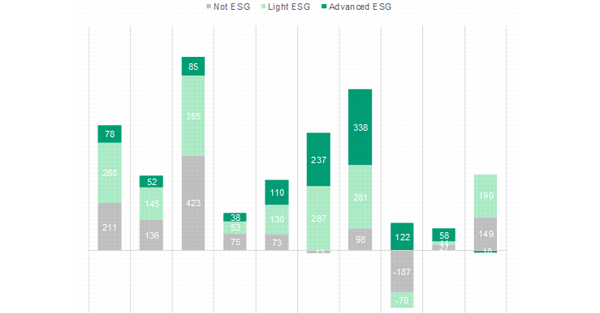
"Of course, as with almost all asset classes, investment styles or portfolios that do not exactly replicate the market, there can be short-term phases of the market cycle that tend to be less favourable to strategies that invest sustainably. For example, market rotations that favour certain segments of the energy sector may prove more challenging for some sustainable strategies that tend to underweight this sector and thus not participate fully in energy rallies. This was the case, for example, in 2022,' points out Niemczyk, who continues: 'However, each phase of market turbulence is different. During the Covid-19 pandemic, for example, sustainable funds generally performed relatively well, with the crisis favouring certain sustainability factors, particularly in the social sphere. However, such short-term market phases do not compromise the medium- to long-term goals of sustainable investments'.
Political decisions in the US
.It is undeniable that what is happening at a political level in the United States has an impact on the rethinking of the concept of sustainability and corporate strategies. But it is also true that the rooting of investments in sustainability in Europe is quite different from that recorded overseas, as the data show: on the market for sustainable funds, Europe weighs in at 84% with USD 2,679 billion and 5,502 sources (73% of the total), while investments in sustainability in the USA weigh in at 11% with 344 billion divided among 612 funds (8% of the total globally).
"In the United States, some political decisions may curb certain environmental ambitions, but this does not necessarily mean that there is a desire to stop investing in the sector altogether. Investors continue to protect their portfolios from risk, and economic motivations remain central. A significant example is diversity, equity and inclusion programmes: a reduction in the regulation of information on these initiatives does not automatically mean that investors will stop considering them in their decision-making processes,' explains the Candriam manager, who adds: 'In an increasingly competitive labour market environment, companies may realise that a retreat on these aspects could reduce their ability to attract talent. For investors, on the other hand, the weakening of certain regulations means a greater difficulty in finding data, but the challenge of the availability of ESG information is certainly not new".


