
Canziani: part of a larger story that crosses national borders
For the independent curator, the search for support, public or private, is an integral part of the curatorial process

4' min read
4' min read
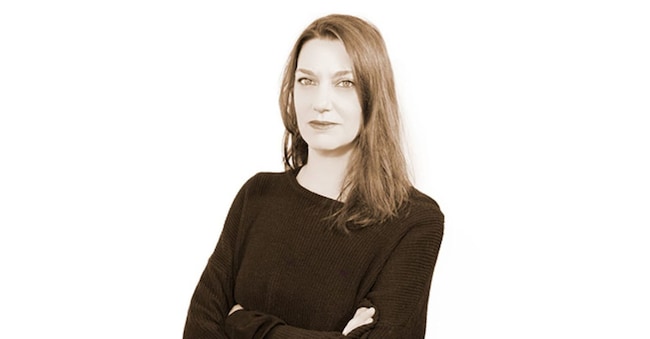
Cecilia Canziani, born in Rome in 1976, art historian, curator, lecturer in Phenomenology of Contemporary Art at the Academy of Fine Arts in L'Aquila, is co-founder of the conteporary art research centre IUNO. Among the most important independent exhibition projects she has curated in 2023 are "Roma, a portrait" at Palazzo delle Esposizioni, "Una felice corsa" at the Fondazione del Monte di Bologna e Ravenna in Bologna; in 2022 "Sara Basta. La prima madre" at the Fondazione Pastificio Cerere in Rome and in 2021 "Io dico io" at the Galleria Nazionale di Arte Moderna in Rome.
Tell us about yourself, your path and your curatorial vision? Above all, which exhibitions, in terms of impact and importance, can be qualifying of your path?
I am a hybrid figure: I trained as an art historian and in parallel as a curator studying in Rome, Siena and Naples and London, always combining research with doing. Curating exhibitions has been my way of giving tangible form to thoughts, and teaching at the Academy - today - is a way of thinking aloud together with other people about things that sometimes become exhibitions or texts. I have worked as an independent curator, as the director of a foundation, as the coordinator of a Masters in Arts Management; I have founded two independent spaces and a publishing house, always together with other people: I believe in exchange and in the strength of relationships. I like long-term relationships with colleagues, with artists and also with institutions: dialogues that last over time and make us grow together. Recent identity projects include: IUNO, which I founded with Ilaria Gianni; "Io dico io", an exhibition commissioned by Cristiana Colluat the National Gallery which I curated with Lara Conte and Paola Ugolini and Rome, at "Portrait", the first edition of the festival of the Academies and Institutes of Foreign Culture that allowed me to tell the story of the lively dialogue from the 19th century to today between the city and the international art community at Palazzo delle Esposizioni. And the satisfaction of exhibiting a painting by Corot. Going back in time, I would mention the Nomas Foundation and ZegnArt, an international public art and diffuse collection project built through a working table that included us curators - in addition to myself, Simone Menegoi and Andrea Zegna - and the company.
Looking back, is there an Italian Pavilion that has particularly impressed or inspired you and what mistakes should not be repeated? And broadening your gaze to international ones?
I have always looked with attention and admiration at the work done by all the artists and curators who have worked at the Italian Pavilion. If I had to indicate a preference, I would say that Massimo Bartolini's pavilion curated by Luca Cerizza and "Il mondo magico" with Giorgio Andreotta Calò, Roberto Cuoghi and Adelita Husni-Bey, curated by Cecilia Alemani, are two different examples but capable of communicating in an immediate way, letting the works speak and using space in an excellent way without being intimidated by its proportions. Among the international pavilions, I really lovedWael Shawky for the Egyptian Pavilion, Archie Moore and Marco Fusinato for the Australian Pavilion; unforgettable Anne Imhof at the German Pavilion; back in timeRagnar Kjartansson for the Icelandic Pavilion; Markus Schinwald at the Austrian Pavilion and Steve Mc Queen at the British Pavilion.


