
Caravaggio's humanity at Palazzo Barberini
The exhibition at the National Galleries of Ancient Art can be visited until 6 July

3' min read
3' min read
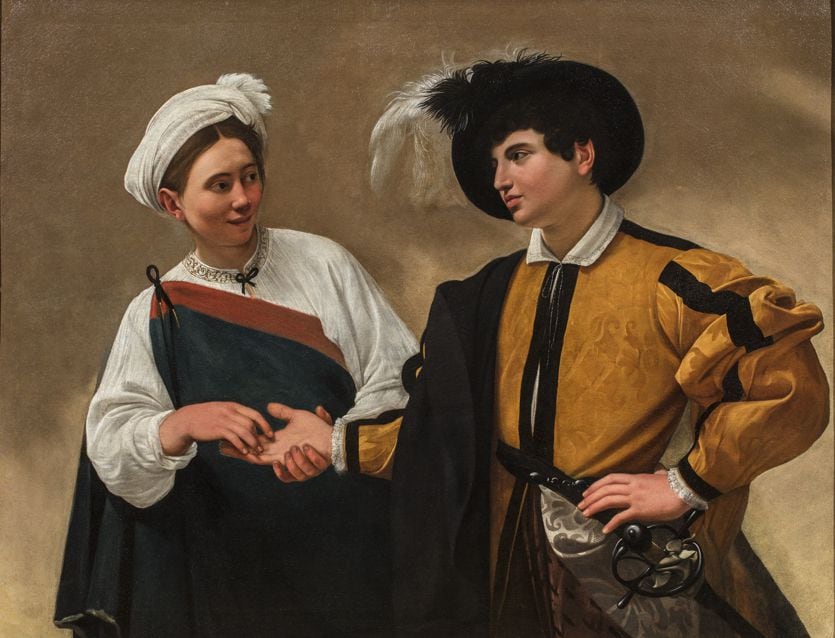
When Caravaggio (1571-1610) arrived in Rome around 1595, although he was already a trained painter (he had grown up in the workshop of Simone Peterzano, a pupil of Titian), he lived by his wits and made paintings for little money. In that city, salons were already essential for making new acquaintances, and so it was that he met the great painting expert Prospero Orsi - who hosted him in his home - Costantino Spada - a junk dealer and picture dealer who was the first to sell his paintings - and Cardinal Francesco Maria del Monte, one of the greatest connoisseurs of music and song in Europe, to whom also belonged, among others, the Buona Ventura and the Bari, masterpieces of comic painting from Caravaggio's early phase, marked by a use of light far removed from the powerful chiaroscuro of his maturity.
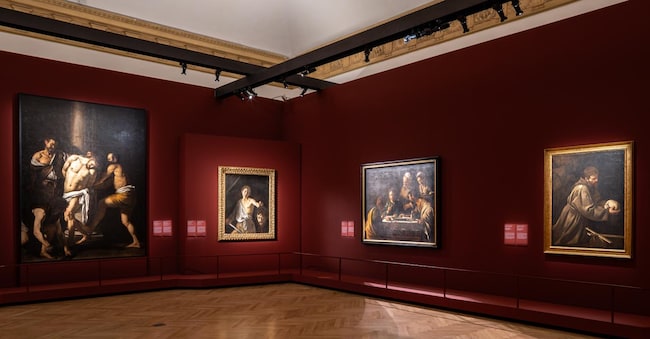
The Buona Ventura - in which a cunning gypsy woman is seen in the act of reading the hand of a naive young man before stealing his ring - and the Bari, are two of the twenty-four works featured in Caravaggio 2025, the great Roman exhibition hosted until 6 July next at the National Galleries of Ancient Art-Palazzo Barberini, a success that was "announced" given the exceptional nature of the event. In fact, 74 years have passed since the first historic exhibition dedicated to Caravaggio and the Caravaggesque painters in Milan curated by the scholar Roberto Longhi, the one to whom we owe the rediscovery of the Lombard painter.
The first part of the exhibition - curated by Francesca Cappelletti, Maria Cristina Terzaghi and Thomas Clement Salomon - is dedicated to Caravaggio's Roman Debut in a city where he also met Ottavio Costa, the owner of the splendid St. Francis in Ecstasy, the first example of a sacred work executed in Rome by the artist and present in the exhibition together with two other masterpieces: Mondafrutto and Bacchino Malato, exhibited together for the first time. In that room you will also find the first draft of the Conversion of Saul, one of the two panels (the other was the Crucifixion of St. Peter) commissioned for the Cerasi Chapel that sealed the artist's success in the city. Not to be missed, continuing in the second section, are the two versions of thePortrait of Maffeo Barberini, the future Pope Urban VIII, placed side by side for the first time because they both come from private collections. Portraits of prelates, therefore, but not only. Caravaggio also drew characters from the humbler social classes, such as the model who lent her image to Martha and Mary Magdalene, Juditta Beheading Holofernes and St. Catherine of Alexandria, whom many have identified as Filide Melandroni. It was with this last painting that the artist initiated the mode of 'Ingagliardire gli oscuri' (chosen not by chance as the title of this section) that characterised all his later production until reaching its peak with the canvases for the Contarelli chapel that you can still find today in the church of San Luigi dei Francesi in Rome.
To admire the most emblematic religious works, you will have to move on to the third section (The Sacred Drama between Rome and Naples), where you will find The Capture of Christ and Saint John the Baptist, from the collection of The Nelson-Atkins Museum, alongside the painting with the same subject in the National Galleries of Ancient Art. Not far away, there is also the St. Francis in Meditation (ten years before Shakespeare invented Hamlet, he was the first to paint the saint in a solitary dialogue with a skull) the David and Goliath from the Galleria Borghese, the Flagellation and Ecce Homo, exhibited for the first time in public because it was only recently found in Spain.
St. Ursula
.Last, but certainly not least, Finale di Partita, the concluding section with works that are the result of Caravaggio's love affairs, disagreements, reunions and other quarrels with prelates (above all, with Pope V Borghese) and others. Also from the Galleria Borghese comes the St. John the Baptist, not to be missed is the Martirium of St. Ursula as well as the Jupiter, Neptune and Pluto, the only mural painting he painted in 1597.

