
Carlin Petrini sets the standard, so Slow Fiber is shaping Pollenzo’s textile industry
“A home for Italian-made textiles, to support the transition towards a model that is ‘good, healthy, clean, fair and sustainable’,” says Dario Casalini, CEO of Oscalito
‘We are working on a project for a centre dedicated to Italian-made textiles, much like Pollenzo is for food – a centre of higher education where the professional skills needed to promote and support the sector’s transition towards a model “Good, healthy, clean, fair and sustainable”, involving and empowering end consumers and attracting younger generations to the textile industry. It would be one of Carlin Petrini’s cultural legacies.” This is recounted by Dario Casalini, CEO of Oscalito and promoter of Slow Fiber, the association of companies in the sector which, since 2021, has been driving forward the project to redefine the industrial model according to a sustainability paradigm tailored to supply chains, suppliers, the environment and social issues. “Within a few months,” adds Casalini, “we will reach fifty members in the Slow Fiber network, effectively the largest ‘distributed’ textile company in Italia.” On 10 June, a symbolic meeting took place with the artist Michelangelo Pistoletto, who, with his “Venus of the Rags”, offered a critical perspective on the economic, social and environmental impact of fast fashion on the fashion industry’s value chain. The Slow Fiber initiative also stems from the experience of Oscalito – Casalini’s family business – which, like the other companies involved in the project, has chosen to maintain an industrial model capable of promoting best practices.
Industrial excellence
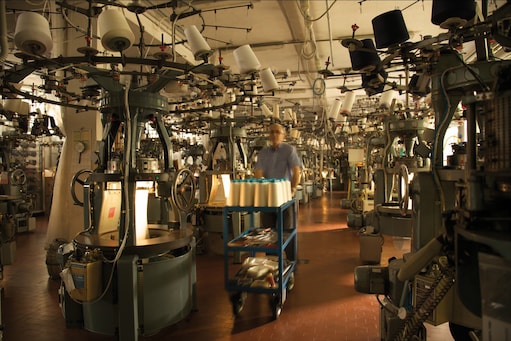
‘The yarn goes in and the finished product comes out.’ The entire production process takes place in-house, from weaving – using strictly natural fibres such as cotton, wool and silk – to cutting, assembly and quality control, as well as prototyping and pattern-making. The fabric pieces are wet-treated, dried and steamed to stabilise the materials. The core business of Oscalito, a company part of the Exclusive Brands Torino network, is the production of tubular-knitwear and underwear. This excellence has been ‘spotted’ by the major players in American, Italian and French haute couture, who around three years ago began relying on Oscalito for lightweight knitwear to be worn next to the skin, with an impact on revenues of between 10 and 15 per cent. “This,” argues Casalini, “is a significant growth opportunity, which offsets the deep crisis in the network of independent retail outlets, and which could come to generate half of the company’s revenue. However, it is a trend to be monitored because a small manufacturer like us is at risk should large orders fail to materialise.” On the other hand, however, this leap represents a success, “because we have convinced the fashion giants to focus on the first layer against the skin, historically the most neglected,” argues Casalini.
Oscalito produces around half a million garments a year, has a turnover of around €11 million and employs nearly 100 people. The technological limit the company has set itself is to produce its core range to the highest standards of excellence; ‘we’re not interested in diversifying and getting into total looks,’ adds the CEO. Ribbing is always cut by hand, whilst plain fabrics are cut automatically. The cutting of lace, another core process for Oscalito which applies it to knitwear, requires artisanal craftsmanship depending on the season and colour. “We have found an Italian company that also supplies us with Leavers lace, which is mostly produced in France.” 80% of Oscalito’s suppliers are located within a 200-kilometre radius, starting with the yarns.
The stages of production


