
Carlin Petrini: 'Food is politics. The Langhe model winning in the world
The founder of Slow Food, who died yesterday at his home in Bra, in this chat with Il Sole 24 Ore, 10 September 2023, recounted his origins and that trip to France from which he understood how to enhance the food and cultural heritage of his land and of Italia

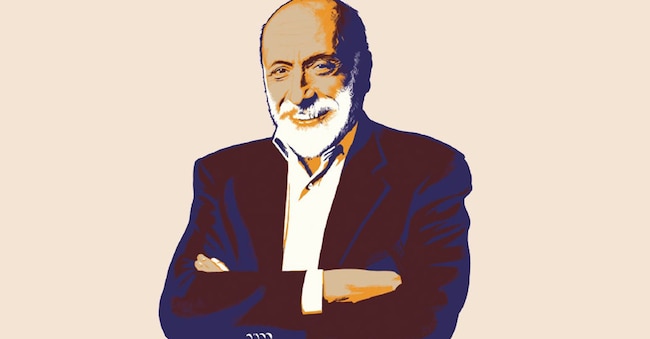
Carlo 'Carlin' Petrini, 76, died last night at his home in Bra, near Cuneo. This was announced by Slow Food, the movement he founded in 1986 to promote the right to pleasure and good, clean and fair food for everyone. We repropose one of his last interviews with Il Sole 24 Ore
'My experience is political. Everything that I have built, from Slow Food to the Salone del Gusto, from Terra Madre to the University of Gastronomic Sciences in Pollenzo, has a political element at its core. I have always had a civil passion. When my friends and I started in the 1970s, many people looked at us with suspicion. We were considered communists. We were communists. Here in the Langhe we spoke to farmers and artisans, breeders and owners of vineyards and orchards. Had we spoken the language of the factory workers in Turin and Milan, in Casale Monferrato and Sesto San Giovanni, no one would have understood us. By building that original language, we composed a new idea of our community one piece at a time. An idea of community made of proximity between people and the subversion of classical hierarchies in favour of the material culture of wine and eating, which became valid first here in the Langhe, then in other parts of Italia, and then in other parts of the world'.
Carlo Petrini, known as 'Carlin', stands in the shade of the trees of Verduno castle, just a few kilometres from his native Bra, where he was born, and from Pollenzo, where the university he founded is based: "As a boy, down there under those pines and lime trees, I used to listen to and talk with Nuto Revelli, who used to spend the month of July on holiday here, and the friends who came to visit him: the magistrate Alessandro Galante Garrone, the writer Primo Levi, the philosopher Norberto Bobbio, the winemaker Bartolo Mascarello". In the castle of Verduno, owned by the Savoys, had lived two centuries ago the general Paolo Francesco Staglieno, the military man with a passion for oenology commissioned by King Charles Albert to transform Nebbiolo, following the French example, into a wine for ageing. Giovan Battista Burlotto, a liberal commendatore, bought it from the Savoys in 1909. Burlotto's heirs are kind, attentive, reserved. Lisetta and Gabriella set the table outside, under a laurel tree. Liliana is in the kitchen. Gabriella jokes, with the irony of someone who has come from a world that was hard for a long time and is still hard, despite the softness of ease, the international successes of great red wines and the growth of the female component among the younger generations: 'In 1973 I became the first Italian woman sommelier. On the diploma they wrote: to Mr Gabriella Burlotto'.
The dining room is this garden overlooking the rolling hills of the Langhe, towards the south-west. September is the mildest of months. The temperature is cool, the wind subtle and regenerating. Carlo Petrini - born in 1949, the son of Giuseppe (electrician by profession, fifth-grade studies) and Maria (teacher's diploma, director of the Bra nursery school) - attended the technical institute in Fossano: 'At the high school graduation exam, I arrived with all eight and nine in the humanistic subjects, but with three failures in technology, industrial design and mechanics. The president of the commission at the end told me 'Petrini, we will promote you, but promise us that you will never be a mechanical engineer''.
Gabriella Burlotto brings us a bottle of Verduno, which comes from the Pelaverga Piccolo vine, a bright ruby red with a hint of pepper, a small operation of oenological philology, the DOC obtained in 1995, some thirty hectares, eleven producers and 230 thousand bottles a year. On the table comes bread with anchovies and butter. Then, some simply amazing Verduno raw meat. "This castle is my place of the soul. I have done everything important here, in the course of my life and activities,' says Petrini. In the primordial soup of the late 1960s, he enrolled in sociology at the University of Trento but did not finish it, 'also because at the time it seemed that you had to do do, and that formal study could abdicate experience of the world'.


