
Carlini listens to the age-old heartbeat of the mountains
The writer has published the story of his arduous journey of rebirth, drawing on the great authors of Resistance literature

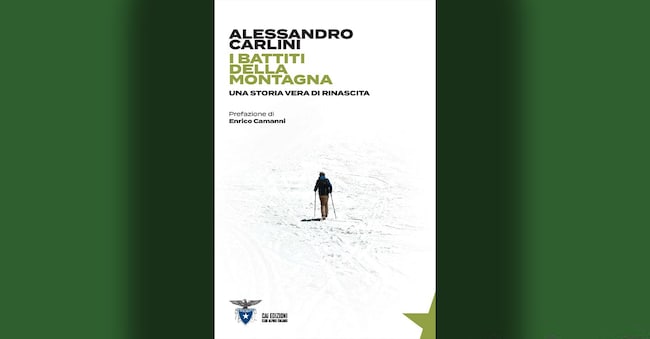
Alessandro Carlini concluded the summer programme of the Iglesias Book Fair with the hope that this town, situated in south-western Sardinia, might become Italy’s new Capital of Books, in 2027, by winning the coveted contest against its Sardinian counterpart Nuoro and the other six finalist provinces that submitted their applications to the Ministry of Culture. The writer and journalist spoke from the windswept stage at Portoscuso, one of the ten municipalities in the Sulcis Iglesiente area that have supported the project conceived by Maurizio Cristella and aimed at promoting reading. An inclusive, community-based project that positions the island as a cultural crossroads and a linguistic hub, but also as a visionary force in the Mediterranean, transcending any geographical boundary or mental barrier, especially if it is exclusionary.
Literature for Life
The focus of the presentation was his new book, *I battiti della montagna* (CAI Edizioni, 2026, 192 pp., €18), a blend of a harrowing memoir and an idealistic exploration. Carlini wrote it firmly in the first person, even when his breath grew short and the pace of his dictation slowed as he neared the precipice. After all, it was Carlo Ginzburg who likened historical research to a detective investigation, and Carlini investigates by putting himself to the test, like someone tackling a via ferrata or scaling a steep cliff face whilst clinging to his principles. “I promise you I’ll go and seek out the mountains I’ve dreamt of. I promise you I’ll come back.” This is the pledge engraved on the back cover that animates the narrative and drives every step of his ascent, beginning with the night before the operation in which he underwent a double heart and kidney transplant.
For those who aren’t afraid of the climb
His journey is underpinned by a concept of reclaiming ground which he himself defines as the ‘existential centimetre’; during his nights in hospital, in fact, he would daydream about mountain peaks, projecting them in his mind onto the wall opposite his bed as if they were slides. And centimetre by centimetre, what drove him was this courage – or illusion – of scaling the hospital wall and finding himself one day on the peaks he had only ever dreamt of, whilst reading Fenoglio, Rigoni Stern, Chiara and Meneghello. There are also female writers who played a crucial role in our literary emancipation from gender prejudices – a subject about which far too little is said – such as Antonia Pozzi and Giovanna Zangrandi. And Carlini often emphasises this because it is highly likely that he received his organs from a woman. Having come from the plains, Zangrandi had settled in Cadore after leaving behind Cortina – already a renowned tourist destination at the time – where she fought for the Liberation, falling in love with the commander of her partisan unit, who died on 26 April 1945.

