
Carlo Levi, a Lucanian among Lucanians
Domenico Notarangelo's photos in Rome document Levi's last trip to Basilicata a month after his death, the funeral and some moments of 'Christ' shot by Rosi: faces that speak against the backdrop of the Sassi
In December 1974, a month before his death, Carlo Levi was in Basilicata. He took part in the "Days of Soviet Culture in Italia" and made several stops in the land where he had been confined forty years before, to which he had remained deeply attached. He presented the lithographs accompanying a special edition ofChrist in Matera, then set off to greet friends scattered throughout the Lucanian municipalities. Nothing foreshadowed the imminence of the end.
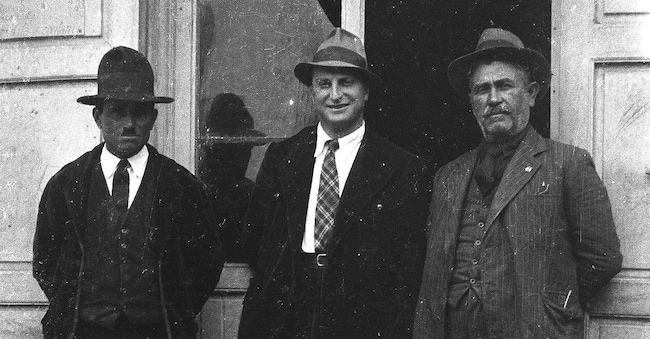
This is another reason why Domenico (Mimì) Notarangelo's photographs are so striking, bearing witness to Levi's double departure: from life (having returned to Rome, he fell ill without recovering) and from the place where he will be buried. The funeral itself becomes itinerant, celebrated in three stages that also mark three belongings: in Rome, in Eboli, in Aliano. In the exhibition Il popolo lucano di Carlo Levi (The Lucanian people of Carlo Levi), set up in Rome at the Foundation of the same name until 18 April, we see the painter, writer and politician portrayed as early as 1968 at a rally in the city of the Sassi, where he had run for the Senate as a left-wing independent. We then see him in Grassano, the town to which he had been destined for exile before Aliano, addressing the audience of the Filef (Italian Federation of Emigrant Workers and Families): absorbed and melancholic faces, exclusively male, that say it all about sacrifices, fatigue, deprivation. Then next to the Honourable Pasquale Franco and in an intense close-up in Aliano, where a little later a poster would convey the condolences of the Basilicata Region for his sudden death. The images of the crowded funeral show the mayor of the small village in the badlands, Maria Santomassimo (one of the first women in southern Italia to hold this position) holding the arm of the writer's elder sister, the same one who had visited him during his exile: at that moment, Luisa Levi was one of them, a Lucanian among Lucanians just as her brother had felt. Who here, not surprisingly, was thinking of buying a house, as a seal on a relationship that had become structured and wanted to take root more and more. A few years later, in 1978, Levi would be played by Gian Maria Volonté in Franco Rosi's Christ Stopped at Eboli, which brought to the screen the denunciation of misery and backwardness set in the masterpiece of 1945. Here too, in the open-air set of the Sassi and elsewhere, Notarangelo's (the director's consultant) lens stops expressions, intercepts moods, captures intimate ways of being in a black and white of extraordinary strength. Where the black of the women's gowns and headgear does not appear mournful and mournful, but fits with simplicity into the everyday life of the time, alongside the equally wrinkled faces of the men.
Mimì Notarangelo, originally from Sammichele di Bari, knew Carlo Levi from the early 1960s. A journalist for L'Unità, he was the provincial secretary of the PCI in Matera, his adopted city. The son of a peasant, the look of a traveller with a camera hanging around his neck, he had built up a relationship with Levi, with whom he shared a civic passion and the redemption of the South and the peasant world. It was no coincidence that the PCI asked him to organise the writer's funeral in Aliano, whose art exhibition he had already curated in Matera in 1967. A bond that grew and was consolidated over time, as demonstrated by Levi's gift of a motherhood, dedicated to him 'with friendship'. Through this small but significant exhibition, we tiptoe into that reality filtered through the eyes and nourished by the experience of figures so different yet so close.
This is done in the Foundation's tiny and spartan space (a stone's throw from Porta Pia), in full harmony with the essentiality of Levi's People, next to the Maestro's easel and chest of drawers (as well as the editorial production linked to the exhibitions organised over time and research work). An institution that goes on with the voluntary work of those who manage it with love and competence. Admittedly, it is surprising that in recent years no institution, neither public nor private, has seized the opportunity to provide a larger venue, suitable for permanently housing at least part of the eight hundred paintings by the Turinese artist. Today, apart from the nuclei exhibited in Matera, Aliano and Alassio, the rest is in storage: invisible. For a protagonist of 20th century culture, there should have been plenty of choice.
Carlo Levi's Lucanian People. Memory and photography


