
Carmen Gallo wins the 2026 Strega Poetry Prize
Following Mari’s victory in the fiction category, Einaudi has also won the liquor-themed trophy for the second year running

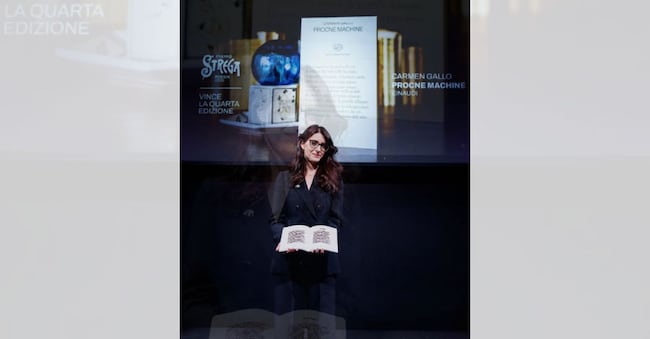
“How can one defend oneself against that / which threatens us or calls out to us from on high”, against a fateful destiny, against the semantic betrayals of time? The question that opens the collection *Procne Machine* (Einaudi) received, last night on stage at the Acquario Romano, 33 votes out of 83 cast – the votes that saw Carmen Gallo win the fourth edition of the Strega Poetry Prize. Next came Isabella Leardini (18 votes) with *Maniere Nere* (Mondadori), who won the Strega Giovani; Vincenzo Ostuni (17 votes) with *Faldone* (Il Saggiatore); Federico Italiano (10 votes) with *Godzilla e altre poesie* (Guanda) and Fabrizio Lombardo (5 votes) with *La linea spezzata* (Donzelli). Under the purple spotlights, the winner paid tribute to Anne Carson, fresh from winning the Nobel Prize, whose poetry is said to ‘renew, first and foremost, the conventions of tradition’. Gallo’s enthusiastic comment was no mere formality, having already written the afterword to *Il genere del suono* (2026), an essay in which Carson traces, from Aristotle to Freud, how a male-centred culture has reduced women’s voices to the status of mere noise. Here, Gallo draws inspiration from a line in *Pene d’amor perdute*, where the woman who approaches the court risks “the loss of her tongue”, “like the Philomela of myth” at the heart of *Procne Machine*.
The roots of language
It is the very wound from which her collection sprang. The myth is well known: Tereus rapes his sister-in-law Philomela and cuts out her tongue; she embroiders an account of what happened and then takes her revenge through her elder sister, Procne, who kills her son Iti, whereupon the gods transform them into a swallow and a nightingale respectively. Less well known is that, for Gallo, an English scholar at La Sapienza, the true metamorphosis is translation – what happens to a story as it passes from mouth to mouth. And in the central section, written in deliberately plain prose, he recounts it anew for every author who has retold it, from Ovid to Gascoigne, who heard the yoke and the ‘iugulator’ in the nightingale’s ‘Jug Jug’; from *Titus Andronicus* to Coetzee’s *Foe*. The ‘machine’ of the title, which echoes Heiner Müller’s ‘Hamletmaschine’, is thus a mechanism of re-translation that juxtaposes the versions without commentary until the violence—which tradition took for granted—emerges from the comparison as mere material to be disposed of. And terse observations such as ‘Philomela is never named’ function as a report rather than a lament. It is no coincidence that Gallo, who translated Eliot’s *The Waste Land* (2021), has claimed to have rendered the ‘stony rubbish’ as ‘rifiuti’ rather than the ‘macerie’ of a twentieth century that always translated an octave higher, consigning poetry to a figurative realm of beauty; whereas his book descends that octave with the same obstinacy, alongside the pigeons gutted by seagulls that end up ‘in the organic waste or the unsorted bin’, for song is a form of knowledge.
The Emancipated Myth
At the heart of the book is the short poem ‘The Metamorphoses’, in which two stuffed swallows speak: ‘Ever since they stuffed us / we no longer need / a place to go’. Whereas before they were caged, at the end of summer they would flutter against the bars “migrating without going anywhere”; then, as they fell silent, “they put us in a bag / and froze us”. Moreover, taxidermy proves to be the opposite of translation, emptying the body to preserve its form, whilst for Gallo, translating means accepting that something of the original will be lost in order to invent something else: a third language “which is not yours, which is not his”. In the afterword to Carson’s essay, one image stands out that sheds light on the short poem: Rabelais’s frozen words are cries from a winter battle that melt into the air come spring, just like the female sounds “frozen in the long winter of male censorship”. Similarly, the two swallows, frozen and then fitted with a device that makes them repeat “a recorded verse / Jug Jug”, finally find a way out amidst the flames, taking the house with them, until “everything was smoke and was burning / slowly and black”.

