
Cash still plays a significant role: 235 billion in 2025
In just twelve months, a sum comparable to the resources of the entire NRRP

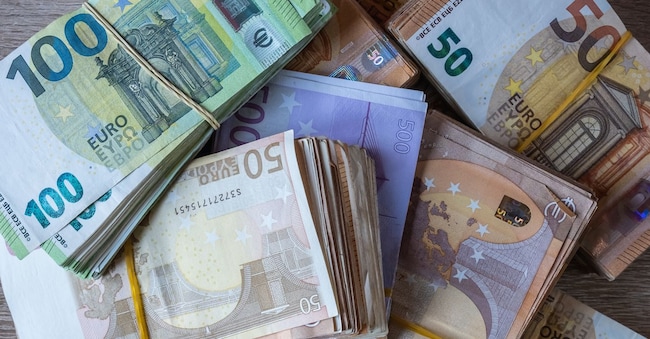
It took just one year to reach 223 billion euros in cash. This is the value of the deposits recorded in 2025 by the Financial Intelligence Unit (UIF) of the Bank of Italia alone: over 600 million a day, on average, mainly via cash machines and cash-in machines.
A sum comparable to the resources allocated to the entire NRRP. However, the Plan to Revitalise the Italian Economy spanned six years: these payments into Italians’ bank accounts were concentrated over just twelve months.
Deposits remain at similar levels year on year, as the graph shows.
How to trace the tax origin of money
We know where this large sum of money ends up. The tax-related question concerns what happened beforehand: how much comes from declared income and how much from undeclared earnings? Simply recording the payment is not enough to answer this. And this question looms large in a country where tax evasion remains extremely high.
According to the Osservatorio Itinerari Previdenziali, almost 25 million people do not declare their income and pay little or no direct tax. This does not make them tax evaders. The problem is not to cast suspicion on those who do not pay personal income tax, but to trace the tax status of the money. The black economy can start with an invoice that shows only part of the amount received. Or it can stem from a payment for which no invoice is issued at all. It is these mechanisms of under-invoicing and payments under the table that the Revenue Agency and the Guardia di Finanza are tracing, even in cases of minor tax evasion.
But small-scale tax evaders can gain access to organisations that are anything but small. Indeed, to launder that money, it is not necessarily required to be able to afford expensive professionals. The network may already be in place: the shadow banks identified by the Fiamme Gialle offer low-cost ‘laundering’ packages for sums of any size. These are run by extensive criminal networks, often of Chinese origin. The small-scale tax evader can thus purchase a sophisticated illicit financial service, once reserved for far more structured organisations. This is confirmed by the findings of investigations into tax fraud linked to money laundering: between 2025 and the early months of 2026, the Italian Financial Police carried out 15,868 judicial investigations into these matters, resulting in seizures totalling 4.7 billion euros.

