
Castro Grueso: 'Fencing is like chess: on the piste I laugh because I enjoy it'
Who is the refugee Paralympic fencer for whom the government has proposed Italian citizenship 'for special merits'?

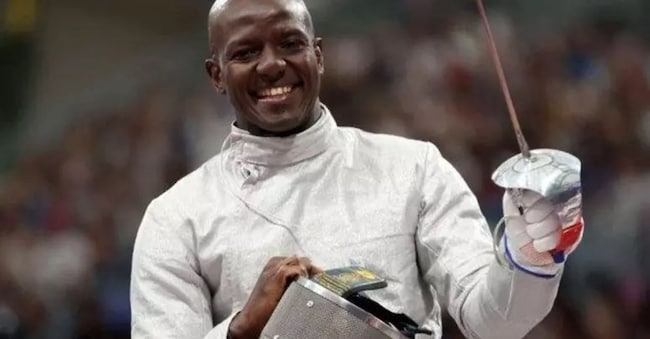
"Se po' ffà". It can be done, with an unmistakable Roman accent. It is the thing that Amelio Castro Grueso - Colombian Paralympic fencer, who participated in the Paris 2024 Games in the refugee team - repeats most often. "Sometimes I see that people are a bit pessimistic. I, on the other hand, want to win, to prove that se po' ffà,' he laughs. Because for him 'challenges are petrol' and make him creative. "If you believe that something is possible, you put yourself in a position to fight: that's the best way to face everything," he says. A few days ago, in Pisa, in the Italian leg of the Paralympic Fencing World Cup, he won a bronze in sabre - in category B, the one for non-ambulatory paraplegic athletes - and a silver in epee. "I also beat Britain's Dimitri Coutya, who won gold in Paris," he says proudly, "I would never have done it if I had not thought it possible."
The Italian citizenship proposal
For him, the government has decided to ask the President of the Republic to confer Italian citizenship "for special merits". "The Council of Ministers, at the proposal of Interior Minister Matteo Piantedosi, having regard to the request for the activation of the procedure for granting Italian citizenship made by the Minister for Sport and Youth Andrea Abodi and in view of the favourable opinion of the Minister for Foreign Affairs and International Cooperation Antonio Tajani, has decided to propose to the President of the Republic the conferment of Italian citizenship, for special merits, to Mr Amelio Castro Grueso," reads a communiqué from palazzo Chigi.
The childhood in Colombia, the accident, faith and fencing
Born in 1992, Amelio Castro Grueso is originally from Calì, in the Cauca valley in the Andes. At the age of 16 he mothered 'because there is a very difficult situation in Colombia', he says. 'There is so much violence, also because everyone suffers losses from an early age and they grow up wanting revenge: mothers, brothers, fathers. But if you don't forgive, you risk being killed too,' he warns.
At the age of 20, after a car accident, he loses the use of his legs and his family abandons him. He is angry, very angry. "But in hospital I experience the Grace of God and I react," he says. His is not 'a deluded faith: I believe because I see, God I see in the doing and in the people he puts beside me'. He decided to write a book to spur others to react as well. "When we suffer we always think we are the only ones, but everyone has their own struggle. And not closing in on oneself is the only way to deal with it,' he says. Sitting in a wheelchair, however, is not reason enough for anyone to read you. So he turns to sports. "I tried basketball, but I didn't like it," he admits. "Fencing, on the other hand, is like chess: fast, strategic. It's beautiful because of that,' he continues. He also doesn't mind being surrounded by people of culture, 'who speak many languages and are always dressed in white, with their uniforms in order, who show respect'.
During a competition in which the Italian national fencing team participates, he meets the Italian national fencing coach Daniele Pantoni, who will become a point of reference for him even outside the piste. In his home country Amelio tries to make a difference by working in social work, with street kids. Because in that 'somewhat peculiar' region the government 'doesn't come with a lot of proposals, so the criminal groups take advantage of this hole to drag children and youngsters to their side, to do their business', he explains. And he wants to show a possible alternative. Even though he has lost as much as they have. Maybe even a little more. But this commitment to young people leads him to receive threats, so he has to leave Colombia. It is September 2022.


