
Catholic University: enrolment up by 3.4 per cent
A growing and increasingly international university. Vice-Chancellor Beccalli: ‘Our appeal is rooted in the quality of our academic programmes and our commitment to fostering strong relationships with students. A university open to talented individuals, where knowledge is experienced beyond the classroom.’

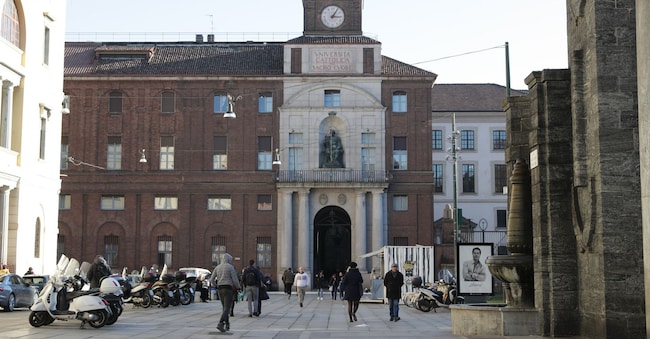
New enrolments at the Catholic University of the Sacred Heart are on the rise. The University is seeing an overall positive trend in new enrolments, with an increase of around 3.4 per cent compared with the same period in the previous academic year (12,236 as at 22 September 2026, compared with 11,834 in 2025).
A strong presence of international students
The increase applies to both first-cycle degree programmes (+3 per cent) and second-cycle degree programmes (+4.2 per cent). Furthermore, across the five campuses, female students and international students account for a significant proportion of new enrolments, totalling 7 per cent: a high number of young people from every continent have chosen three-year degree programmes (10 per cent). This positive trend is also evident in master’s degree programmes (5 per cent). Overall, compared with the previous year, the growth in international enrolments stands at +13.4 per cent, a figure that testifies to the University’s appeal on the global stage.
This, in summary, is the picture that emerges from the enrolment figures for the Università Cattolica del Sacro Cuore for the 2026/2027 academic year. It is an evolving picture which nevertheless points to substantial interest in the University’s academic programmes, as demonstrated by the significant results achieved by numerous degree programmes across the 12 faculties located on the five campuses: Milan, Brescia, Piacenza, Cremona and Rome.
The Vice-Chancellor: “Experiencing knowledge”
‘The positive trend we are seeing in enrolment figures is the result of an approach centred on nurturing relationships with students, the quality of our academic programmes, and an educational mission that bases its competitiveness on values rather than market forces. A university that aims to be a place where knowledge is experienced beyond the classroom. This is our defining feature, which has enabled us to develop an academic programme capable of addressing the major issues of our time – one that is recognised and distinctive, even on a global scale,” says Elena Beccalli, Rector of the Università Cattolica del Sacro Cuore. ‘This growth, in fact, is accompanied by a substantial number of international students, a sign of an open university. In this regard, the Catholic University of the Sacred Heart presents itself as an established player not only at a national level, but also at a European level, in its ability to attract and retain talent. Let us not forget that we are the largest Catholic university in Europe. Our mission is to be a university open to talent and capable of promoting the circulation of human capital,” continues Rector Beccalli.
Milan
At the Milan campus, there are 8,826 enrolled students, representing an increase of 2.1 per cent (compared with 8,647 in the same period last year). This result was driven primarily by first-cycle degree programmes, which saw an increase of 3.6 per cent (5,497 compared with 5,307). The most significant figure relates to the single-cycle Master’s degree in Law, which has seen substantial growth. Alongside this result is the positive trend in Psychology, which has exceeded last year’s final figure, indicating a now stable consolidation. Other faculties also performed well, including Economics, Education, Political and Social Sciences, and Banking, Finance and Insurance. On campus, the trend in enrolment of international students was very positive, accounting for 10 per cent of the total in three-year degree programmes and 5 per cent in master’s programmes.
Brescia
In Brescia, enrolment figures are driven by the most recently introduced degree programmes, which also stand out for their proportion of international students (6 per cent). In fact, amongst first-cycle degrees, the trends for the English-taught ‘Business and Finance’ programme – a joint programme between the Departments of Banking, Finance and Insurance and the Department of Economics and Law at the Piacenza campus – are very positive, showing a 25 per cent increase, precisely due to the high number of students from other countries. Enrolment in master’s degree programmes has risen by 16.2 per cent, thanks to innovative programmes such as ‘Artificial Intelligence for Banking and Finance’, which is led by the Faculty of Mathematical, Physical and Natural Sciences and has seen significant growth compared with last year.

Brand connect


Newsletter Scuola+
La newsletter premium dedicata al mondo della scuola con approfondimenti normativi, analisi e guide operative
Abbonati