Interview

Cattelan: ‘When the future seems frightening, the past becomes alluring’

In Berlin, the Italian artist’s solo exhibition “Night” features a mix of historic and site-specific works, engaging in a dialogue with the Neue Nationalgalerie and the present day

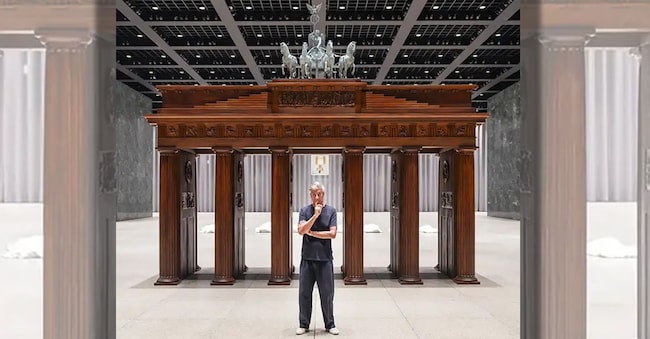
Maurizio Cattelan, Neue Nationalgalerie, 2026 © Neue Nationalgalerie – Stiftung Preußischer Kulturbesitz / David von Becker

10' min read

Translated by AI
Versione italiana

10' min read

Translated by AI
Versione italiana

The first major institutional exhibition in Germany by Maurizio Cattelan, , entitled “NIGHT”, opens tonight, 9 September, in Berlin. It is taking place at the Neue Nationalgalerie, in the iconic building designed by Mies van der Rohe, as part of the 15th Berlin Art Week, following the award to the renowned Italian artist of the Preis der Nationalgalerie 2026, of which BMW has been a partner for many years. The exhibition, which opens to the public tomorrow and runs until 7 March 2027, brings together historical works and site-specific installations created especially for this occasion. Arteconomy interviewed the artist about his exhibition, his career, his relationship with the art market and the recognition of Italian art abroad.

Which works have you chosen to exhibit, and why?

Loading...

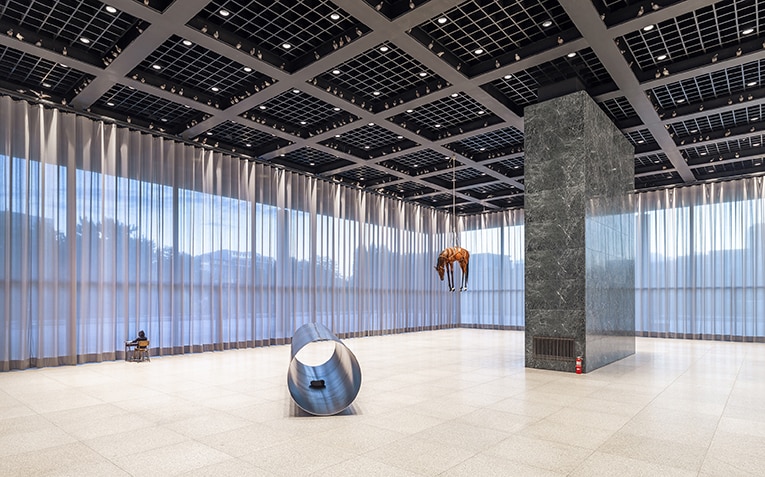
It wasn’t an easy selection process, not least because we didn’t want to put on a traditional retrospective. The exhibition grew out of a lengthy conversation with Klaus Biesenbach and Lisa Botti, but also with Berlin itself and with the Neue Nationalgalerie, the building designed by Mies van der Rohe that houses it: a space that is almost entirely transparent yet monumental at the same time, where it is difficult to isolate one work from another. Everything ends up within the same field of vision.
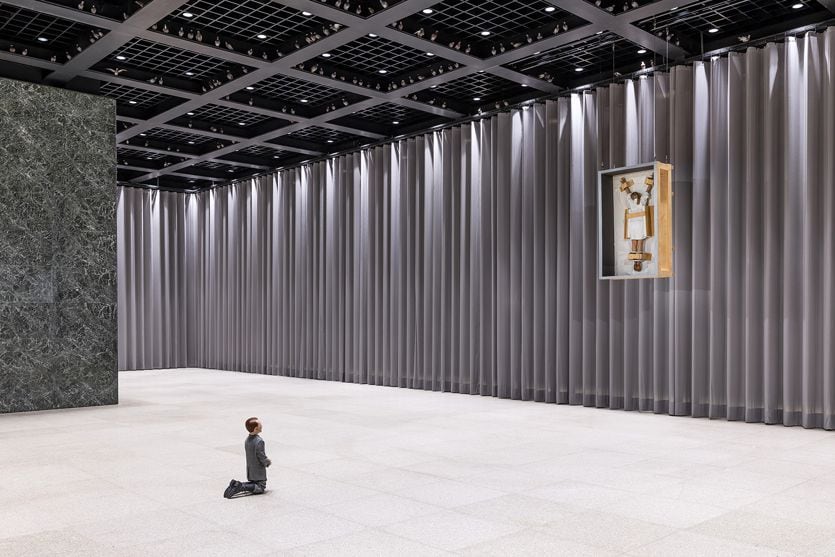
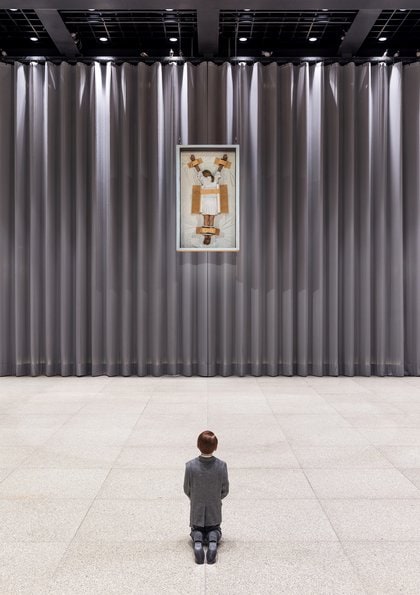
Maurizio Cattelan. Night, vista della mostra, Neue Nationalgalerie, 2026 © Neue Nationalgalerie – Fondazione del Patrimonio Culturale Prussiano / David von Becker

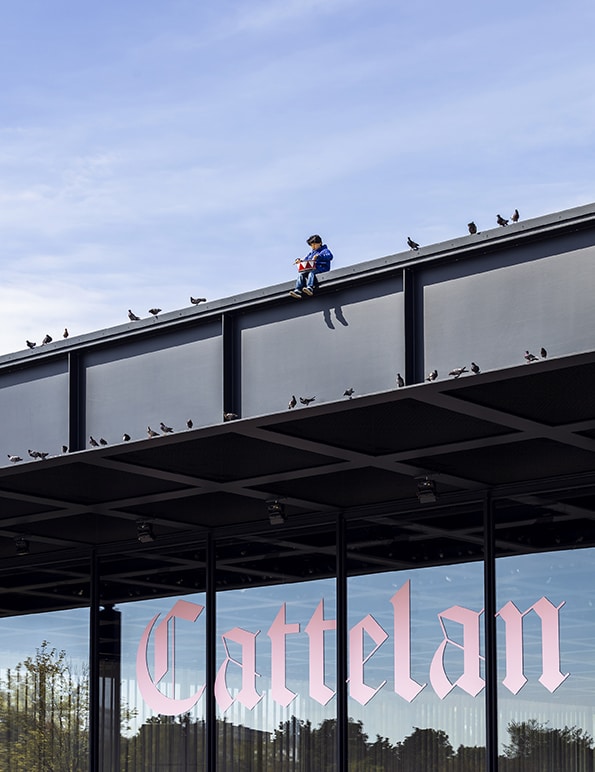
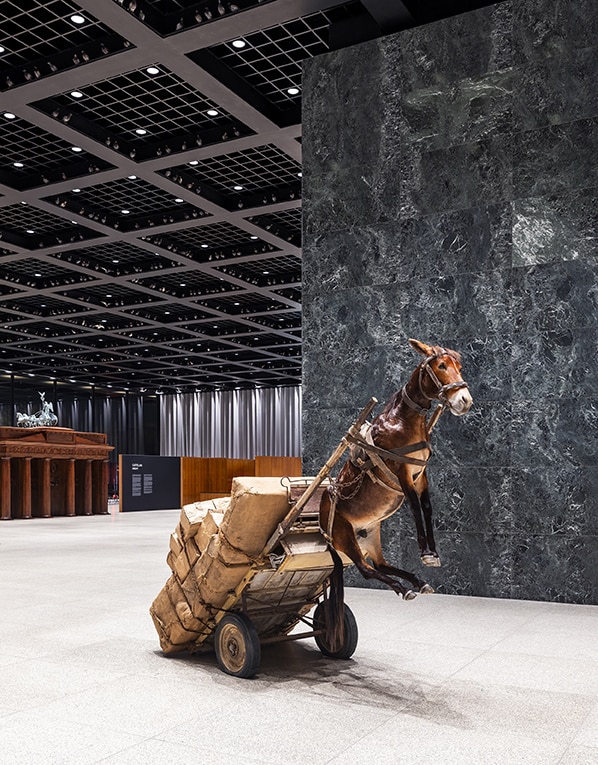
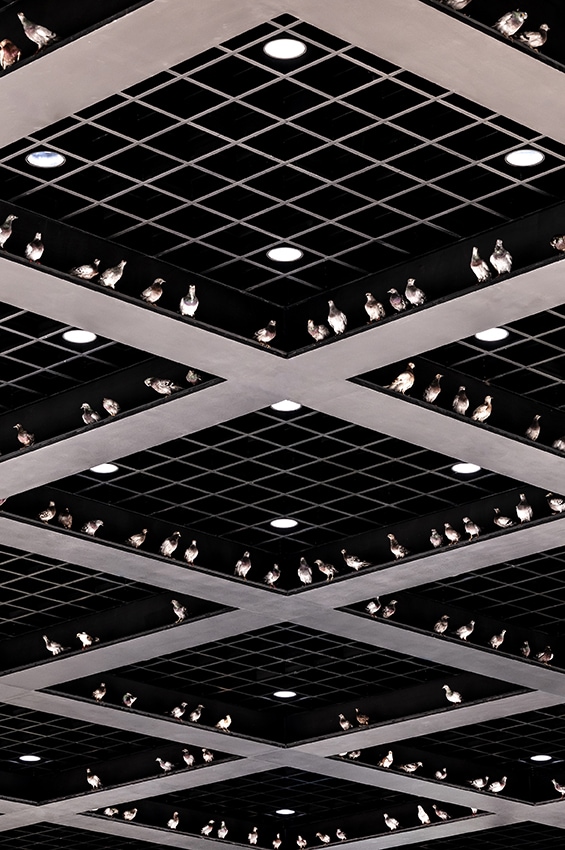
We have chosen works from very different periods: “Him”, featuring Hitler kneeling inside a child’s body; “All”, the nine covered bodies carved from marble; ‘People’, the pigeons occupying the museum from above; ‘900’, the suspended horse. Not because they were simply the best-known works, but because, brought together today, they began to tell a story that none of them could have told on their own. That is what surprised me. ‘Him’ dates from 2001, but bringing it back to Berlin 25 years later inevitably changes the perspective from which we view it. The bodies in “All” are the same, but they arrive after years in which war and death have once again become a daily sight before our eyes. Even the pigeons in “People”, which elsewhere might have seemed above all intruders or spectators, end up here resembling something watching us from above. The criterion was not chronological. It was a question of understanding which works still had enough life in them to respond to the present, and which could truly exist only here, in this building and in this city. The works have not changed. It is the world that has returned to them.

Will there be any new works? What sort of works will they be, and what themes will they cover?
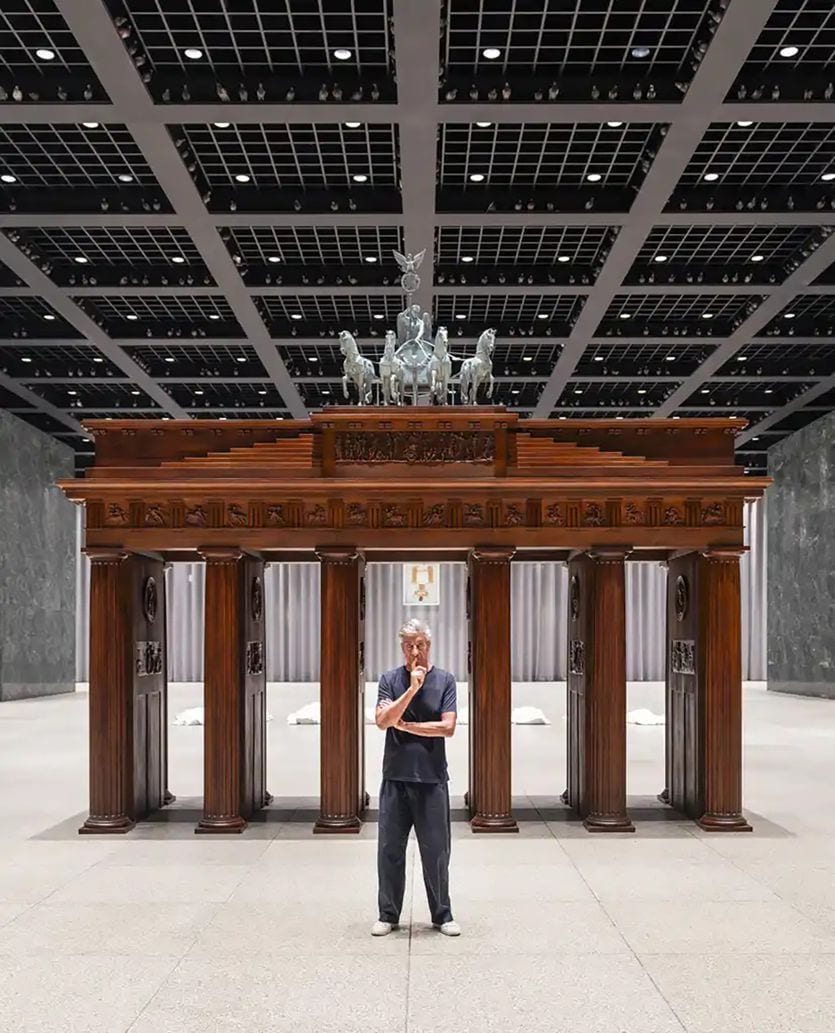
Yes, and some of them have even ended up changing the way I look at the older ones. In *Dust*, there are the ashes of a friend of mine who died recently, inside a fire extinguisher. So his body literally enters the museum. It’s a work born out of something very close to me, almost without any distance. ‘Purgatory’, on the other hand, takes its cue from the Brandenburg Gate, one of Berlin’s most iconic landmarks.

Maurizio Cattelan, Neue Nationalgalerie, 2026 © Neue Nationalgalerie – Stiftung Preußischer Kulturbesitz / David von Becker

We’re reconstructing it in wood and placing it at the museum’s entrance. It’s a door that has weathered empires, wars, division and reunification, and which normally appears as something definitive. Here, it almost becomes a model once more. I was interested in the idea that even a symbol so steeped in history could, for a moment, lose its certainty, and that the visitor would encounter it even before actually entering the exhibition, as if Berlin were already part of the journey. Then there’s ‘Franz’, in the museum lobby. He’s a figure who seems to have remained there whilst everyone else has left, almost like a ghost. He does nothing, yet he immediately transforms the space in which he stands. These new works have ultimately tied everything else together: the dead who remain present, monuments that seem less solid than we thought, figures whose place in our world we are no longer sure of. This is also where the title, ‘Night’, comes from. It is not an exhibition about darkness. Night is the time when things are still before us; we recognise them, but we are no longer as certain as before about what they are. You recognise everything, but you no longer know whether you can trust what you see.

How does the exhibition respond to the current political and social climate in Germany?

This is not an exhibition about German politics, but it would be absurd to think that the present stops at the museum’s door. There is a sense of instability that is not confined to Germany alone. We are moving very quickly into a new world with very ancient fears. Work is changing, as is the way we receive information and distinguish truth from falsehood; and the faster everything moves, the greater the desire for something that seems constant: clearer boundaries, simpler identities, stronger governments. When the future is frightening, the past suddenly becomes very appealing.

Maurizio Cattelan, Neue Nationalgalerie, 2026 © Neue Nationalgalerie – Stiftung Preußischer Kulturbesitz / David von Becker

That is why ‘Him’ carries a different weight today. Not because we have returned to the same point. That would be too simple. But certain ghosts have learnt to dress better. The work hasn’t become more political. The exhibition doesn’t seek to explain what’s happening. It places the present alongside images that were already there and which have suddenly come very close again. We thought we’d consigned them to history, yet they’re still capable of looking back at us. And this, too, is what makes ‘Night’ difficult to separate from Berlin: here, the city, the building and the artworks constantly influence one another. History does not repeat itself. But it has a very good memory.

Loading...

What is your relationship with the art market? How do you react to the record prices achieved by your works?

I don’t think you can really separate the market from what we do. It’s part of the same ecosystem as museums, galleries, critics and collectors. All of them, in different ways, help to shape the perception of an artist: how much they are seen, how much they are desired, how much they are believed in. It’s almost a contest of blame.

Maurizio Cattelan, Neue Nationalgalerie, 2026 © Neue Nationalgalerie – Stiftung Preußischer Kulturbesitz / David von Becker

Auctions are one of the moments when all this becomes visible and is quantified. A record can give you credibility, boost confidence in your work and enable you to do things that previously seemed too risky or too expensive. With ‘Comedian’, something even more interesting happened. The higher the price rose, the more the question of what people were actually buying became part of the work itself. At a certain point, the record no longer merely measured the work: it completed it. Of course, price and value are not the same thing. But it would be naïve to think that price has no consequences. It can change the scale of the work, the freedom you have, the way you’re viewed. For better or worse, it becomes part of the work’s history.

According to an analysis by the Osservatorio Arte Contemporanea, your work enjoys the greatest international visibility amongst contemporary Italian artists. How do you explain this?

It surprises me, partly because I’ve never really thought of my work in purely national terms. I’m Italian, of course, but for me art has always functioned as a community that transcends national borders. What matters is whether a piece of work can move from one context to another without losing its impact. Today, this ability matters even more, because the problem is no longer simply about being seen. We are all visible, all the time. The problem is not getting lost in the flow. An artist competes not only with other artists, but with millions of images produced every day, with advertising, cinema, social media, the news and memes.

Maurizio Cattelan, Neue Nationalgalerie, 2026 © Neue Nationalgalerie – Stiftung Preußischer Kulturbesitz / David von Becker

Attention has become one of the scarcest resources. Perhaps part of my work has been successful because I have always sought images that are immediate, yet capable of remaining open to interpretation. The Pope struck by a meteorite, the horse, ‘Him’, ‘Comedian’: they immediately stick in the mind, but their meaning isn’t fully grasped on first viewing. In a world where producing images has become almost cost-free, value will increasingly shift towards the ability to create. The challenge is no longer to be seen. It is to become difficult to forget.

Italian contemporary art does not enjoy much visibility abroad. What are Italian artists lacking? Or is it a systemic problem? If so, what is it?

I’m not sure that visibility is really the problem these days. There are art fairs, biennials, foundations, social media – a virtually non-stop international circuit. An artist can be discovered in Milan in the morning and seen in New York by the evening. The difficulty comes later. The art-collecting scene has become much younger; collectors buy through different channels, move more quickly and often have less patience. This creates far more opportunities, but also far more turnover. You can rise to prominence quickly and just as quickly be replaced by something else. This is where the system really matters: not so much to make an artist visible, but to give them enough time and continuity so that their work can grow, change, and even make mistakes without being immediately discarded.

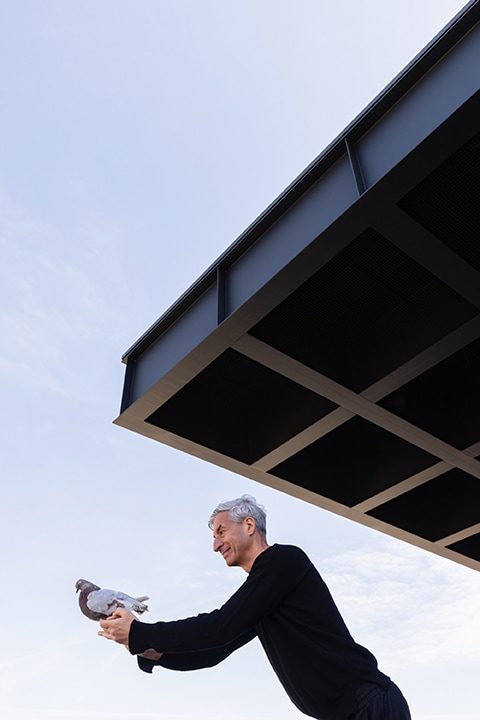
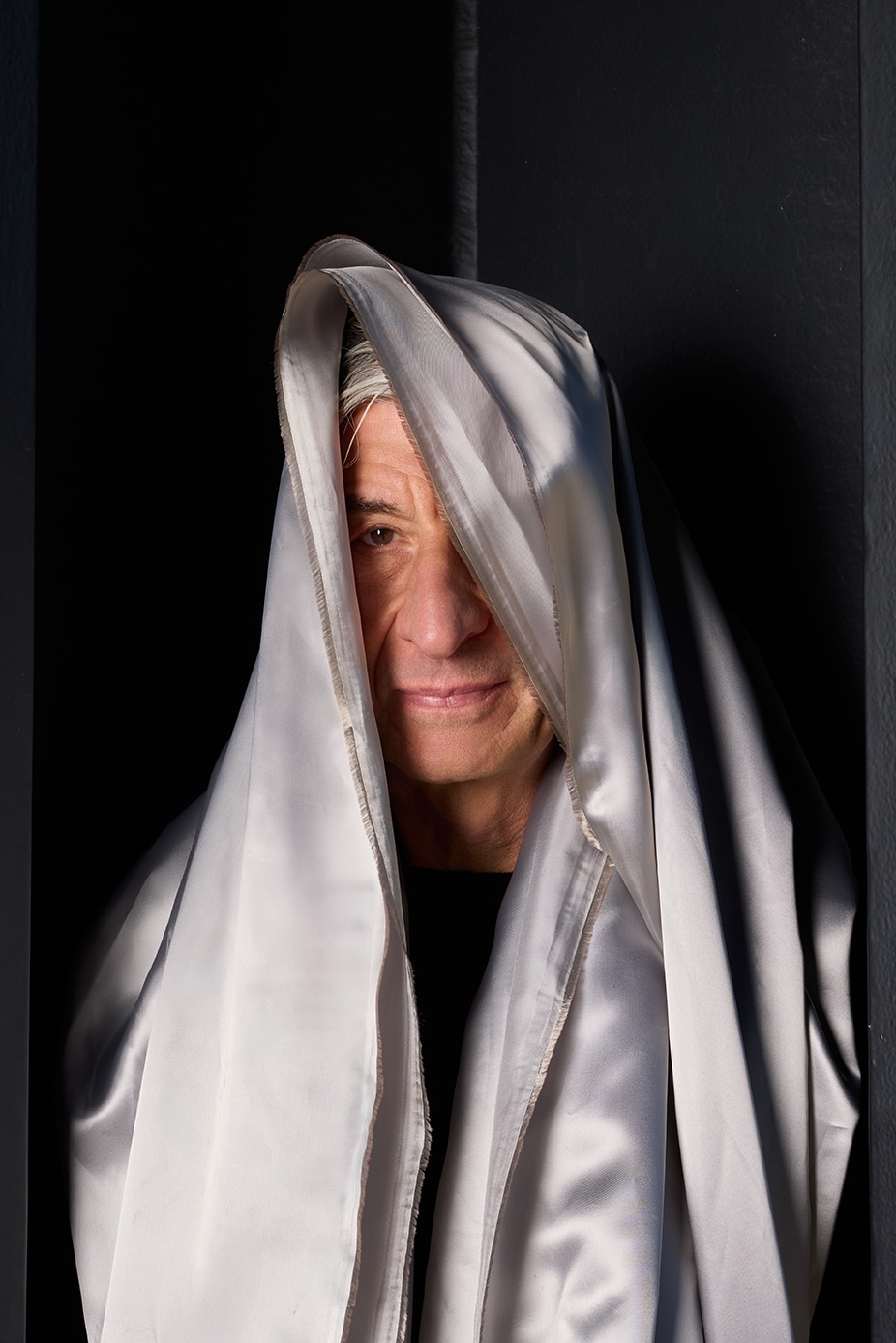
Maurizio Cattelan, 2026 © Neue Nationalgalerie – Stiftung Preußischer Kulturbesitz / Ivan Erofeev

In the end, though, it’s the work that remains. I don’t think it should chase after the language of the present, because that would be the quickest way to become outdated. It must understand the pace of the present, navigate it, and find a form that continues to make sense even when attention has already moved on. Perhaps today the real challenge is no longer to create visibility, but to lay the foundations so that something can endure long enough to become truly significant.

What have been the key moments in your career, from both a critical and commercial perspective?

Critics and the market have often followed one another, but they have not always converged. The first Biennale (Venice, 1993), emerging practically out of nowhere, was a huge success. Then in 2001, with Harald Szeemann, ‘Hollywood’ was in Palermo, and during the opening days around 150 people left Venice to fly to Sicily to see the work. In those days, Venice was the undisputed centre of the art world: managing to shift that level of attention elsewhere, even for a few hours, already struck me as a very tangible form of value. The Guggenheim in 2011 marked the high point and, at the same time, the end of a twenty-year run. I stopped working, and the market, rather than rewarding scarcity, felt almost betrayed for a while. Some works lost ground. It was a good lesson: the market loves continuity far more than absence. Then I came back, and everything got back on track. Looking back, perhaps the defining moments are not those when your career takes off, but those when it changes direction. A Biennale, a museum, a record can establish you; disappearing for a few years can almost wipe you off the map. Your career truly begins when you discover what remains without you.

What further goals would you like to achieve in your art and your career?

It’s funny, but I think I’ve only really started to feel like an artist quite recently. For many years, I saw myself as an outsider – someone who worked in the field of art without ever feeling that I truly belonged to the art world. Perhaps what has changed most of all is my relationship with time. At first, success meant independence: being able to make my own decisions about my life and my work. Today, that freedom is there, but it can become dangerous if it’s only used to repeat what has already worked.

Maurizio Cattelan, Neue Nationalgalerie, 2026 © Neue Nationalgalerie – Stiftung Preußischer Kulturbesitz / David von Becker

So I don’t have a list of museums or awards. I’m interested in understanding just how far I can still change direction without becoming a copy of myself. After so many years, the risk isn’t failure. It’s knowing all too well how it will end. Perhaps the advantage of discovering your identity late in life is that you’re no longer particularly interested in protecting it.

Has your relationship with galleries changed over time? In what way?

Not really. I’ve never used the gallery as my main venue for presenting my work: prior to ‘Sunday’ at Gagosian in New York in 2024, I hadn’t had a solo exhibition in a gallery since 2002. For me, the gallery has always been, above all, an interface with the market. Production, communication and the development of projects have remained very close to me. Today, however, I find the term ‘agent’ more interesting. Not someone who merely represents you, but someone capable of extending the reach of the work and bringing it into situations where it isn’t already protected by the conventions of the art world. It is not just the relationship with the gallery that has changed; the artist’s relationship with the world has changed. A strong work should be able to change context, audience and the language through which it circulates without losing its value. The true strength of a work lies in its ability to traverse different markets without losing its value.

Maurizio Cattelan. Night, vista della mostra, Neue Nationalgalerie, 2026 © Neue Nationalgalerie – Fondazione per il patrimonio culturale prussiano / David von Becker

What is your relationship with emerging art? Could you name a few young artists you follow closely?

When I’m in New York, I spend a lot of time in galleries. Not so much to find out who the ‘it’ artist of the moment is, but because they’re still one of the places where you can get a sense of what’s coming before it becomes mainstream. A young artist’s exhibition might be flawed, unresolved, even bad, and yet still contain an idea that you can’t help but carry with you. That’s what I’m looking for: not confirmation, but a sign. Interesting artists often emerge before the right language exists to describe them. Among Italian artists, I’d say Diego Marcon. I’m interested in him because he starts with forms that seem almost innocuous and slowly takes them elsewhere. At first you recognise everything, then something begins to shift and you realise that the work has left you in a far less comfortable state than the one you started in. The image ends. The unease does not.

In your work, irony, provocation and the art market often seem to engage in a dialogue. Do you still feel the need to provoke today, or has it become inevitable because it is an expectation of the public who follow your art? How difficult is it to maintain the provocative power of a work when it enters major institutions and the international art market?

These days, provocation is probably the easiest thing to do. We are constantly being provoked: by politics, by advertising, by social media, by algorithms. Provocation has almost become an industrial-scale means of generating attention. Adding yet another one doesn’t strike me as particularly interesting.

Maurizio Cattelan, 2026 © Neue Nationalgalerie – Stiftung Preußischer Kulturbesitz / Ivan Erofeev

The problem is creating something that immediately sticks in people’s minds without fading just as quickly. The shock lasts only a moment. Even success can wear a work down if that was all it had to offer. Perhaps the question I ask myself today is simpler: what must a work have in order to survive everything that happens to it after it has been created? Sooner or later come the museum, the art market, the photographs, the interpretations, perhaps even a record. All things that seem to add value but sometimes, on the contrary, erode it. The art market can set a price, the museum can consecrate a work, critics can change the way it is interpreted. The true judge is time.

Copyright reserved ©
Loading...

Brand connect

Loading...

Newsletter

Notizie e approfondimenti sugli avvenimenti politici, economici e finanziari.

Iscriviti