
Calderone: '+40% more permanent hires among young people in 2025'
The minister spoke at the Welfare & HR Summit 2026, emphasising the government's commitment to the younger generation, equal pay and start-ups

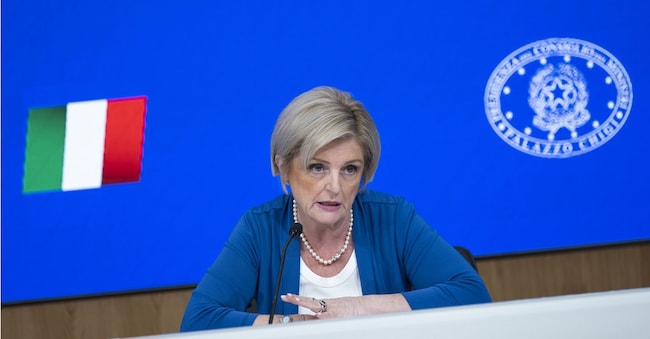
Increase in recruitment of young people on permanent contracts by more than 40% in 2025 compared to 2024. Almost EUR 2 billion invested by the government in the facilitated taxation of contract renewals. A 5% substitute tax for the salary increases resulting from the renewals of national collective agreements (Ccnl) signed between 1 January 2024 and 31 December 2026 and referring only to 2026. These are some of the important points discussed by the Minister of Labour, Marina Elvira Calderone, in her speech during the "Welfare & HR Summit 2026 - Corporate welfare as a lever for growth", organised by Il Sole 24 Ore on Wednesday 25 February.
Young people
The topic of young people and their working future is particularly close to the Minister's heart. "The numbers tell us that in 2025, especially with regard to young people, we had very important results. Compared to the previous year, there was an increase in permanent hiring ofover 40%. This is a significant element, because it tells us that youth employment has had a turnaround'. Indeed, Calderone recalled that of the 105,000 young people hired in the last year, almost half were women, a sign of a growing female participation in the labour market, which is much needed in a country that is suffering a strong and atavistic backwardness on this front and is experiencing a serious demographic crisis. It is no coincidence that the number of young people who choose to emigrate abroad does not know any counter-trend. "It is necessary to work so that young people understand that the road abroad can be an opportunity for training and comparison with other cultures and methodologies, but that it is then possible to return," explained Minister Calderone, reiterating the need to make the Italia system more attractive. In this regard, she cited the almost two billion euros invested by the government in the subsidised taxation of renewals and sums linked to onerous work to 'improve the cincome condition and the spending capacity of workers'. The manoeuvre envisages - at the moment only for 2026 - a 5% substitute tax on increases resulting from contract renewals. The aim, should the measure produce the desired effects, is to include it in astructural system of support for companies and workers. In the wake of the measures in favour of employment, the Minister of Labour also recalled that the government intends new resources to continue with the measures tosupport work, as it did with the extension of the Cohesion Decree incentives for young people and workers in the Zones of Southern Italy, set for 30 April.
The Value of National Bargaining
In Minister Calderone's speech, it was then emphasised that the government intends to strengthen national bargaining, giving employers' and unions' organisations the possibility of investing in contract renewals, moving away from the hypothesis of applying a minimum wage by law. The reference is to the 5% preferential taxation (substitute tax) for salary increases resulting from the renewals of collective bargaining agreements signed between 1 January 2024 and 31 December 2026 and referring only to 2026. "We reiterated that where a company applies a national collective agreement signed by the comparatively most representative organisations, that application already constitutes a presumption of correct behaviour. The aim is not to accentuate differences and to avoid gender discrimination, which is the purpose of the directive (90/2023, ndr)," Calderone commented during the event organised by Il Sole 24 Ore and dedicated to work organisation and human resources management. According to the minister, the implementation of the European directive on wage transparency requires an adaptation to the Italian system: the envisaged text, in fact, takes into account the complexity of the Italian production fabric, largely composed of small enterprises. "A comparison with the social partners will be necessary to ensure a balanced application of the rule and a simplification of the fulfilments," because the public administration should not ask companies and workers for data it already has.
Start-ups
During her speech at the 'Welfare & HR Summit', Minister Calderone also dwelt on the number of years that start-ups, in particular young ones, survive. "The statistics tell us that there is a problem, especially in the phase following the start-up, when accompaniment in the first years of business is useful. Entrepreneurial and management skills are needed, a real toolbox for running a business, especially a business that is starting out'. This is why the public incentives, the support provided by the government go beyond the initial phase. "We finance not only the start-up of the business, but alsothe training of the entrepreneur and, once the business is up and running, also the mentoring that is especially needed when starting a business. Accompanying young people on their entrepreneurial journey enables the critical issues of youth start-ups to be transformed into success stories. This is our goal,' Calderone concluded.

