
Council of Ministers gives the go-ahead to the DPFP and the 28 billion extra-budgetary deficit for energy and defence. Giorgetti: a cautious approach to the budget
The government’s request for flexibility amounts to around 14 billion for 2027 and 14 billion for 2028, split equally between the two expenditure items each year. This amounts to 0.3 per cent of GDP for defence and 0.3 per cent for energy in each of the two years. GDP for 2026 has been revised upwards to 1 per cent from the original conservative estimate of 0.6 per cent. It is set to stand at 0.8% in 2027 and 0.9% in 2028. The deficit, adjusted for the deviation, is below 3%.

Key points
- Giorgetti: deficit, adjusted for the deviation, below 3%
- GDP for 2026 revised upwards to +1 per cent, debt at 138.1 per cent
- ‘We should take a more cautious approach to the budget; the current situation calls for caution’
- “We are not asking for further flexibility, but for the impact of inflation to be assessed”
- Decree-law allocating 200 million for remediation in the Terra dei Fuochi
The Council of Ministers has given the go-ahead to the Public Finance Policy Document (DPFP) and the report on the budget deviation. The agreement between the majority leaders on the partial use of the national safeguard clause for expenditure on energy and defence has therefore been formalised. The expenditure commitment for the extra deficit is divided exactly equally between the two items: 7 billion per year for the next two years, totalling 28 of the 36 billion envisaged in August, before Istat confirmed that the 2025 deficit had reached 3.1 per cent of GDP, preventing Italia from exiting the EU excessive deficit procedure.
This amounts to 0.3 per cent of GDP for defence and 0.3 per cent for energy in each of the two years. Compared with the initial plans, therefore, the defence budget has been scaled back by 8 billion (projected at 0.6 per cent of GDP in 2028). This solution satisfies those on the centre-right, such as the Lega, who were pushing for a substantial reduction in the budget allocated to security and rearmament.
It is no coincidence that sources within the Carroccio have expressed their appreciation for the fact that ‘the investments to support citizens, families and businesses in tackling high energy and fuel prices have been increased by the Council of Ministers to match those allocated to security’. “Now,” they continue, “among Minister Salvini’s priorities are free travel and substantial discounts on public transport and trains for millions of students and commuters.”
Giorgetti: deficit, adjusted for the deviation, below 3 per cent
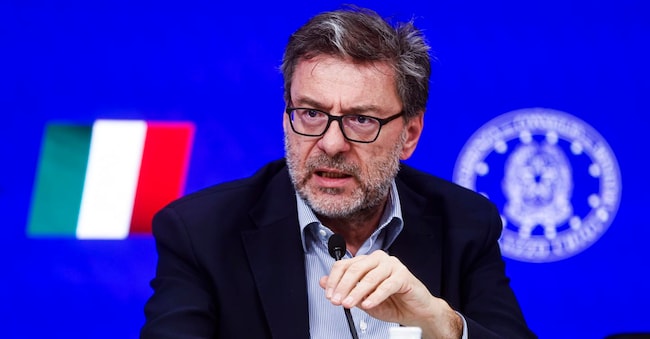
“The deficit is expected to remain below 3 per cent in 2026, but as you know, that is not enough, and our forecasts – taking into account the additional spending permitted under European rules – are that it will rise to 3.4 per cent in 2027, 3.3 per cent in 2028 and 2.4 per cent in 2029,” said the Minister for the Economy Giancarlo Giorgetti at a press conference following the Council of Ministers meeting. “It is not certain” that we will remain subject to the excessive deficit procedure, the minister added. “The deficit figures for 2027 and 2028 are above 3 per cent, but they must be adjusted for the deviation relating to defence and energy; consequently, if you adjust them by 0.6 per cent, you will find a figure below 3 per cent. The decimal places make all the difference, so the hope is to create that leeway.”
GDP for 2026 revised upwards to +1 per cent, debt at 138.1 per cent
The projected growth rate for 2026 has been revised upwards to 1 per cent, compared with the original conservative estimate of 0.6 per cent. It is set to stand at 0.8% in 2027, 0.9% in 2028 and 0.8% in 2029. ‘As regards the debt path, the trend profile stands at 138.1 per cent in 2026, 138.6 per cent in 2027, 137.7 per cent in 2028 and 136.3 per cent in 2029,” added the Minister for the Economy, who explained: “The impact on debt stems from interest rate trends; we expect the downward trend to resume from 2028, when the queues for Superbonus payments will have ended.”


