
Cefla focuses on fuel cells with Nova Solution

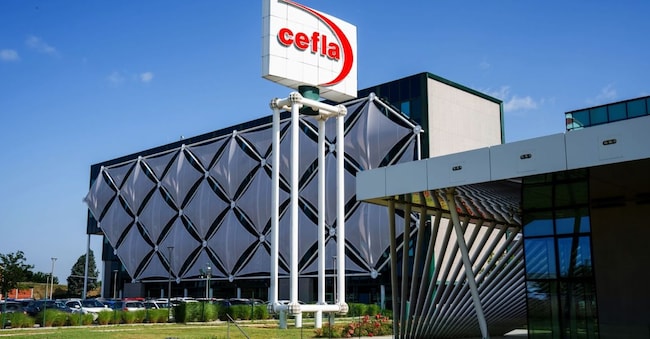
From Romagna to the new global energy race for artificial intelligence. It is in this space, where manufacturing, energy transition and data centres intersect, that the Imola-based Cefla Group is trying to carve out a role for itself with Nova Solution, the fuel cell technology on which the company is building part of its future. The goal is ambitious: to reach nine operational installations by 2026, for a total investment of 42 million euros.
Cefla, an industrial cooperative headquartered in Imola and active in the engineering, plant, medical and wood finishing sectors, has a turnover of over 600 million euros and over 2,000 employees. For some years now, the group has chosen to invest in innovative energy solutions, focusing on a system developed in the United States for space and brought to Europe in partnership with the Californian company Bloom Energy. The development programme is now entering into full swing. Seven Nova systems have already been installed, although not all of them are in operation yet. The first was started up in Cefla's own premises, while the second is now operational in Red Bull's factory in Romagna. Today, at the Key Energy trade fair in Rimini, the one built for ItalA milk will also be presented, while two others are being activated for Igor Gorgonzola and at a Biogas plant. The principle behind the system is relatively simple: transforming agricultural waste and biomass into energy to be used directly in production plants.
While the model has so far been tested mainly in the food industry, the prospect that opens up now looks much further afield. The world of data centres, fuelled by the growth of artificial intelligence and the cloud, is becoming one of the world's largest consumers of energy. In Italia, potential demand is growing at a rate that is putting pressure on the grid: according to the most recent analysis by Politecnico di Milano, while the power actually installed in national data centres is around 600 megawatts, connection requests submitted to Terna exceed 60 gigawatts. The pie is large: in the three-year period 2023-2025 in Italia, EUR 7.1 billion were invested in data centres, and announcements for the period 2026-2028 exceed EUR 25 billion, distributed over more than 80 initiatives.
It is in this space that the global operators that have landed in Italia - see Milan - are looking with interest at systems that can be installed quickly. Nova systems, according to the company, can be built in a matter of weeks and can deliver power in the order of 10 megawatts. The same technology is attracting attention in the United States. In October, Bloom Energy announced a $5 billion partnership with Brookfield for data centre energy infrastructure. For the Imola-based group, the challenge is therefore twofold: to consolidate a technology that was born for industry and, at the same time, to provide an answer to the hunger for electricity in the age of artificial intelligence.

