
Performer, cellist, singer: listen to Kelsey Lu and her many facets
She has modelled for Nan Goldin, composed soundtracks for Netflix and the cinema, worked for Miu Miu, Gucci and Bottega Veneta, forged collaborations across various fields, recorded her second album, directed a short film and taken part in a series of podcasts...

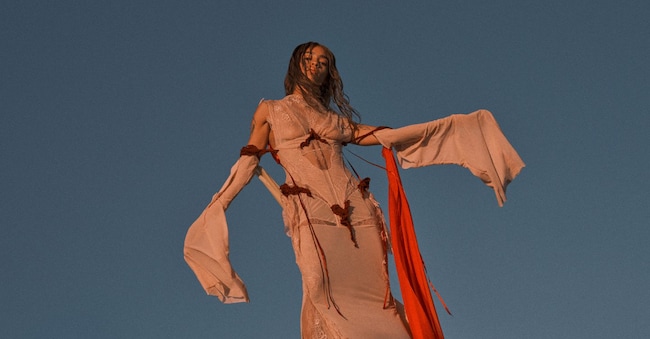
Kelsey Lu does not turn slowness into a virtue. She does not use it as a pose to sugar-coat the story of the seven years that passed between her debut album and her second: an eternity, by the standards of the contemporary music market. A performer, singer and cellist, Kelsey Lu – the stage name of Kelsey McJunkins, born in 1991 – hails from Charlotte, North Carolina, and sees time as a malleable substance: it can be a period of waiting or a form of resistance, but it does not automatically guarantee depth. ‘I believe that slowness can seem like an act of rebellion when everything around us demands such speed. The world moves at the speed of light; there are machines that help produce things ever more quickly; demand is high, and so we’re expected to move at its pace. It’s capitalism, in short. But that doesn’t mean that, if something is created quickly, it can’t still be a work of art. For me, performance is also about this: a large part of it stems from improvisation, from trusting one’s instincts,” he explains from Red Hook, Brooklyn, where he lives. This immediacy also runs through American Sonnet, one of the tracks on the new album: “I wrote it in an hour, and the vocals you hear on the track are the first take I recorded.” The album in question is So Help Me God, released in June on Dirty Hit, following Blood, the debut with which Lu had already carved out a musical territory that was difficult to categorise: cello, vocals, slightly offbeat soul, classical training and experimental pop. Co-produced by pop guru Jack Antonoff and Yves Rothman, So Help Me God features an eclectic line-up of collaborators: British producer Sampha, American saxophonist Kamasi Washington and Kim Gordon, co-founder of the cult band Sonic Youth. But rather than simply marking a return to recording, the project is conceived as a world unto itself: an album, but also a short film created in collaboration with director Savanah Leaf, starring Lu and French actress Garance Marillier, and shot by photographer Yumna Al-Arashi.
If slowness is not a virtue and art can arise from reflection just as much as from a sudden flash of inspiration, why did Lu wait so long before returning to the recording studio? Part of the answer lies in where she comes from: ‘There are things that have always been with me and probably always will be, such as the unhurried pace of the South, which is undeniable, and perhaps my relaxed rhythm comes from there’. She tells her story and digresses, because definitions need to be filled with stories: Lu recalls her early days in New York, when she was amazed that nobody made eye contact. One evening, whilst crossing the road, she decided to stare at the first man who walked past. ‘He stopped dead in his tracks. Then he followed me. I was laughing and said to a friend: ‘See? It’s absurd.’ Later, in a bodega, she saw him turn up again: ‘I was eating a sandwich and he walked in saying: “I’ve been looking for you in every bar, in every shop.”’ He even wrote her a long love letter: ‘I met your gaze. I’m a baker. The next time you come back to New York, I’ll bake your favourite cake and we’ll eat it in Central Park.’ He’d even drawn a picture of the cake. ‘I thought: wow, looking people in the eye is really powerful.’
In reality, the main reason for the hiatus lies above all in the fact that Kelsey Lu is much more than just a musician. Since Blood, she has built up a diverse body of work: songs, soundtracks, performances and visuals. In recent years, she has composed the music for Earth Mama (2023), Savanah Leaf’s debut feature film, and the Netflix documentary Daughters (2024). She explains that her work in film has allowed her to refine the relationship between sound and storytelling: ‘I love storytelling, and my music is quite cinematic. I ask myself: who are the characters? What is the story saying? Which instruments can accompany and enhance it? Whether it’s desire, fear, joy or liberation, what accompanies these feelings?’ In recent years, her slender figure, large eyes and untamed beauty have attracted fashion houses and photographers, but not merely as a body to be dressed. The Miu Miu brand chose Lu for Mind Mapping, the Spring/Summer 21 campaign featuring photographs by Steven Meisel; for Gucci Beauty and Dazed Beauty, she took part in Growing Pains, a video and podcast series in which she revisited her childhood in North Carolina; she appears in Bottega Veneta’s digital journal alongside DJ Honey Dijon, with photographs by Nan Goldin; Goldin, a photographer and activist, went on to produce some new portraits for the magazine of the dating app Feeld. But the list of brands matters less than the way Lu talks about clothes. When asked whether fashion allows her to tap into parts of herself that music alone cannot reach, she does not separate the two forms of expression. “They go hand in hand, because they are both artistic expressions,” she says. “I’ve always had a love for style and fashion, because they bring out different parts of the self.” A Comme des Garçons suit and a Miu Miu dress, she explains, do not create the same persona. During her residencies at the Blue Note in Los Angeles and New York, with two concerts a night, she wore a different outfit for each show: ‘And in each one, I was a different persona’. Sometimes a dress brings joy; other times it can be painful: “I find myself thinking: I feel uncomfortable in this – how can I perform in what I’m wearing?” Her most vivid memory is *i* *This is a test* , a performance commissioned by The Shed in Manhattan in 2021, when the city was beginning to reopen its live venues following the Covid pandemic. The artist describes it as a ritual passage: at the start, a Simone Rocha veil over an all-black ensemble, “a sort of funeral, a procession”; at the end, a huge, organic pink shape, like a mushroom blooming: ‘On stage, I couldn’t help but feel joy,’ she says.
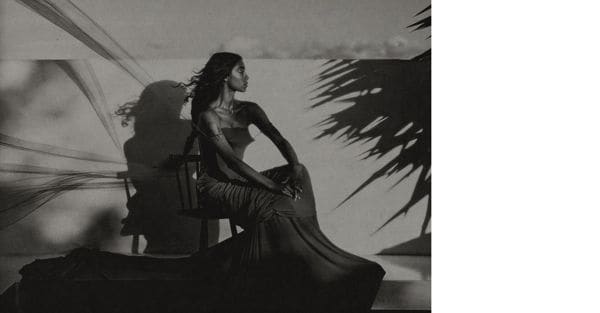
Her collaborations, too, seem to stem from this same logic, which is more instinctive than strategic. When asked what makes someone suited to entering her artistic world, she replies: ‘Perhaps it’s a visceral instinct’. She then talks about her connections. With the photographer Yumna Al-Arashi, for example, she has been friends for almost ten years. “We’ve collaborated on our emotions, on our friendship, on building that relationship. She’s like a sister to me.” For Al-Arashi’s wedding in the Swiss Alps, Lu even composed the music for the ceremony, recording the sounds of nature – the cows’ bells, the water of a waterfall – whilst out walking. The same goes for other names that feature on the album and in its story. Sampha, she explains, was one of the figures through whom she began to break into the London scene; her first gig in the city was actually as the support act for him and Kamasi Washington. Kim Gordon had seen Lu in concert in 2017 and, years later, whilst he was working on his new album in Los Angeles, she popped into the studio: ‘She came along and gave the album her blessing’. Amidst this interweaving of performance, music, fashion and cinema, is there anything that continues to be a source of inspiration? He mentions Nine Inch Nails, Trent Reznor’s band. Then he pauses and goes back much further, to the cassette tapes of Bible stories he used to listen to with his parents before going to sleep. Her favourite story was that of Jezebel, or Gezabele, a Phoenician princess and queen of Israel, a figure associated with wickedness, manipulation and false religion. “But it was also my favourite childhood story,” she says. In Lu’s memory, however, that figure has shifted elsewhere: she has become more ambiguous, almost free. “Perhaps she was just going after what she wanted. She was living her life. She was riding the beast. I think we all, in one way or another, have to ride the beast.” And she adds: “In reality, she was rebelling against the patriarchy.” It is not a moral, and perhaps not even an explanation. Rather, it is a final image: a female figure who has always been seen as a threat but who, in Lu’s eyes, becomes movement and transformation.

