
The best and brightest of Central Europe’s youth fighting against the taboo
Mally and Marelli’s film about Egon Schiele tells the story of young people in the early 1900s searching for new forms of expression, in a striking parallel with Gen Z

Key points
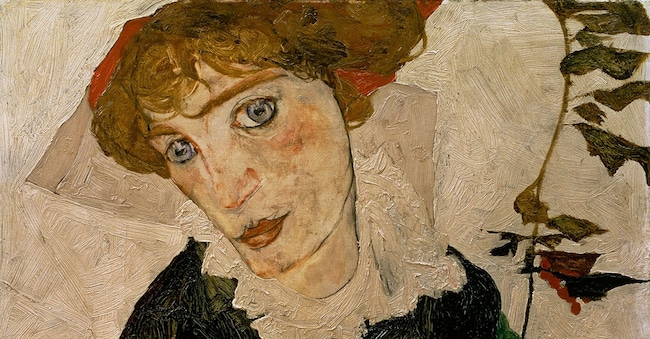
Between 18 and 20 May 1910, Halley’s Comet made a close pass by Earth, which many interpreted as an ominous sign. For Giovanni Pascoli, it filled the sky of mortals with tears / and red blood rains down, / in the twilight, as you climb step by step . Aleksandr Blok warned: ‘You come threatening us with the final hour’ and in his Diary, Leo Tolstoy became convinced that it was ‘about to capture the Earth, to annihilate the world’. At that time, Egon Schiele (1890–1918), barely twenty years old, was at the height of his creative maturity in a Vienna where the Habsburg Empire was beginning to creak and discussions were taking place about the division between the conscious and the unconscious. A month before Halley’s Comet passed overhead, on 20 April 1910, Sigmund Freud had organised a conference to analyse the reasons behind the ever-increasing number of suicides, particularly among young people. Those who did not succumb reacted to this unease with a need to live life to the very full, through the active or contemplative practice of art and sexual freedom unburdened by religion. Schiele drew from both these sources, causing scandals through his cohabitation and his disturbing art; his frenetic output, continuing right up until his death at the age of just 28, comprised hundreds of paintings (almost 400) and works on paper (almost 3,000).
From art critics to psychoanalysts
The documentary *Tabù* describes this well. Egon Schiele by Michele Mally, co-written with Arianna Marelli, features a host of specialists – ranging from museum directors to art critics, psychoanalysts, Germanists, writers and film directors – brought together through the voice of a performer, Erika Carletto, aged twenty – just as Egon, his soulmate, partner and model, Wally Neuzil, his wife Edith Harms, and his sister Gerti were at the time. Carletto’s beautiful voice weaves its way through lullabies and songs of the era. *Tabù* is a documentary, lulled by the original music of Laura Masotto, which narratively weaves together historical and archival perspectives, analysis and interpretations with Schiele’s drawings: disjointed, distorted, anguished and restless self-portraits and paintings of models, little girls, little boys, friends, dried flowers and dilapidated houses, teetering on the brink of solitude.
The Difficult 1900s in Central Europe
Such was the world back then, at least the one revolving around the all-powerful Vienna, populated by young people who would soon die by the millions from the Spanish flu, as indeed happened to Wally (1917), Edith and Egon (1918) themselves. In Central Europe, death and life had never been so close; this is why genius expressed itself so voraciously and precociously in Schiele, Kraus, Trakl, Michelstaedter and Kafka. The documentary plays off the Prague-based writer, showing the two artists as mirror images in their desire to break with convention and in their bonds with their sisters – Gerti for Schiele, Ottilia for Kafka. With Gerti, aged just twelve, and Egon, aged seventeen, he visits Trieste, which bears the same scars as Vienna. ‘Trieste has one of the highest rates of madness and suicide in Europe,’ noted Bobi Bazlen at the time. The trenches of the Great War would soon surround the ‘White City’, just a few kilometres from its elegant cafés.
Sex and Disinhibition
Egon wallows in self-pity, returning to his childhood as a child unloved by his mother, painting Dead Mother, in whose womb lies a colourful foetus entirely untouched by the blackness surrounding the uterus. And above all, there is sexuality, presented in a geometric dimension, flaunted and uninhibited. Egon’s father, a stationmaster – from whom he had inherited an obsession with punctuality – had died of syphilis when Egon was not yet five years old, amidst delirium and terrible torment. Thus, for Schiele, sex is not merely a taboo to be fought, but also a means of revealing one’s inner ‘deviation’. His human subjects are often viewed from above, from the perspective he learnt by observing the winding streets of Krumau (now Český Krumlov in the Czech Republic), his mother’s hometown, where he took refuge ‘to escape the envy of his colleagues’. He missed the rural setting in which he had grown up (Tulln); he felt the need to leave the concrete behind and embrace Nature. He then left for Prague as a soldier. Following the vast army were not only wives and Red Cross nurses, but also a severe epidemic of lethargic encephalitis (sleeping sickness) which developed in Austria and spread throughout the world between 1917 and 1927, affecting almost five million people, mainly aged between 5 and 30. We can read about this in Oliver Sacks’s masterpiece, Awakenings (Adelphi, 1987), which details the L-dopa therapy that made it possible to treat the few survivors.
Connecting with Gen Z
Viewed from a teleological perspective, it was almost a form of collective youthful fainting in the face of such overwhelming horror. The turn of the century plays strange tricks on young people: there is a striking parallel between Schiele’s generation and today’s Generation Zeta. Apart from sexuality, in which they seem to have no interest (Matteo Lancini, Be Yourself My Way, Cortina, 2023, What Our Young People Need, Utet, 2025), young people are destroying themselves through self-harm, eating disorders and severe anxiety. Fortunately, Halley’s Comet will pass close to Earth in 2061.


