
Earthquake in Central Italia: 10 years on, the (slow) reconstruction is boosting GDP

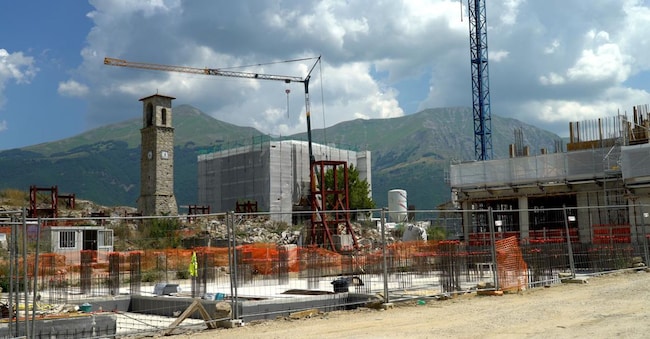
The shops that once lined the decumanus of Amatrice – 10 years on – can still only be imagined, clustered around the ancient town tower that remains standing and the pillars of the future town hall that are beginning to rise. In Castelluccio di Norcia, with streets and buildings gone, even the most frequent visitors are beginning to wonder exactly where the restaurants and shops used to be. Before the earthquakes of 24 August 2016 and then 30 October – with a seismic swarm that continued for months – struck central Italia at its heart, transforming it into Europe’s largest crater and building site. The reopening of the first hotel on Norcia’s main street is being celebrated, whilst on the other side of the Sibillini Mountains, in the Macerata area, none of the hotels that suffered severe damage have yet welcomed guests again. But the cranes – whose numbers have risen over the last two years in this part of the Apennines spanning Lazio, Umbria, Marche and Abruzzo – are a sign of a movement that has turned into recovery and GDP growth. This has been accompanied by a surge in employment contracts and added value within the disaster zone. Thus, on the eve of the commemoration of the 299 victims, ruins and building sites stand side by side.
The GDP of the Crater
In the 138 municipalities affected by the earthquake, there is an economy centred on and driven by reconstruction. Last year, 106,116 contracts were activated – according to figures from the Ministry of Labour. It is not only the driving force behind the construction sector, which is the leading sector in the most severely damaged municipalities (Amatrice, Arquata del Tronto, Accumoli), but also the fourth-largest across the entire area. Leading the way are services (18,819 contracts), hotels and restaurants (17,949), and healthcare and education (17,585). By 2025, the funds disbursed by the NextAppennino programme to businesses (154.9 million) will have more than doubled.
And the added value of the ‘crater’ – estimated by Cresme at 15,959 million – is growing faster than the national average, according to calculations by the commissioner’s office for *Il Sole 24 Ore*. The Marche region accounts for the largest share, although the provinces of Fermo and Macerata, home to the footwear district, are suffering due to tariffs and trade wars. In Umbria, in the affected municipalities, the number of craft businesses has fallen from 489 in 2015 to 411, but they now employ more people. Overall, 10 years after the earthquake, the economic snapshot provided by the commission points to an additional 1.49 billion in GDP and 9,841 jobs generated by projects ongoing as of March 2026 – driven by investment, the substantial injection of funds provided for in the National Recovery and Resilience Plan (PNRR) through the NextAppennino programme (Macro-measure B worth 560.5 million) and the synergistic reconstruction efforts – with forecasts of further growth (3.87 billion in GDP and 15,298 jobs). ‘These are encouraging figures; the Central Apennines are charting a new course for growth. The rise in GDP, employment and investment demonstrates that reconstruction can and must be a driver of growth, accompanied by economic and social recovery. Through this comprehensive strategy, we can tackle depopulation and transform the Central Apennines into a model region,’ comments Guido Castelli, Special Commissioner for Reconstruction, to whom the region continues to direct many requests.
Amatrice
One was approved by the Council of Ministers on 5 August, through a decree allocating 5 per cent of the funds to the hardest-hit areas and 4 per cent to the others. “It brings the support we had asked for to sustain a struggling economy; it will encourage investment,” hopes Giorgio Cortellesi, mayor of Amatrice, who sees the town’s fame as the key to its development. This centres on the famous restaurants, historic businesses – “such as the Petrucci dairy for its pecorino cheese or the Sano charcuterie in Accumoli for its guanciale” – or those that have grown stronger since the earthquake, such as “Fragole ad alta quota”. And then “there is the reconstruction economy”, as Cortellesi puts it: the economic activity generated by the building sites now, and in the long term the impact of “the new infrastructure”. These remain the priority for the entire area, to make it easier to bring back the visitors of the past to these small communities, which are still struggling to come together in the absence of communal spaces.
Norcia and Valnerina
As with Amatrice, history has also ensured the survival of the Valnerina in Umbria over the last ‘dark’ decade: ‘We were shipwrecked; now we can see a lighthouse,’ is the metaphor used by Vincenzo Bianconi following the reopening of the hotel – Casa Bianconi – and the family restaurant in the historic centre of Norcia. The other hotel, Salicone, has instead been demolished and is ‘embarking on a new life in the wellness sector’. At its renowned sports centre, however, teams have returned for training camps, such as ‘Ascoli, who have been promoted to Serie B, spurred on by their fans and their enthusiasm’, he explains. What Norcia has lost in terms of accommodation capacity, “Cascia has gained: sports tourism, nature tourism and walking trails have all been boosted. We’ve doubled our turnover and guest numbers. And the number of staff,’ says Paolo Armini, manager of the Hotel delle Rose (at the Monastery of Santa Rita), ‘has risen from 45 to 67’. The hospitality and agri-food sectors go hand in hand. So even though tourist numbers are not yet what they were ten years ago – 392,000 visitors in 2015 in Valnerina, 379,000 last year – producers of cured meats and lentils confirm that “turnover remains the same”. At Antica Norcineria F.lli Ansuini – four generations and a destroyed factory – “production has never stopped”, confirms Walter. And precisely because of their reputation, ‘sales of Castelluccio lentils have not fallen’, assures Paolo Coccia of the producers’ co-operative from the destroyed village. ‘The shops are now in the Deltaplano shopping centre and are just about managing,’ he says. It’s not the same thing strolling through ancient alleyways as it is through a structure, however futuristic it may be. ‘The reconstruction of the village,’ sighs Coccia, ‘has, however, begun.’


