Immigration

Centres in Albania, two years without peace. And it is dark about the actual costs

The balance of the experiment: a slalom between the judges' stops and the rules to overcome them. On 13 November Giorgia Meloni will relaunch the first official Italy-Albania summit with Edi Rama in Rome

by Manuela Perrone

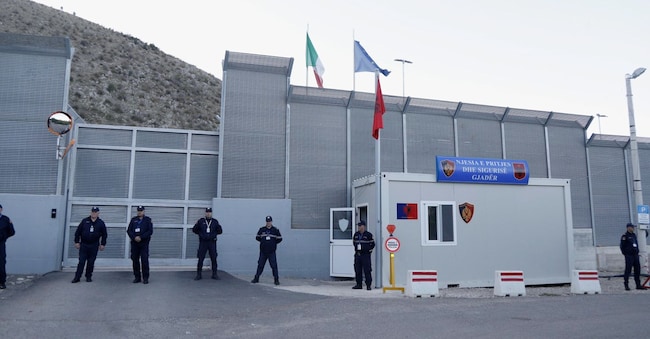
 Agenti di polizia presidiano l'ingresso del centro di detenzione per migranti gestito dall'Italia, a Gjader, in Albania.  (Epa/Malton Dibra)

8' min read

Translated by AI
Versione italiana

8' min read

Translated by AI
Versione italiana

The Italy-Albania Protocol, thanks to which the Shëngjin hotspot and the Gjader centre, which is currently only operational as a detention centre for repatriation, were realised, turns two years old today. The government's objective - to 'externalise' the borders and build an innovative model for the management of irregular migrants - has proved more difficult than expected, and certainly failed, also due to the long theory of non-validations of detentions decided by judges. Compared to the theoretical capacity of 3,000 contextual migrants, so far, according to the Viminale, 'about a thousand people' in all have passed through the Albanian facilities. There are currently about 40 foreigners present.

The first Italy-Albania summit will be held in Rome on 13 November

Giorgia Meloni is not giving up. At the beginning of the year, at a press conference, she promised: "The centres in Albania will work, if I have to spend every night there from now until the end of the government". The premier will welcome her Albanian counterpart Edi Rama back to Rome on 13 November for the first official Italy-Albania summit since 2010, when the two countries signed the Declaration of Strategic Partnership. On that occasion, a strategic cooperation agreement will be signed in at least ten sectors, from healthcare to immigration, and the commitment on centres will also be renewed. Waiting - this is the government's hope - for the entry into force of the new European Union Migration and Asylum Pact, from June 2026, the "return hubs", i.e. the centres for returns to third countries proposed in the Return Regulation by the EU Commission, may become a model for all.

Loading...

The expectation of 36 thousand people per year

The story begins on 6 November 2023, when the Rome-Tirana protocol was signed at Palazzo Chigi by Meloni and Rama. With three aims, emphasised by the prime minister: 'to combat human trafficking, to prevent illegal migratory flows, and to welcome only those who are truly entitled to international protection'. The facilities 'will initially be able to accommodate up to 3,000 people, who will remain in these centres for the time necessary to be able to quickly complete the procedures for processing asylum applications and possibly for repatriation'. Meloni goes further: "We are talking about a maximum of 3 thousand people contextually, but it is clear that by using the accelerated procedures that allow applications to be processed in 28 days, with this project, when fully operational, these numbers can be considered monthly and therefore the overall annual flow can reach up to 36 thousand people alternating". This will not be the case.

More than 650 million in five years, but the actual costs are a mystery

The expenses listed in the ratification law (no. 14/2024, published in the Official Gazette of 22 February) amount to around 650 million for the five years of the agreement and include a wide variety of items, from maintenance to recruitment, from insurance to staff travel from Italy: the latter is the largest (over 250 million). For the chartering of the ship, the 'preliminary market consultation' launched by the Viminale speaks of a maximum of 13.5 million for three months. The cooperative Medihospes won the contract to manage the reception for 24 months with a bid of 133.8 million euro. But it is impossible to reconstruct today what the actual costs have been so far: no data is made available by the government. ActionAid has filed a complaint with the Court of Auditors and calculated, together with the University of Bari, how the Gjader centre cost a good 570,400 euro for the few days it was operational in 2024 for twenty people: 114 thousand euro per day.

The accelerated border procedures

Law 14 establishes that in the facilities in Albania only persons embarked on vehicles of the Italian authorities may be taken to areas outside the territorial sea of the Republic or of other EU States, also as a result of rescue operations. The areas granted for use to Italy by Albania have been equal to border or transit zones, in which, under certain conditions, an accelerated procedure for examining applications for international protection can be carried out. That of 28 days (seven for the Territorial Commission's decision on asylum or repatriation, 14 for a possible appeal and another seven for the final verdict), which was extended in Italy by the Cutro Decree to migrants from countries considered safe for repatriation.

The node of 'safe' countries

Here lurks the first vulnus. Because on 4 October 2024, on the very eve of the openings of the centres - in Shëngjin the one for identification and eligibility procedures; in Gjader, twenty kilometres inland, a centre for the detention of asylum seekers with 880 places, plus a CPR with 144 places and a small prison with 20 places - the EU Court of Justice ruled that a country cannot be considered safe if it is not safe in certain areas of its territory or for certain categories of people, such as homosexuals. The Italian list, renewed on 7 May by a decree of the Ministry of Foreign Affairs, is faltering.

Almost a year for the centres to be operational

Based on the ruling of the Luxembourg judges, once the facilities opened on 14 October and the first transfer of 16 migrants on board the navy's Libra ship (four of whom were immediately sent to Italy, two because of health problems and two because they were minors), the immigration section of the Court of Rome decides not to validate the detentions in Gjader of the remaining 12, who are sent to Bari with the coast guard's patrol boat Visalli.

The first decree law

The government's reaction is to hurriedly pass a decree-law at the Council of Ministers on 21 October (a decree that was later merged in Parliament into the Flows Decree) to raise the list of safe countries from a secondary to a primary norm and strengthen its solidity. Confirmed in the list are 19 countries - Albania, Algeria, Bangladesh, Bosnia-Herzegovina, Cape Verde, Ivory Coast, Egypt, Gambia, Georgia, Ghana, Kosovo, Northern Macedonia, Morocco, Montenegro, Peru, Senegal, Serbia, Sri Lanka and Tunisia - that is, all those previously indicated by the Farnesina except Cameroon, Colombia and Nigeria. A path with which the Executive tries to reaffirm its supremacy over a choice that "is not up to the judges". The Parliament will add its own: in the phase of conversion of the Dl, it will subtract from the immigration sections of the courts the competence to decide in first instance on detentions, both in terms of validation and extension, to devolve it to the Courts of Appeal in monocratic composition.

The New Flops and the Clash with the Judiciary

The reason is simple: even on 8 November, when the ship Libra landed again in Albania, this time with just eight migrants, still traced in the waters south of Lampedusa, the script repeated itself. One had been immediately transferred to Bari, because he was found to be vulnerable for health reasons, for the others a few days later the Roman judges again failed to validate the detention. With one more detail: they suspended the judgement and, on the basis of what had already been done by the courts of Bologna, of Catania and of Palermo (intervening on the detentions of other asylum seekers in Italian prisons), they raised the issue before the EU Court of Justice.

The Supreme Court's pronouncements

In December 2024, the Supreme Court of Cassation also intervened: on 19 December, following a preliminary referral requested by the Capital Court, it opened the way for the disapplication of the ministerial decree on safe countries when the presumption of safety contrasts with the different qualification criteria defined by EU regulations; on 30 December, in an order, called into question by the Government's appeal against the lack of validation, it recognised that it is up to the Executive to determine the list of safe countries, but also that the judge can and must intervene in the individual case. But it suspends the judgement in view of the European Court of Justice's ruling urged by the Italian courts.

In January the third failed transfer

Since November, the government has chosen to stop the transfers, which resume at the end of January. But they are more failures. Forty-nine of them disembarked from the navy ship Cassiopea at the port of Shengjin: six of them were transferred to Brindisi after being screened at the hotspot; for the other 43, the Court of Appeal (where, ironically, the same judges of the immigration section are applied due to staff shortage) suspended the judgement on the validation of detentions, releasing the migrants "pending the decision of the European Court of Justice" expected on 25 February.

The second decree law

Thus, within the government, the decision matured to proceed with a new decree law (37/2025) that was approved in the Council of Ministers on 28 March and did not amend the Rome-Tirana Protocol, but only the transposing law. With one objective: to clarify that the Gjader facility will not only be able to host people picked up in international waters by Italian military ships and coming from safe countries, as provided for by law 14/2024, but also migrants already present in the CPRs in Italy, i.e. recipients of expulsion orders and detainees. A change that serves to relaunch the operation by circumventing the magistrates' stops.

The fourth bankruptcy and the new regulatory correction

On 11 April, in fact, the ship Libra leaves with 40 migrants from Italian centres. But a new stumbling block is just around the corner, because it turns out that, in the absence of an agreement for the execution of expulsions allowing repatriations from a third country, they must first be transferred back to Italy. Not only: the Court of Appeal in Rome ruled that a foreigner who, after being transferred, applies for international protection cannot be detained in the Albanian centre. The government once again took corrective action and, with a package of amendments tabled to the Law Decree in the Chamber of Deputies, 'corrected' its aim: on 20 May the measure became law and the judges' margins of intervention were increasingly reduced.

EU Court's verdict: judges' review of individual cases legitimate

In the meantime, again in May, came both a new ruling by the Supreme Court of Cassation that comforted the Executive, because it established the principle of law according to which it is legitimate to detain a foreigner in the Cpr in Gjader even after an asylum application has been submitted, and two ordinances that instead worried it because they still raised doubts and questions to the EU Court of Justice. Which finally ruled on 1 August. A cold shower: the designation of a third country as a 'safe country of origin' does not exclude, even when it is established by law, judicial review of individual cases. The reaction of Palazzo Chigi is vehement: that of the Court is an undue intrusion in "spaces that do not belong to it".

Only the Cpr remains, the gap reported by the Consulta to be filled

Since then, while the oppositions all continue to cry failure and demand accountability for costs and waste, only the Cpr in Gjader, with limited numbers, can continue to function in Albania. Another void hangs over all the repatriation centres, which the Viminale has promised to fill: in July, the Constitutional Court, with its pronouncement 96/2025, pointed out that there is a lack of rules regulating the 'methods' of detention to ensure that migrants deprived of their personal freedom can enjoy the guarantees provided by the Charter.

Horizon 2026, between EU Pact and revised conventions

Meloni is waiting for 2026 and for Europe's moves, but in the meantime she has moved the goalposts and started to press, together with eight other European countries such as Denmark, for a revision of the international conventions on migrants, in particular the European Convention on Human Rights, so that member states can act without strings (and without the pro-migrant rulings of the European Court of Human Rights) against irregular migration and human trafficking. Yesterday a meeting was held at Palazzo Chigi at senior civil servant level: the horizon is 10 December, when the Committee of Ministers in Strasbourg should start the path towards a political declaration within the Council of Europe to be adopted next year.


Copyright reserved ©
Loading...

Brand connect

Loading...

Newsletter

Notizie e approfondimenti sugli avvenimenti politici, economici e finanziari.

Iscriviti