
Cerasa and the optimistic manifesto against the dictatorship of catastrophism
A call to overcome the dominant negative narrative by rigorously analysing environmental, technological and geopolitical challenges to discover opportunities and hopes

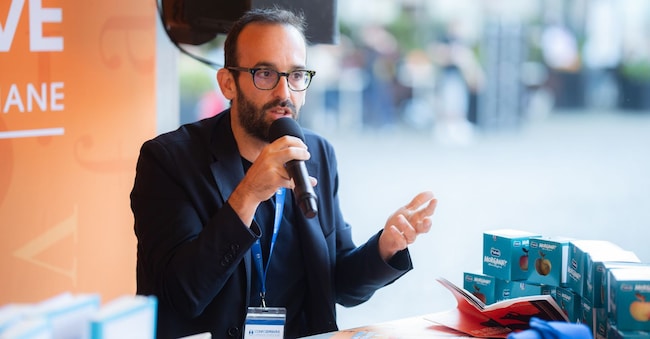
The editor of the Foglio quotidiano, Claudio Cerasa, took part in one of the appointments of the Incontri con l'autore series, here in Trento, but what he wrote 'is not a book, it is an almost desperate appeal to observe reality for what it is, not for what it appears'. His The Antidote - Freedom, Environment, Technology. An optimistic manifesto against the dictatorship of catastrophism (Silvio Berlusconi editore) is an essay against, in order, 'the society of resentment', the related anxiogenic narrative with its 'media circus', and the political use of pessimism, which in politics naturally feeds populism and in information a widespread conviction that leads to only bad news being considered news.
Speaking to a packed hall in Palazzo Sardagna, Cerasa sometimes almost seems to apologise for wanting to be an optimist in such a chaotic world and in a media square so crowded with pessimists, but he explains that to be an optimist in his job, a journalist, is also a method of investigation, it means asking yourself some decisive questions. And he lists them, one after the other, with passion. Is it true that environmental care is only catastrophe? Is it true that globalisation only creates inequality? Is it true that Ukraine is only destined to capitulate? Is it true that artificial intelligence will only destroy jobs? "Of course you can imagine my answers...", but so you dig, you study, you delve deeper to see if there is at least a half-full in the glass. Cerasa starts with a 'macro' observation: 'The West is a civilisation that has specialised in self-criticism'. Then he dismantles the false myths, always and only critical, of globalisation "which now has a great ally" paradoxically - he explains ironically -, precisely Trump, given that last year, the year of tariffs, "there was more trade in the world than ever before in history". Because actions are always followed by reactions and consequences; tariffs, and not only tariffs, are followed by antidotes. Before questions from the audience on Russia, digital sovereignty and European ambitions, Cerasa plays a little game. A reason - just one word - to be optimistic for Italia? "Exports. For Europe? 'Learning from mistakes'. For the world? 'Reactions'. And for artificial intelligence? 'Regeneration'.

