
Ces 2026, Bosch reduces car sickness with intelligent software and new cockpit based on artificial intelligence arrives
Las Vegas shows how software and hardware can work together to pave the way for a smarter future

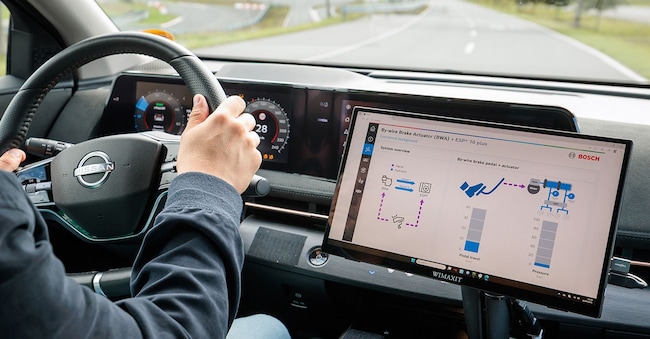
More safety, comfort and services. Bosch's expertise in software and hardware integration arrives at Ces 2026 in Las Vegas with a long list of innovations, starting with a new automotive cockpit based on artificial intelligence to software that can reduce car sickness. Bosch expects, by the beginning of the next decade, to generate more than 6 billion euros in sales through software and services, much of it based on artificial intelligence. Around two-thirds of this turnover is expected to come from the business mobility sector. The company expects sales of software, sensor technology, high-performance computers and network components to double to well over EUR 10 billion by the mid-2030s. In the field of artificial intelligence, Bosch will invest more than EUR 2.5 billion in this area by the end of 2027.
Bosch, AI-based cockpit
Debut at Ces 2026 for Bosch's unprecedented AI-based cockpit. It is an all-in-one system that enables advanced personalisation of the car's environment. The cockpit features a Large Language Model that allows you to communicate as if you were interacting with a real person. It also has a visual model that can interpret what is happening both inside and outside the vehicle. With this functionality, the system can, for example, automatically search for a parking space when arriving at a destination or compile meeting minutes online.
Car sickness
Reduce car sickness thanks to Bosch's intelligent software, which controls vehicle movement in all six degrees of freedom, centrally managing brakes, steering, engine and chassis. This allows the individual actuators to be better coordinated and used more efficiently. In the future, they will even be adapted to the driver's needs. The software developed by Bosch can significantly reduce rolling movements when cornering or pitching in stop-and-go traffic, thus helping to prevent car sickness and at the same time taking a step forward in autonomous driving.
Self-driving Bosch
Bosch unveiled at Ces 2026 a technology that combines sensor technology and AI with the new Radar Gen 7 Premium, the latter of which had its world premiere. The radar sensor enhances driver assistance functions such as the freeway pilot. Thanks to the special antenna configuration, it guarantees maximum angular accuracy and a very long range. For example, the sensor detects very small objects, such as pallets or tyres, at a distance of over 200 metres. This allows it to precisely detect lost loads or other road users even in complex traffic situations, thus activating the most suitable driving manoeuvre.
New Sensor Mems
Bosch is presenting its new Bmi5 Ai Mems sensor platform at Ces 2026. All sensors developed on this basis are characterised by a high level of precision, robustness and energy efficiency. They also have integrated AI functions capable of recognising movements, positions and even contexts. One of the areas in which these new motion sensors find application is virtual and augmented reality. By tracking head movements accurately and with virtually no delay, they allow users to interact naturally in 3D environments. They also help robots recognise their surroundings and their own movements with great accuracy - for example, they allow humanoid robots to find the correct path even when an object obscures the camera lens

