Products

CES 2026, Nvidia launches Alpamayo a family of Ai models for autonomous driving

From the CES stage in Las Vegas, Jensen Huang presents Alpamayo, a new family of models, simulators and open source datasets designed to train autonomous cars and robots to reason in the real world.

by Luca Tremolada

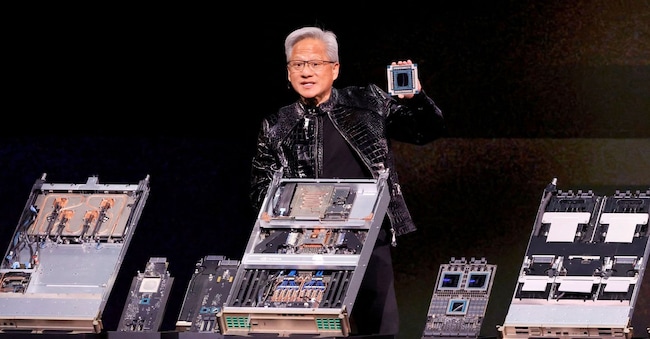
Il CEO di Nvidia Jensen Huang tiene in mano un interruttore per il supercomputer Nvidia Vera Rubin NVL72 AI durante il keynote di Nvidia al CES 2026, una fiera annuale dell'elettronica di consumo, a Las Vegas, Nevada, Stati Uniti, il 5 gennaio 2026. (REUTERS/Steve Marcus)

4' min read

Translated by AI
Versione italiana

4' min read

Translated by AI
Versione italiana

LAS VEGAS - Nvidia lifts the bonnet of the autonomous car and sticks its brain in it. It is called Alpamayo: a new open source family of artificial intelligence models, simulators and datasets for training robots and physical vehicles. The goal is ambitious and very concrete.
After dominating the 2025 edition with the announcement of the RTX 5000 series GPUs and the desktop supercomputer, Jensen Huang returns to the Consumer Electronic Show in Las Vegas as the undisputed king of AI, like a new Elvis Presley to shape Physical AI, which defines artificial intelligence that understands the laws of physics. No less. Jensen shows up greeting Las Vegas in a black crocodile leather rock star jacket.

Loading...

For Jensen Huang, number one at Nvidia, it is a historic step. "The ChatGPT moment of physical artificial intelligence has arrived," he says. Translation: machines no longer just see and react. They now begin to understand, reason and act in the real world. Like a human driver.

At the heart of the system is Alpamayo 1. A VLA model - vision, language and action - with 10 billion parameters. It not only recognises what is happening in front of the windscreen, but also lines up thoughts. It reasons in steps. It breaks down problems. It evaluates options. Then it chooses the safest. It is the famous chain of thought, applied to asphalt.

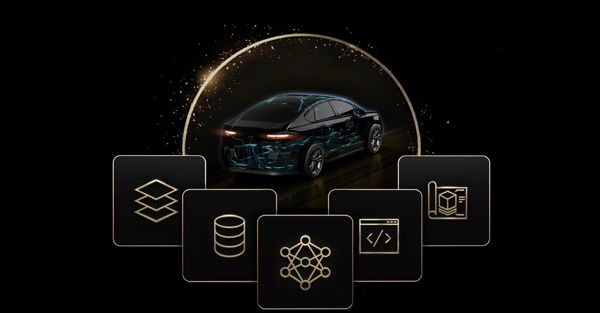
Technically, he explained, it is a complete and open ecosystem for reasoning-based autonomy. Alpamayo integrates three fundamental pillars (open models, simulation frameworks and datasets) into a cohesive, open ecosystem that any automotive developer or research team can build on.

Instead of running directly inside the vehicle, the Alpamayo models serve as large-scale training models that developers can refine and integrate into the backbone structures of their complete AV stacks.

During his presentation, Jensen traced the stages of artificial intelligence, from the reasoning models introduced by OpenAI to open source models such as DeepSeek, which have brought AI inside computers and machines. Jensen re-explained the economics of intelligent agents, explaining how in this new ecosystem the business is in our ability to use LLM and software and applications to create new services. But the heart of his keynote focused on Physical AI. Learning does not come from data, text and video and audio, but from simulation environments in three dimensions. 'Simulation is what Nvidia does,' he was keen to point out to make the positioning even clearer.

How did Alpamayo come into being?

According to Nvidia, World Foundation Models are the next step up from large language models. They are not for understanding sentences, but for understanding the world.

The idea is simple and radical: train artificial intelligence models not just on text, images or video, but on the physical, spatial and causal laws of reality. A World Foundation Model learns how a three-dimensional environment works: gravity, collisions, the movement of objects, the relationship between an action and its consequences. It does not answer a question. It predicts what happens if you act.

For Nvidia, these models are the cognitive basis for robots, autonomous cars and physical agents. A robot cannot just 'recognise' a chair: it must know that it can go around it, move it, bump into it, climb on it. It must have an internal model of the world, continuously updated, on which to simulate decisions before executing them in the real world.

This is where simulation comes in. Nvidia builds these models using photorealistic virtual worlds, such as those developed in Omniverse, where the AI can do millions of experiments without breaking anything. Fall, make mistakes, learn. Exactly like a child does, but at data centre speeds.

The key difference from language models is epistemological. An LLM learns correlations between symbols. A World Foundation Model learns dynamics. It does not learn 'what to say', but 'how something works'. It is an AI that thinks in terms of space, time and cause-effect.

For Nvidia, these models are the invisible infrastructure of the next wave of automation. Without a model of the world, AI remains confined to screens. With a model of the world, it can finally get out and act.

During the presentation, Jensen introduced Cosmo, which is Nvidia's World Foundation Model. Basically, it is the model that tries to teach machines not to talk about the world, but to imagine how the world works.

Nvidia describes it as a basic model capable of understanding and generating physical, three-dimensional environments: space, objects, movement, causes and effects. Cosmo was not born to chat. It was born to simulate. It is used to predict what happens if a robot grabs an object, if a vehicle turns, if two bodies collide, if a force is applied. Alpamayo was born within this context.

How will it work in practice?

It is designed for the autonomous vehicle research community and is available on Hugging Face. Open source for real: open weights, open inference scripts. Developers can 'slim it down' to run it in real time in a real car, or use it as a reference brain to build tools: evaluators that judge whether a manoeuvre was sensible, self-labelling systems that bring order to videos without human intervention.

And it doesn't end there. The next models in the family will grow still further: more parameters, finer reasoning, more flexible inputs and outputs. And, a non-trivial detail, options for commercial use. Open today, business tomorrow.

Then there is AlpaSim. The Simulator. An end-to-end, completely open source framework, available on GitHub. Here, autonomous cars can make virtual crashes at no real cost. Realistic sensors, configurable traffic, closed-loop test environments that scale. It is used to quickly validate driving policies and correct them before they leave the digital garage.

Finally, the data. Lots of data. Nvidia brings to the table its open data set for physical artificial intelligence: over 1,700 hours of driving time, collected in a wide variety of locations and conditions. Rain, sun, cities, suburbs, rare and complex edge cases. It is the raw material of reasoning. Without hard examples, AI remains naive. These datasets are also on Hugging Face.

Copyright reserved ©
  • Luca Tremolada

    Luca TremoladaGiornalista

    Luogo: Milano via Monte Rosa 91

    Lingue parlate: Inglese, Francese

    Argomenti: Tecnologia, scienza, finanza, startup, dati

    Premi: Premio Gabriele Lanfredini sull’informazione; Premio giornalistico State Street, categoria "Innovation"; DStars 2019, categoria journalism

Loading...

Brand connect

Loading...

Newsletter

Notizie e approfondimenti sugli avvenimenti politici, economici e finanziari.

Iscriviti