Spain

Schengen, Ceuta’s special status and precedents for suspension

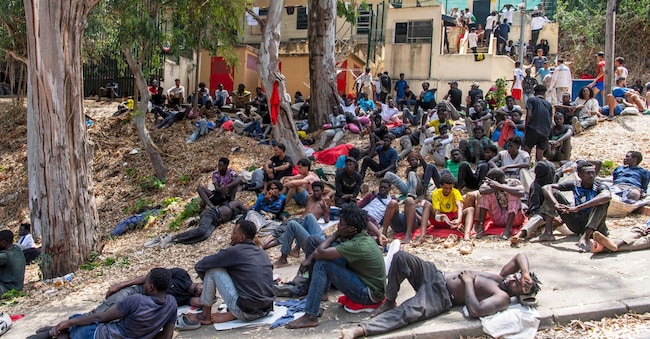
Alcuni migranti si riposano fuori dal Centro temporaneo per immigrati (CETI) dopo aver attraversato il confine dal Marocco all’enclave spagnola di Ceuta, venerdì 31 luglio 2026. CETI è l’acronimo spagnolo di centro di accoglienza per migranti. (AP Photo/Antonio Sempere)


Associate Press/ LaPresse
Only Italy and Spain APN

3' min read

Translated by AI
Versione italiana

3' min read

Translated by AI
Versione italiana

The Schengen Agreement, signed in 1985, establishes an area of free movement without internal border controls. To date, the Schengen Area covers an area of 4 million square kilometres and is home to more than 450 million people. Twenty-nine countries have acceded to the agreements: all EU Member States except Ireland and Cyprus, as well as Iceland, Liechtenstein, Norway and Switzerland. The Agreement provides that, in exceptional cases, Member States may temporarily reintroduce border controls, in whole or in part, at their internal borders.

How the suspension works 

Loading...

Under the agreement, the reintroduction of border controls is a measure that must be adopted as a last resort, in the event of a serious threat to public order or internal security. Although the decision rests with individual Member States, the European Commission may, in certain cases, have a say on the necessity and proportionality of the measure.

In the event of unforeseeable circumstances, a Member State may immediately reintroduce border controls without prior notice for a period of one month (which may not be extended beyond three months). However, the other Member States, the European Parliament, the Council and the European Commission must be informed.

In foreseeable circumstances, however, the duration of the reintroduction of border controls is limited to six months, and may be extended to a maximum of three years in exceptional circumstances.

The case of Ceuta and Melilla

The Schengen Borders Code lays down specific rules for Ceuta and Melilla, as these two enclaves constitute the only land border between the European Union and Africa.

In particular, Spain must ‘maintain controls on domestic flights and regular ferry services departing from the cities of Ceuta and Melilla to a destination in another State party to the Convention’. Consequently, anyone travelling from these two cities to mainland Spain must present their identity documents when leaving the two territories.

Indeed, during the ongoing migration crisis, senior EU officials have given assurances that those who have entered Ceuta illegally will not be able to reach Spain, let alone other EU Member States. Furthermore, Morocco is on the list of safe countries of origin (for Spain), thereby facilitating return procedures should the need arise.

Almost 500 times

Loading...

Since 2006, border controls have been reintroduced on nearly 500 occasions, often in response to international crises that posed a risk to the countries’ internal security.

For example, during the pandemic, between 2020 and 2022, several EU countries decided to reintroduce internal border controls. Similarly, between 2025 and 2026, Slovenia and Poland temporarily reintroduced controls at their borders due to ‘persistent migratory pressures’ and ‘hybrid threats’ from Russia and Belarus.

Checks have now been reinstated in several areas

Since mid-June, border controls between Austria and Italia and certain countries in Central Europe and the Balkans have been reintroduced.

Austria took this decision due to the ‘ongoing threats to internal security’ arising from irregular migration along the Balkan routes, the strain on reception systems, the Russian invasion of Ukraine and the war in the Middle East. Border controls will therefore remain in place until 15 September along land and river borders with Slovakia and land borders with the Czech Republic, Hungary and Slovenia.

Italia did the same with Slovenia, until 18 December, for similar reasons and citing the emergency situation caused by ‘a significant presence of criminal networks involved in smuggling and human trafficking’.

Germany, too, for similar reasons, has reintroduced land borders from 16 March until 15 September with France, Luxembourg, Belgium, the Netherlands, Denmark, Austria, Switzerland, the Czech Republic and Poland.

The Netherlands has reintroduced land border controls with Belgium and Germany, as well as intra-Schengen air border controls, from 9 June to 30 September, citing reasons such as irregular migration and the strain on the migration system. Poland did the same on 5 April, with regard to its borders with Germany and Lithuania, until 1 October.

Norway has reinstated border controls from 12 May until 11 November due to ‘the general threat to the energy sector and threats of sabotage by the Russian secret services’.

On 12 May, Sweden reintroduced all internal borders and its land borders with Denmark until 11 November, citing threats posed by ‘cross-border organised crime and other criminal activities’, with reference to violent Islamist groups and individuals.

France has reintroduced border controls with Belgium, Germany, Luxembourg, Switzerland, Spain and Italia, from 1 May to 31 October, for various reasons, including ‘jihadist threats’, ‘a rise in anti-Semitic attacks’ and the G7 summit in Evian.

Copyright reserved ©
Loading...

Brand connect

Loading...

Newsletter

Notizie e approfondimenti sugli avvenimenti politici, economici e finanziari.

Iscriviti