
CGIL general strike on 20 November: who is taking part and who isn’t, essential services and marches across Italia
The strike affects everything from schools to universities, public administrations, the health service and local public transport. The Guarantee Commission has exempted air and rail transport, as well as several local public transport operators (ATM in Milan, GTT in Turin, EAV and ANM in Naples). The Cobas are also downing tools.

Key points
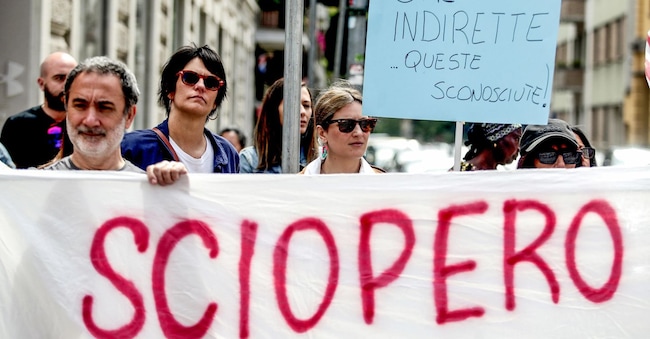
In protest against the Meloni government’s budget measures, a general strike organised by the CGIL is scheduled for Friday 20 November, with workers in both the public and private sectors abstaining from work for the entire working day (in accordance with the guaranteed service periods during which essential services will be maintained), and marches taking place in around a hundred Italian cities. The strike will affect schools, universities, public administrations, the health service and local public transport. The Guarantee Commission has decided to exclude air transport, rail transport and several local public transport operators (ATM in Milan, GTT in Turin, EAV and ANM in Naples), but the decision is the subject of a standoff with the CGIL and the sectoral trade union FILT, which have announced they will appeal. Cobas and Unicobas have also called a general strike on 20 November, with demonstrations across Italia (excluding passenger transport).
Exclusions decided by the Guarantee Commission
The Commission for the Guarantee of the Right to Strike has ruled that the entire air and rail transport sector, as well as rail freight transport, are excluded from the general strike; in the telecommunications sector, companies in the CRM/BPO sector (contact centres, customer service, telemarketing, back-office and digital support services provided on behalf of major clients). In the local public transport sector, GTT (Turin), ATM (Milan), EAV and ANL (Naples), as well as SAD (Bolzano), Trentino Trasporti (Trento), Ferrovie Udine Cividale (Udine), Sistemi Territoriali (Rovigo), Trasporto Ferroviario Toscano (Arezzo), Ferrovia Adriatico Sangritana (Abruzzo), Ferrovie del Gargano (Foggia), Ferrovie della Calabria (Catanzaro and Cosenza), Ferrotramviaria (Bari, Taranto, Lecce) and Atvo (Venice). Exclusions also apply in the environmental sanitation sector: the companies DM Service S.r.l. (Municipality of Marigliano – NA), DM Technology S.r.l. (Municipality of Vitulazio – CE) and Econova s.r.l. (Municipality of Meta di Sorrento – NA).
The Guarantee Commission’s guidelines on exemptions from the strike apply to passenger transport companies that operate both rail and inter-urban road transport services, such as Trenord, Fnm Spa, Fnm Autoservizià Spa and Eav, as they are ‘already covered by the CUB-SGB strike called for 21 November’.
In the Regions and Local Authorities, the following organisations are excluded: Paolo Scoppio Autolinee (Municipality of Rome and Local Health Authority No. 1) and those providing specialist school transport services for the Municipality of Naples. Within the National Health Service, the Brotzu Hospital Trust in Cagliari is excluded. Exemptions for the organisation of election rallies also apply in the municipalities of Chieti, Calvi Risorta (CE) and Stefanaconi (VV).
The impact of the transport strike
Although rail transport has been excluded by the Guarantee Commission from the sectors affected by the CGIL strike, it remains at risk from this evening, as from 9.00 pm on Friday 20 (until 8.00 pm on Saturday 21 November), the strike called by the Assemblea Nazionale PDM/PDB Gruppo FSI and CUB Trasporti will come into effect.


