
Challenge senior living, the paradigm of living in the age of longevity
Flats for the elderly for rent within a residential complex: the model that opens up new market perspectives lands in the Milan area

Increasingly numerous, increasingly long-lived. Italia is one of the oldest countries in the world and the ageing process of the population shows no signs of slowing down. Today the over-65s make up more than 24% of the population, but according to ISTAT by 2050 they could approach 35%, while the over-85s will rise from 4% to more than 7%. A structural change that also affects the population's lifestyle. In fact, the proportion of elderly people living alone is increasing, thanks to labour mobility that is driving children and parents away, redrawing family geographies. In this context, models such as senior living (or housing) are beginning to appear on the market, ready to respond to new social and housing needs.
Despite the excellent fundamentals on which it could stand, this residential format in Italia is still at an embryonic stage. The answer to "why?" - according to sector experts - is cultural. Italia is historically a country of owners. The generations that are now over 65 own the house they live in and remain deeply attached to the idea of home ownership throughout their lives. Even though labour mobility has increased in recent years, when their children remain in their place of origin, the tradition of staying close to them persists.
The development of Milan 3.0
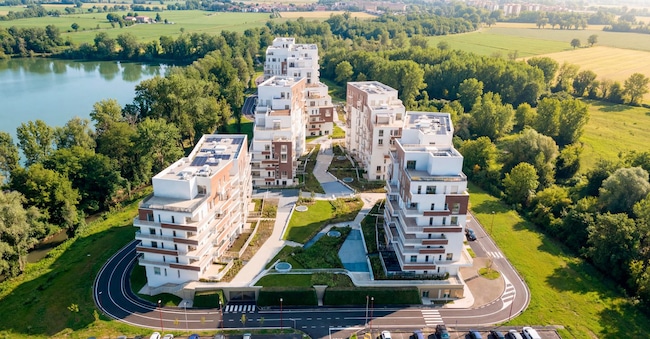
Nevertheless, on the Italia market operators are taking their first steps. Speaking of independent senior living, the new residential complex near Milan 3 marketed by Dils and owned by Fondo Aristotele Senior, managed by Fabrica Immobiliare Sgr, is almost ready to hit the market - starting this spring. These are two of the buildings that are part of the larger new construction project Milano 3.0 - Next Generation Living realised by Fondo HighGarden, managed by Dea Capital Real Estate sgr. The buildings include 87 flats of different types (studios, one-, two- and three-room flats) to be rented out to over-65s.
This is not an RSA within a residential complex, but flats dedicated to a still active, autonomous and often still working population. The project includes multifunctional rooms and equipped terraces, designed to encourage socialisation, all managed by a dedicated community manager. The flats will be delivered already semi-furnished with kitchens and without canteen or medical centres. "However, there will be dedicated services that residents can access to meet their needs. It will also be possible to practice wellness and sports activities, thanks to a sports centre in the area," explain Dils. The project is unique in Italia, where the market is still oriented towards models similar to RSAs.
Models on the market
In Anglo-Saxon and Nordic countries - especially in the United States - the sector instead has a more defined identity: we speak of independent living, facilities for autonomous seniors who do not require continuous medical assistance. In Italia, on the contrary, the perimeter is still unclear and often confused between Rsa, senior housing and hybrid formulas. The former represent the more structured healthcare segment; senior living, on the other hand, is aimed at self-sufficient elderly persons looking for solutions combining independence, services and sociability. If the word housing recalls mainly a community dimension, senior living is declined in independent flats, set in organised contexts as in the case of Milan 3. A substantial difference, marking the boundary between assistance and lifestyle.
Brand connect


Newsletter RealEstate+
La newsletter premium dedicata al mondo del mercato immobiliare con inchieste esclusive, notizie, analisi ed approfondimenti
Abbonati