
Artificial intelligence, the challenge is to develop the right skills
On the second day of the Milan summit, a discussion on cultural and organisational changes in business and training

3' min read
3' min read
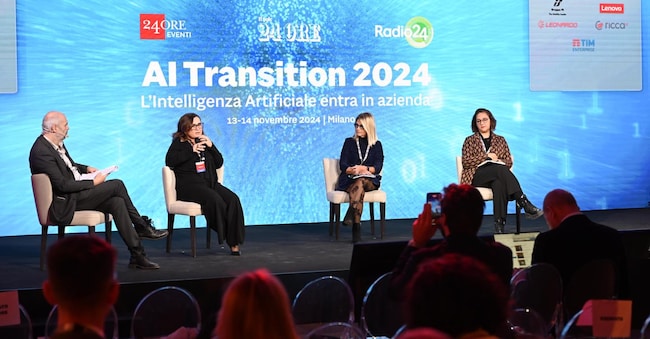
It is no longer in dispute that artificial intelligence will change, and substantially so, many of a company's processes. From human resources management to customer service activities via production lines, all business functions and operations will be impacted by the work of algorithms and increasingly enhanced data analysis capabilities. The challenge facing entrepreneurs and managers is therefore played out on two levels: one of a technological nature for the integration of AI into the company's nervous system, and the other, perhaps even more complex, of a cultural and organisational nature for the development of the skills required to drive this transformation. These issues were discussed on the second day of the AI Transition 2024 event organised by Il Sole 24 Ore, and Mauro Palmarini, director of Sopra Steria Next, recalled how at the basis of an approach to innovation today there are a number of indispensable factors. First and foremost, an understanding of the returns and benefits associated with the use of new technologies and the ability to overcome the difficulties inherent in transforming "proof of concept" into use cases of their own.
Another fundamental point, not surprisingly, is the centrality of the people who will use these tools. On the same wavelength was Marco Gay, executive chairman of Zest and of the Unione Industriali di Torino, who pointed out the widespread awareness of the possible applications of AI in the industrial sphere, which is why we need laboratories capable of bringing innovation to the districts and supply chains: 'It is essential to understand how new-generation technologies can bring efficiency inside companies and increase their competitiveness. We are facing a very strong revolution that, in order to create real value, needs to bring together the skills of start-ups and the ecosystem of companies and the players of open innovation. Ai is not a parenthesis but a trajectory along which the development of our entire industry is being played out'. There is therefore a need for innovation processes to no longer be merely occasional but systemic and more easily engineered, as observed by Daniele Pes, Head of Innovation at FS Group, and that, as Silvia Zancarli, Business Development & Innovation senior manager at Eit Manufacturing, admonished, the Ai-led transformation verb should also be embraced by SMEs, which are the preponderant component of the industrial structure. Inside companies, in any case, and especially where there is enough data and quality It infrastructures, Ai and Gen AI are starting to find fertile ground, entering production processes to reduce the most repetitive activities and to help operators to better manage their operations, to make predictive analyses or to design products. "We are only at the beginning," said Andrea Bianchi, president of Anie Automazione, with conviction, "but there is awareness of the great potential of this technology. What must certainly not be lacking are skills. Mariapia Pedeferri, the Rector's Delegate for Innovation and Professor of Materials Science and Technology at the Politecnico di Milano, explained how in education "Ai is transversal to all courses and should be considered as a tool that can be applied anywhere, even for training, adding as a facilitator to traditional skills and becoming an integral part of the individual's knowledge base".
Equally decisive will be ensuring equitable and sustainable access to technological tools to change learning modes and validate the usefulness and relevance of technology. However, there is no doubt, as confirmed by Susanna Sancassani, head of the Metid Centre, and Dianora Bardi, president of the ImparaDigitale Study Centre, that the application of generative AI to education can improve, speed up and better contextualise the training process with respect to the characteristics of the individual person. Those working in the world of education generally share a common thought: change will be radical and continuous learning is the key to ensuring the evolution of skills in the world of work.

