
Chamber, from the platform for legislative texts to the chatbox on MPs' activities: AI for MPs and citizens arrives
Three projects were awarded at a ceremony in Montecitorio by President Lorenzo Fontana and Vice-President Anna Ascani, who heads the Supervisory Committee on Documentation, the body that carried out a survey on AI in parliamentary activity, and promoted the competition in which 28 projects from various universities and research centres took part
by Redazione Roma
 Aggiungi Il Sole 24 Ore
ai preferiti su Google
3' min read
Key points
3' min read
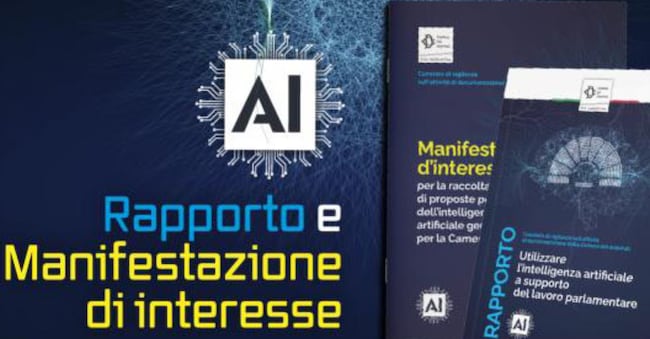
Generative Artificial Intelligence enters the Chamber, with three projects designed to support the offices of Montecitorio, MPs and citizens who want to know about the activities of their representatives. The projects were awarded at a ceremony in Montecitorio by President Lorenzo Fontana and Vice-President Anna Ascani, who heads the Supervisory Committee on Documentation Activity, the body that carried out an investigation into AI in parliamentary activity, and promoted the competition in which 28 projects from various universities and research centres participated.
The three award-winning projects
.The first award-winning project, called Legislab, was developed by the Milan Polytechnic and the Einaudi Institute. Aimed at the offices of the Chamber of Deputies, it is a platform for the analysis of Italian legislation to support the drafting of new laws. Intended for parliamentarians is the GenAI4Lex project, developed by a consortium of universities (Alma Mater, Luiss, CNR, University of Turin). It aims to support the 'drafting' of legislative texts, the analysis of amendments and regulatory references, and the 'compliance' of the text with respect to the legislative framework. The third prize-winning project, DepuChat, developed by the Universities of Rome 3 and Florence, is instead aimed at citizens. It is a chatbot that uses generative intelligence to probe data and information stored on the Chamber's websites to provide users with answers to questions on the activities of their representatives in Parliament.
Fontana: happy for high response to expression of interest in Chamber projects
"We are very happy with the response, which has been very positive, both in terms of participation and the quality of the proposals submitted," said the President of the Chamber of Deputies, Lorenzo Fontana, speaking at Montecitorio at the award ceremony for the winning projects of the expression of interest in the use of generative artificial intelligence. 'For several years now,' he recalled, 'the Chamber has been using applications such as the transcription system for speeches, the basic sorting of amendment proposals, basic translation into foreign languages, unassisted subtitling of parliamentary speeches, automated classification of parliamentary acts, and also support for IT security systems. The advent of these models, in particular of the generative type, has made it necessary to explore the prospects for using these tools'. The experience conducted by the Chamber in the field of AI 'will be presented at the G7 of Parliaments,' Fontana added, 'scheduled to take place in Verona from 5 to 7 September. It testifies to our constant commitment to innovation and the improvement of our institutions. The integration of artificial intelligence in the institutional context offers significant opportunities in terms of efficiency, it can optimise document processing, support individual MPs in their activities, and make this mass of data easily and comprehensively accessible to citizens'.
Risks not to be underestimated
Mr Fontana concluded by pointing out: 'But we cannot ignore the risks that this system brings. The results of any automated system cannot escape careful review by operators with the appropriate skills. The human component must be preserved in all operational and decision-making processes, not least to avoid criticalities in the interpretation and production of data. It is essential that the future horizons of artificial intelligence express an idea of development that is nevertheless based on the centrality of the human being. In this way, everyone will benefit from the advantages of unprecedented innovations'.
Ascani: protecting the centrality of the person
These concepts were reiterated by Anna Ascani. 'Even in the face of an epoch-making revolution, such as the one represented by artificial intelligence,' said the Vice-President of the Chamber of Deputies, 'at the centre there is, and must always be, the person. With his rights, his talents, his frailties. But above all with its capacity to decide. Because it is in this capacity that human 'specificity' resides. And, at the same time, the hope for everyone's future. The core of this reflection, the call to responsibility as decision-makers, the need for an anthropocentric approach have been hallmarks of our action: to ensure that the easy accessibility to knowledge that AI generates is not a blunder, a democratic hallucination. And to act so that it is clear to everyone that no innovation is neutral and that, without solid responsible leadership and structured regulation, there is a real risk of remaining subservient to oligarchies interested only in profit and power'.

