
Chanel’s technical and sartorial innovation on the catwalk

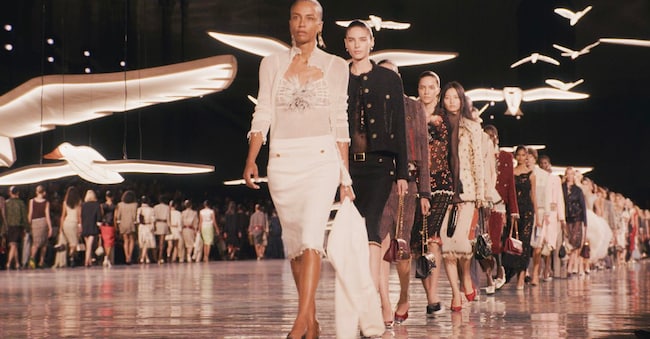
Diversity: this is the current theme in fashion, reflecting a more general fragmentation of identities. We are all complex, never just one but many: why should a designer or a fashion house limit themselves to dressing a single figure, an absolute ideal, when they can conceive of multitudes? Together with Michael Rider of Celine, Matthieu Blazy is at the origin of this shift. The work he is doing at Chanel has sent a global shockwave that has reshaped the system. The effects can be seen everywhere. Blazy’s journey is still unfolding – it began just a year ago – but in some ways it has already become a formula, kept alive by small internal disruptions. Now, for example, this multiplicity reflects the different personas Gabrielle Chanel embodied throughout her life: from the woman obsessed with the practicality of lingerie to the enthusiast of menswear tailoring to the champion of the suit. The narrative device certainly works, and is underpinned by extraordinary technical and sartorial craftsmanship, but the real message is that it is perfectly acceptable to be different each time whilst remaining true to oneself. Blazy divides the show into sections, in a manner that is, all things considered, rather didactic, but he redeems himself through the sheer amount of inventiveness he infuses throughout – and above all because, at a certain point, he begins to lighten, to strip back, to dematerialise. That is where he truly soars, whilst bringing the joy of dressing up – and of playing with clothes – back to the forefront: something that far too many of his colleagues have forgotten.
By a perfect twist of fate, this very day of fashion shows is a showcase for feminine visions: women creating for women, with all the practicality that entails – just as it was for Gabrielle Chanel, in fact. A practicality that is never oppressive or vulgar, let’s be clear; rather, it is inspired, multifaceted and liberating. At Sacai, Chitose Abe brings the complexities of the inner world to the surface. She does so quite literally: sheer jackets and coats fully reveal the various layers of their internal structures; fur linings become prints glimpsed beneath layers of organza. She does so metaphorically, too: the hybrid – Sacai’s hallmark – becomes a sculptural subversion, a twist that rewrites forms and functions, so that shirts transform into skirts, with collars running along the hem or forming a peplum; the military safari jacket, meanwhile, becomes a mermaid skirt, crafted from satin. Nothing we’ve ever seen before, of course. What makes the difference is Abe’s touch: architectural, understated, never over-the-top. This time, moreover, there is a decisive shift towards bling and ornamentation, which is welcome as it softens the aesthetic, cloaking it in sparkling complexity.
Gabriela Hearst turns her gaze to Afghanistan – as much a destination on the hippie trail as it is a treasure trove of culture and craftsmanship – reflecting above all on the status of women in the country, which was once pioneeringly progressive but is now overshadowed by rampant ignorance. Hers is not mere storytelling, nor is it aesthetic plagiarism. True to the language of hyper-luxurious minimalism, Hearst incorporates fragments and materials – from lace to miniatures – into fluid, elongated silhouettes, lending the minimalist allure a welcome tactile quality. Everything floats at Zimmermann, the Australian brand founded by sisters Nicky and Simone Zimmermann. It floats so much that the collection veers off in all directions, from hippie lace to panier skirts to fluid abstractions. It is where the touch is lightest that the collection truly shines, even if it is undoubtedly the lace and the Chloé-esque feel that ultimately cause a sensation in the shops. Yet, after years of coherent and consistent designs, there is a sense that an evolution is needed.
Behind Kiko Kostadinov’s womenswear collection lie sisters Laura and Deanna Fanning, who skilfully translate Kiko’s dystopian futurism – his penchant for uniforms and workwear – into a collection that retains that spirit, as well as the angular, geometric cuts, but softens it, moulding it to the body and feminine grace. The result is an unconventional elegance, which this season draws inspiration from Nanda Vigo’s work with light and which, imbued with a sense of restrained eroticism, proves particularly successful.

