
Change the system before questioning the decisions of individuals

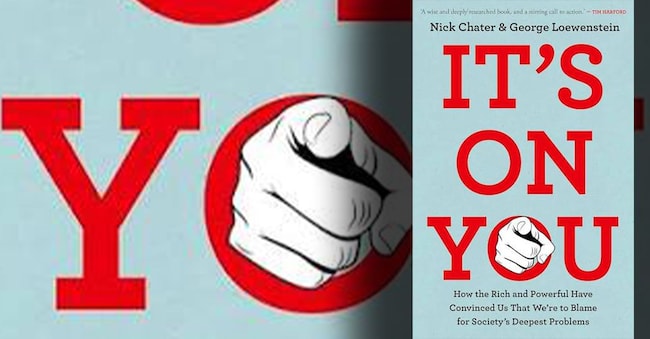
For a long time, we believed that freedom was synonymous with the ability to choose. What to eat, how to save money, how much to consume, what lifestyle to adopt. And then we ended up believing the opposite as well: if something goes wrong – if our bodies fall ill, if the planet overheats, if the future becomes more precarious – there must have been a bad choice made somewhere. A bad choice on our part. But this is nothing more than one of the great moral narratives of our time: the one that transforms collective problems into individual faults.
*It’s on You* by Nick Chater and George Loewenstein analyses precisely this blind spot in contemporary culture, and does so with authority. The two authors are by no means outsiders. Chater is a professor of behavioural science at Warwick Business School, whilst Loewenstein is an economist and psychologist at Carnegie Mellon. Both belong to that intellectual world which, in recent decades, has helped to correct the image of the perfectly rational individual on which economic theory has long been based. This is not a pamphlet against behavioural economics, but rather an examination of conscience conducted from within.
At the heart of their analysis lies an idea so familiar that it is almost invisible: the tendency to view collective problems as the sum of private choices. The authors call this the ‘i-frame’ (individual frame). We encounter it everywhere: in health campaigns, in discussions about saving money, in environmental rhetoric, and in the language of psychological wellbeing. Is the planet getting warmer? We should consume more wisely. Are we overweight? We should eat more healthily. Are we not saving enough? We should plan better. In short: the problem is you. The authors contrast this frame with the ‘s-frame’ (system frame). The idea is that what we observe depends above all on the rules of the game, on incentives, on institutions, on markets, and on the environments within which we make our choices. The implication is clear: very often we need to change the game, rather than merely correcting the players.
To grasp the significance of this message, we need to understand what a ‘nudge’ is – a term that is often mentioned but rarely explained. A ‘gentle nudge’ is a small intervention in the design of choices that guides behaviour without imposing obligations or restrictions: placing a button in a certain spot on the screen, reminding someone of a deadline at the right moment, or positioning healthier foods where they are more likely to be noticed. The idea, made famous by Thaler and Sunstein, is that distracted or impulsive individuals can be helped to make better decisions through minor changes to their environment. Chater and Loewenstein know this world well; they met whilst working with the British government’s Nudge Unit, set up by the then Prime Minister David Cameron, and it was there that they developed a growing scepticism. They do not claim that nudges are useless. Rather, they argue that their prestige has been disproportionate to their results and, above all, that their popularity has reinforced a worldview in which the system disappears and only the individual’s responsibility remains visible. The most telling example is that of the carbon footprint, the spread of which is linked to British Petroleum’s (BP) communications. In the corporation’s communications, the climate issue – rather than appearing first and foremost as a problem of energy infrastructure, public regulation and industrial interests – is recodified as the sum of individual habits. We take showers that are too long, we eat too much meat, we fly too much. It is not that these choices are irrelevant. It is simply that, when isolated from their systemic context, they become a perfect moral distraction.
Here, the book touches on a philosophically crucial point. Responsibility does not consist merely in asking individuals to do the right thing, but in building institutions that do not systematically make it difficult, costly or futile to do so. Implicit in this is an age-old lesson from political philosophy: freedom is not an abstract capacity to choose, but a quality of the conditions within which that choice takes shape. If the labour market rewards precariousness, if the ecological transition remains subordinate to the interests of the fossil fuel industry, if the food environment is designed to induce compulsive consumption, then the call for individual responsibility risks becoming an elegant way of avoiding any mention of power relations. An individual solution is reassuring, non-confrontational, even comforting. A systemic solution involves taxes, regulations, public investment, redistribution and democratic dissent. It demands that those in power assume their responsibilities.


