AI for Social

'Sportellino', the chatbot that simplifies bureaucracy for asylum seekers

Available on WhatsApp and Telegram and designed by Viktor Seibert, the service offers clear and up-to-date answers on asylum, permits and rights, helping to navigate the complex Italian bureaucracy


by Angelica Migliorisi

4' min read

4' min read

A new digital ally promises to revolutionise the lives of people fleeing war, poverty or persecution. It is called "Sportellino", an intelligent chatbot on WhatsApp and Telegram that explains to asylum seekers how to untangle permits, health, documents and rights. Free, anonymous and up-to-date, it could turn a daily nightmare into a finally understandable path.

A digital guide for those arriving in Italy

.

Conceived by social entrepreneur Viktor Seibert, 32, 'Sportellino' was developed after years of experience in the field, in close contact with those who are often trapped between incomplete information, closed counters or insufficient staff. "During my voluntary work in Rome, talking to asylum seekers, I realised how difficult it was to navigate the Italian bureaucracy. Important questions on how to apply for asylum, obtain a residence permit or access the health system were often answered only with great difficulty and not always correctly or up-to-date. Many rely on word of mouth among friends, an approach that can easily lead to misunderstandings. Online information, even if published by well-known organisations, often does not reflect reality. Language barriers, then, make everything even more complicated: even understanding where to go or what documents are needed can become a huge obstacle,' Seibert explains.

Loading...

Hence the idea of Sportellino, a chatbotactive 24 hours a day that answers questions about bureaucratic procedures in a clear and personalised way, in several languages. It is available on the apps most used by asylum seekers, WhatsApp and Telegram, to reach even those with cheap phones or slow connections. And it does so without asking for registrations or personal data: use is completely anonymous, in line with the General Data Protection Regulation (GDPR) and without advertising.

Seibert again: 'We protect users' privacy in a concrete way through well-defined technical and organisational measures. Although "Sportellino" runs on WhatsApp and therefore the phone number is automatically recorded for technical reasons, we do not use it to identify, track or profile users.We do not collect any other personal information and we never ask for sensitive data. We have consciously chosen to base our chatbot on an LLM model developed by Mistral, a European company with some of the highest privacy standards in the industry. In addition, our server is located in Frankfurt, within the European Union, and all data is processed in full compliance with the GDPR'.

L’infografica

A living database, built with people working in the field

.

The strength of 'Sportellino', however, lies not only in artificial intelligence, but in the quality of the data it is trained on. In fact, the team built a knowledge base from official regulations, but enriched it with practical information collected by cultural mediators, social workers and operators of asylum seekers' counters. "The main problem is that even the most reliable sources often publish outdated or incomplete information," says Seibert, "so we check each piece of information several times before entering it.
The result is a system capable of explaining how to apply for asylum, renew a residence permit, register with the health service, understand one's rights at work, register at the registry office or find a language course. Not only that."Sportellino" also indicates average times, necessary documents and useful addresses, allowing those who use it to better prepare for appointments.

But there is one point on which the social entrepreneur wants to shed some light: 'Especially for sensitive and important questions (but actually also in general),it is always advisable to check the answers of chatbots also through other sources, whether it is a generic assistant like ChatGPT, Gemini or Claude, or a specialised one like "Sportellino".

AI complementing, not replacing, human support

"Sportellino" is designed as a first level of orientation, answering the most frequently asked questions and helping people understand what steps to take, freeing up valuable time for the human operators, who can then concentrate on the more complex and urgent cases. "We do not want to replace people," Seibert points out, "but to give a tool that lightens the work of the operators and makes life easier for those who have just arrived.

The chatbot is also planned to evolve:in the future it will also support offline use for those living in areas with unstable connectivity and voice communication for those who cannot write or read well. All while maintaining the basic promise: a free, anonymous, ad-free service accessible in multiple languages.

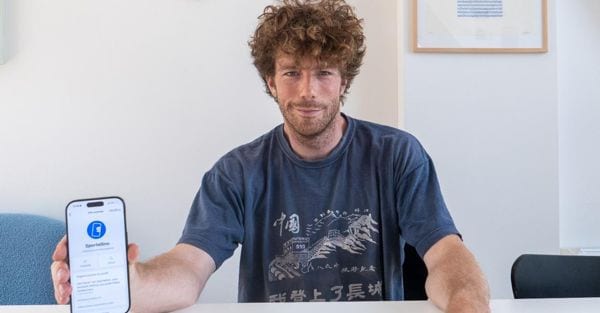
Viktor Seibert, 32 anni, fondatore di “Sportellino”

A non-profit project looking to the future

.

"Sportellino" is a non-profit project, born thanks to private donations, but now seeking public and European funds such as those from the National Recovery and Resilience Plan (PNRR) and the Asylum, Migration and Integration Fund (the European Union's financial instrument created to support member states in the management of migration flows, to foster the integration of third-country nationals and to strengthen the common asylum system). The aim is to expand the functionalities, constantly update the database and reach more and more people.

For now, 'Sportellino' represents a model of digital inclusion that can be replicated in other European countries, a tool that uses technology to bridge a real and often underestimated gap, that of access to information. At a time when artificial intelligence is often associated with profits and driven automation, this chatbot shows how AI can become an ally for rights, inclusion and dignity.

"One moment has particularly stuck with us: a few weeks ago we presented the prototype in a house shared by asylum seekers in the Esquilino district of Rome. Seeing the enthusiasm and surprise of the people as they tested the test version for the first time was really touching. In particular, many were struck by the fact that 'Sportellino' could answer in Arabic, explaining with simplicity how to prepare for important appointments and where to find free support in their area. It was a moment that made us realise, in a very concrete way, the potential of such a tool. That said, we are still at the beginning (300 users, ed.). Our goal is to make 'Sportellino' even more useful, intelligent and close to people's real needs,' Seibert concludes.

Copyright reserved ©
Loading...

Brand connect

Loading...

Newsletter

Notizie e approfondimenti sugli avvenimenti politici, economici e finanziari.

Iscriviti