Artificial Intelligence

Chatgpt, the new model: talk to us, even for free

No search engine but a new AI model, Gtp 4o and the desktop version of ChatGpt
by Alessandro Longo

4' min read

4' min read

Talk to ChatGpt in real time, fluidly - and a voice that in English is somewhat eerily reminiscent of the seductive voice of the AI in the film Her.

There is this and more in the announcement made today by OpenAi: a new AI model, Gtp 4o and the desktop version of ChatGpt.

Loading...

Plus the promise, hinted at at the beginning of the event, to make the new model available to everyone, including free users, in the coming weeks, as Chief Technology Officer Mira Murati said in the livestreamed event.

"A very important part of our mission is to be able to make our advanced AI tools available for free to everyone. We think it is very important that people understand what technology can do," he said.

He added that the new model, GPT-4o, is 'much faster', with improved text, video and audio capabilities.

O stands for omni: it accepts any combination of text, audio and image as input and generates any combination of text, audio and image as output. It can respond to audio input in as little as 232 milliseconds, with an average of 320 milliseconds, a time similar to the human response time (opens in a new window) in a conversation.

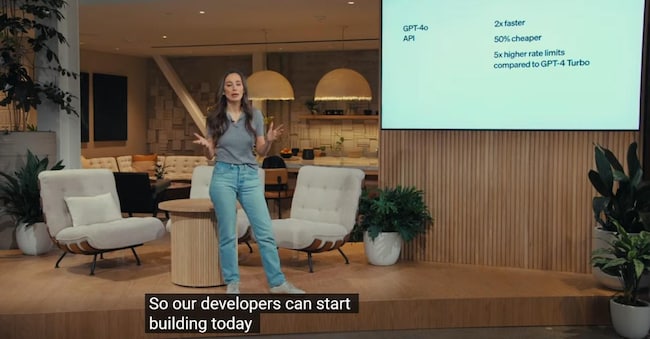
Compared to its predecessor, 4.0 Turbo, it is twice as fast, costs half as much at OpenAI due to the efficiencies achieved (and this will allow prices to be lowered and some functions to be extended to free users) and has five times higher frequency limits (a parameter indicating how often users can make requests to the model, for example, to generate text, analyse data or interact in other ways).

A very useful parameter for developers and companies using the OpenAI API: they can now make more requests in less time, improving efficiency and allowing more intensive use of artificial intelligence in their applications without quickly reaching usage limits that could slow down or interrupt their services.

The new template has also improved the quality and speed of ChatGpt for 50 different languages and will also be available via the OpenAI API, so developers can start building applications using the new template today, Murati said.

A real-time translation from English into Italian was also shown, which Murati seemed to be able to speak. The artificial voice in our language is much less natural than in English, but it worked.

Real-time interaction with Chatgpt, by voice and video, actually strikes the imagination. It happens naturally and one can only realise that one is talking to an AI at certain moments (in the transition between questions, where the bot suddenly stops). The AI, in an example shown in the live broadcast, realised that the user was too emotional (he was breathing fast) and helped him to calm down, with some advice, offered in a warm and persuasive voice, in the manner of a coach. Mark Chen, researcher at OpenAI, said that the model is able to 'sense your emotions'. The team also asked him to analyse a user's facial expression and comment on the emotions the person might be feeling. He realised that he was smiling and deduced that he was happy at that moment.

It should be remembered that this branch of AI - emotion recognition - is much criticised among civil rights activists for possible dangerous uses (e.g. during interrogations, in the workplace or for mass surveillance).

However, Murati reiterated his commitment to work with government agencies and other institutions to ensure the safe and ethical use of his AI.

Chen demonstrated the model's ability to tell a bedtime story and asked him to change the tone of his voice to make it more dramatic or robotic. Or even made him sing it, quite naturally.

The model's ability to solve mathematical equations was also seen, with a step-by-step voice guide useful for students to write code (competing with Microsoft's GitHub Copilot).

Chatgpt could read, in real time, the equation written by the user by hand on a notebook and follow him through the operations as they were written on the paper.

Murata explained that in the new 4o model, the multimodal AI functions have been natively integrated, which is why everything feels smoother and more natural.

"This is the first time we are taking a big step forward in terms of user-friendliness. This is incredibly important because we are looking at the future of interaction between us and machines. We think Gpt-4o is really shifting the paradigm towards the future of collaboration,' Murata explains.

Prior to today's launch of the GPT-4o, conflicting rumours had anticipated that OpenAI would announce an AI search engine capable of competing with Google and Perplexity, a voice assistant integrated into the GPT-4 or a completely new and improved model, the GPT-5.

None of this has been forthcoming, but it has not gone unnoticed that OpenAI has decided to anticipate this launch ahead of Google I/O on 14 May, the tech giant's flagship conference, where we expect to see the launch of various Gemini artificial intelligence-related products.

Copyright reserved ©

Brand connect

Loading...

Newsletter

Notizie e approfondimenti sugli avvenimenti politici, economici e finanziari.

Iscriviti