Digital Economy

ChatGPT Sol takes on Claude Fable 5. The new battle isn’t about chatbots but about the cost of digital labour

Following the race to develop the most powerful models, OpenAI and Anthropic are changing their strategy: platforms, agents and business services are becoming the real battleground. The winner will be whoever generates the most value per euro spent, not whoever provides the best answer to a question.

3' min read

Translated by AI
Versione italiana

3' min read

Translated by AI
Versione italiana

Following the race to develop the most powerful models, OpenAI and Anthropic are changing their strategy: platforms, agents and business services are becoming the real battleground. The winner is whoever generates the most value per euro spent, not whoever provides the best answer to a question.

For two years, competition in artificial intelligence has been a horse race. Every few months, a model more powerful than the previous one would emerge. Today, the race seems to have changed. The question is no longer which chatbot writes the best text, but which system can replace some human labour at the lowest cost.

Loading...

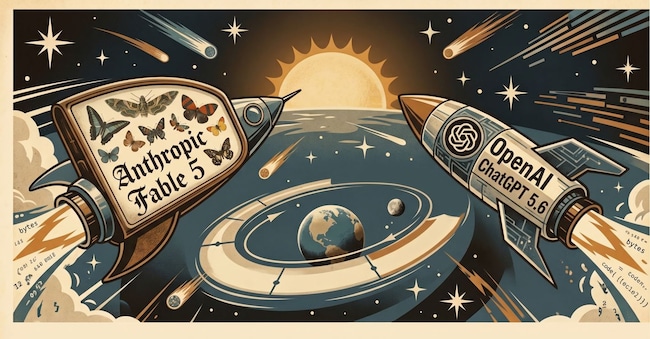
On the one hand, there is ChatGPT Sol, OpenAI’s flagship model. On the other, Claude Fable 5, Anthropic’s response. Both promise to function as autonomous assistants: they read documents, write code, analyse data, use tools and carry out complex tasks. But they follow different strategies.

Sol’s key strength is its ecosystem. OpenAI is transforming ChatGPT into a platform that integrates search, writing, programming and software agents. The aim is to keep users and businesses within a single working environment. The model becomes the driving force behind a productivity suite. It is the same evolution that transformed the browser into an operating system.

Anthropic, on the other hand, focuses on the quality of professional work. Claude Fable 5 has been designed primarily for developers, researchers and businesses that require autonomy on long-term projects. The model intervenes less frequently to seek confirmation and maintains a good flow of reasoning. This is a feature that is highly valued in software development and the analysis of large document repositories.

The difference is also evident in the prices. Sol costs $5 per million tokens for incoming transactions and $30 for outgoing ones. Fable 5 charges $10 and $50 respectively. For a company that processes hundreds of millions of tokens every month, the difference becomes significant. A project that costs around $1,100 with Sol can exceed $2,000 with Claude. The price, however, tells only part of the story. If one model completes a task on the first attempt whilst another requires more human intervention, the final cost can be completely different.

Both have their weaknesses. OpenAI is paying the price for the growing complexity of its offering. With its range of models, operating modes and tools, the platform risks losing the simplicity that had been the key to its initial success. Anthropic, on the other hand, has been criticised for overly strict security filters, particularly in areas such as cyber security and scientific research, where some users have complained about a lack of transparency regarding these restrictions.

The most interesting change, however, concerns the business model. The first era of artificial intelligence was based on premium subscriptions and APIs sold to developers. Today, the focus is shifting towards services for businesses. OpenAI is complementing its licences with consultancy teams to help integrate the agents into business processes. Anthropic is strengthening its presence in the major cloud platforms and offering pay-as-you-go options for its most advanced models. Artificial intelligence is looking less and less like software to be purchased and more and more like infrastructure to be managed.

Meanwhile, new competitive pressure is mounting. Open-source and Chinese models are rapidly closing the quality gap by offering lower prices. If this trend continues, artificial intelligence risks becoming a commodity. In that case, the competitive advantage will not lie in having the best model, but in the ability to build services, applications and customer relationships.

In short, the real challenge is no longer to prove who has the most ingenious algorithm. It is to convince businesses that a digital worker generates more value than they cost. As in every industrial revolution, it is not the most sophisticated machine that ultimately wins. It is the one that makes work more cost-effective.

Copyright reserved ©
Loading...
  • Luca Tremolada

    Luca TremoladaGiornalista

    Luogo: Milano via Monte Rosa 91

    Lingue parlate: Inglese, Francese

    Argomenti: Tecnologia, scienza, finanza, startup, dati

    Premi: Premio Gabriele Lanfredini sull’informazione; Premio giornalistico State Street, categoria "Innovation"; DStars 2019, categoria journalism

Loading...

Brand connect

Loading...

Newsletter

Notizie e approfondimenti sugli avvenimenti politici, economici e finanziari.

Iscriviti