
Checco Zalone at Christmas on the 'Buen Camino' of the box office
Zalone is a very rich man forced, in pursuit of his teenage daughter Cristal (Letizia Arnò), to walk the Camino de Santiago

Key points
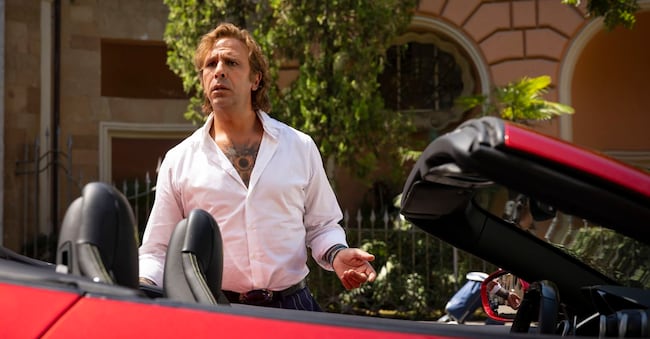
Welcome back Checco Zalone. With Buen Camino, from 25 December in cinemas, the actor, comedian, onemanshow who has made pugliesity a trademark, resumes his omnivorous polish. He is no longer the man of the people who spares no wise lashes against the left and the right, the average Italian regionalist to the bone and barbaric to the point of mocking the disabled and fragile categories, only to make up for it with tenderness. In Buen Camino Zalone is a wealthy second-generation man, who has never worked a day making a boast of it, forced, in order to chase his teenage daughter Cristal (Letizia Arnò), to walk the Camino de Santiago.
A new politically incorrect
This time he does not measure his 'impropriety' with domestic politics, but with thorny international issues (Gaza and the Shoah) or with the middle-aged man's virility attacked by prostatitis. There are good expectations that Buen camino will halt the drop in box office that Tolo Tolo had recorded in 2020 compared to the previous film, despite the fact that the latter also confirmed itself as the king of the box office in Italy that year, as had happened from Che bella giornata in 2011 onwards. Produced by Indiana Production with Medusa Film, in collaboration with MZL and Netflix (on which we will see the film in 110 days), Buen Camino - distributed by Medusa Film, like all of Zalone's previous films - will be on a thousand screens. Staggering numbers, considering that even a blockbuster has half that number on average and that distribution has increased them by 10% (Tolo Tolo had 908), perhaps also because, after the solo direction of Tolo Tolo, Zalone returns in the 'safe' version with Gennaro Nunziante.
The return paired with Gennaro Nunziante
With the TV director and screenwriter, whom he met at Telenorba, Zalone shot his first four films. Accomplice also to the sector being at a standstill due to the difficulties surrounding the tax credit law, knowing of Zalone's release, the Christmas "vanzinate" were retracted like tortoiseshells, an adjective of improper origin because the Vanzina brothers only actually made two cinepanettoni, Christmas Vacation (1983) and Christmas Vacation 2000 (1999) with Massimo Boldi and Christian De Sica, but so impressive as to create a genre. Every time Zalone and Nunziante appear on sets, the film industry and exhibitors breathe a sigh of relief, sniffing the box-office smash. No one, in terms of politically incorrect comedy, has really ever trailed Zalone, not even Angelo Duro, who with his only film, I am the end of the world - co-directed, by the way, by Nunziante - reached 9 million box-office in 2025. It lacks the compassionate, regenerative coda with which Zalone, born Luca Medici, closes his stories.
The Zalone phenomenon
The 'Zalone phenomenon' is made up of auriferous strands and numbers. The first cinematic storm, Cado dalle nubi, arrived at the end of November 2009, when 'Checco', as his fans call him, was still only a cabaret performer, albeit a prodigious one, on Zelig. Together with Nunziante, he wrote a script in which he parodied the tamarro boy from the South (Checco Zalone is a sort of decomposed contraction of Che cozzalone! which in Apulian dialect, the comedian's homeland, means Che cafone!) who 'goes up' to Milan to realise his dream as a singer, stumbling over his bias against gays, fragile subjects and clashing with those of the leghism of his origins. The box office was a real surprise: €14,084,263; tickets sold 2,289,259; 596 cinemas screened it, and for five days it topped the box office. The twoabsolute beginners of the big screen are now in ninth place in the Italian ranking. Everyone realises that something has happened: first at the box office is box office mammasantissima Tim Burton with Alice in Wonderland with 3o million. But in the ranking of Italians, Medici and Nunziante are only surpassed by Neri Parenti with Christmas in Beverly Hills in third place, which distances them by "only" six million, and Verdone with Io, loro e Lara, with less than two million. The scheduling of the next film, Che bella giornata, in 2011 was moved from the end of November of the debut to Befana.
The overcoming of cinepanettoni and beyond
No one dared openly challenge the cinepanettoni of 2010 - A Natale mi sposo, Natale in Sudafrica, La banda dei Babbi Natale - and Zalone was released on 5 January 2011. In truth, there was nothing to fear: Zalone in 2011 is box office champion with €43,477,161, rewarded by the general public, despite the theme of Islamic terrorism (albeit in Zavatt's sauce): admissions are 6,831,777, screens increase by 100 compared to the previous film, to 695. The film tops the box office for 16 days. From then on, for other Italians, the pair is a 'weed killer', the Creso of Italian cinema. With Sole a Catinelle in 2013 they fear Frozen, which comes out on 19 December, and The Hobbit (12 December) and programming is brought forward to the Bridge of the Dead. There is no match, not even for the colossals. Shooting against the 'cashmere left', talking about the industrial recession of the North East and with bonhomie of childhood illness, the takings are stellar: €51,948,739, 8,025,608 admissions, 707 theatres. They are 20 days at the top of the box office. Then comes their true masterpiece, Quo vado? As of 1 January 2016 the box office grosses €65,365,736, there are 9,368,154 admissions, 833 theatres, and 17 days on which the film tops the charts. On its own, the film accounts for 9.87% of the entire yearly takings (662 million according to Cinetel). The parody of the employee attached to the 'fixed job', the brain drain and LGBT love broaden the fan base with fresh physical comedy, not exempt from addressing current social issues, which is the function of Italian comedy, in whose wake, however, the Bari couple never put themselves.


