Industry

Chemicals: output down 3 per cent – the EU has a decisive role to play. Meloni: take action on the ETS

At the Federchimica general meeting, industry representatives refocused attention on energy and health. President Buzzella: “It’s a burden”

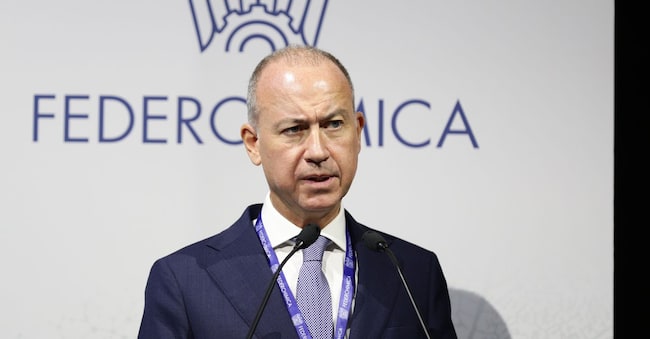
Il presidente di Federchimica Francesco Bruzzella IMAGOECONOMICA

7' min read

Translated by AI
Versione italiana

7' min read

Translated by AI
Versione italiana

‘In Europe, we have taken our industrial leadership for granted for far too long. The wake-up call – a much-needed jolt for which we are grateful – came from Mario Draghi. Two years on, however, over 80 per cent of the recommendations in the Draghi Report have not been implemented, and progress has been slowest in the fields of energy and digitalisation: two crucial areas.” These are particularly crucial for the chemicals sector, as Federchimica’s president, Francesco Buzzella, explained in his speech at the Annual General Meeting, which was opened with addresses by the Prime Minister, Giorgia Meloni, and the President of the European Parliament, Roberta Metsola.

Meloni: take action on the ETS

“The Green Deal and European policies have contributed to exacerbating the difficulties” faced by Italian industry “by imposing costs and burdens that are disconnected” from the needs of the production system, said Meloni. “The ETS system” is where action is needed. “We need realistic timelines and protection against those who do not bear the same costs as us, particularly environmental costs.” The Prime Minister highlighted that “the European chemicals sector is going through a deep crisis. Energy costs, weak demand and international competition that we cannot contend with on a level playing field are taking their toll,” explained Meloni. “Europe cannot respond to these challenges by imposing further costs and constraints on those who continue to invest and produce here. The Green Deal and European policies have also contributed to exacerbating these difficulties by imposing burdens and deadlines that are out of step with the availability of sustainable technological and energy alternatives for businesses. The ETS system is one of the key areas requiring action. For this reason, the Government is fighting – and will continue to fight – for a review of European climate policies, starting with the ETS, which balances decarbonisation with competitiveness. We need realistic timelines, technological neutrality, energy at sustainable costs and effective protection against competition from those who do not bear the same costs as we do, particularly environmental costs.”

Loading...

The decline in production

This is not an easy time; at European level, ‘the loss of production capacity in the chemicals sector between 2022 and 2025 amounts to 37 million tonnes, equivalent to around 9 per cent of the total, with some 110,000 jobs affected. Over the last four years, the number of announced closures in the chemical sector in Europe has increased sixfold. In Italia, chemical production is more than 13 per cent lower than in 2021. “Hopes for a swift resolution to the conflict in the Middle East are proving to be in vain, and chemical production in Italia is forecast to contract by a further 3 per cent in 2026, with possible knock-on effects into 2027,” said Buzzella.

EU policies of vital importance

In his speech, Buzzella highlighted the fact that by 2050, on a planet with a population of nearly ten billion, ‘the combination of demographic and technological change will result in a multipolar world order, with reduced American influence. The influence of the G7 countries will continue to wane in favour of China, India, Indonesia, Brazil, South Korea, Turkey and other emerging economies, such as Vietnam, the Philippines and Nigeria. Europe will have an even smaller role to play and will face fiercer competition to defend it. This is why we have long maintained that the European Union’s policies – now, not tomorrow or the day after – are of vital importance in determining whether we intend to carve out a role for ourselves as co-leaders, or whether we will succumb to the aggressiveness of the world’s new industrial leaders, thereby sacrificing our prosperity and our values.”

American and Asian competition

Europe has an extraordinary industrial heritage, but finds itself caught between the American model, which ‘relies on technological and scientific dominance, a formidable network of innovation and finance, low-cost energy and significantly less stringent environmental regulations than ours’, observes Buzzella, and ‘China, which is at once a market, a supplier and a competitor – unfortunately, often an unfair one. In 2019, 5 per cent of Italy’s chemical imports came from China, compared with 17 per cent in 2025. Over this same period, our exports to that market increased by 20 per cent, but imports rose by 410 per cent’. Moreover, ‘between 2005 and 2024, Chinese companies benefited from forms of public support between three and eight times greater than those in OECD countries. We are therefore talking about pure structural dumping, with strong backing from Chinese state-owned banks,’ explains Buzzella.

A broader view of sustainability ...

For those in the chemical industry, the sustainability of the system must undoubtedly guide industrial decisions as well, but this realisation can only lead to a broad interpretation of the concept of sustainability. Over the years, there have been numerous plans leading up to the Green Deal, which has caused the industry considerable difficulties. And even the recent revision of the ETS system for the chemical sector can only be regarded as a first step. ‘Between the direct and indirect costs of the ETS system, the Italian chemical industry pays over 600 million euros a year, a figure set to rise to 1.5 billion by 2030,’ noted Buzzella. This is a paradox, given that whilst the EU has reduced its emissions to 5.8 per cent of global emissions, global emissions have instead risen by 60 per cent since 1990. Meanwhile, in Europe, between 2021 and 2025 alone, investment in new chemical production capacity has plummeted by 90 per cent. It is unthinkable to reduce emissions through industrial desertification. The ecological transition must be pragmatic, not ideological.”

... and the evolution of the One Health concept

At the Federchimica general meeting, the debate focused extensively on the key issue of energy and on the topic of health, which was also interpreted in a broad sense. ‘Human, animal and plant health, and the quality of ecosystems, are not separate spheres, but rather parts of a single system on which safety, well-being and the quality of development depend. This vision is well summarised by the ever-evolving concept of ‘One Health’, with which Federchimica fully identifies,” explained Buzzella. “The paradigm goes beyond healthcare and requires us to consider prevention, the environment, nutrition and productive activities together. Chemistry underpins medicines for humans and animals, medical and diagnostic technologies, agriculture and food safety, and is therefore one of the key enablers of One Health.’ The meeting was attended by Confindustria President Emanuele Orsini and the Minister for Foreign Affairs, Antonio Tajani. Orsini reiterated that ‘today, nothing can be done without chemistry’. And there is considerable concern amongst industrialists because ‘on the European front, it seems that we Italians are the only ones who have realised what is happening. We were on our own in the ETS battle, we are on our own on chemicals, and we are on our own on basic industry. We are due to have an important meeting with Confindustria Germany and Confindustria France, but what we are seeing is that they are treating it as a fait accompli that we have lost our basic industries. We have not managed to change course as quickly as others; the reaction from the US and China has been very swift, unlike ours.” On the ETS: ‘We have maintained a consistent position. The ETS was worth 5.8 euros per tonne in 2008; it is now worth 87 euros. We already have many business owners who have relocated.’ The fact is that the whole concept is fundamentally flawed for businesses, and trading should be organised directly between companies themselves, eliminating all the financial speculation within the system. According to Orsini, ‘we need to rebuild our industrial sovereignty and our energy sovereignty’.

Supporting competitiveness

Tajani added that ‘we need serious policies that enable businesses to compete on a global scale. Europe risks being overwhelmed in the competition with the US, China and India because red tape is stifling the system’s competitiveness, whilst elsewhere there are far fewer rules. One of the issues closest to our hearts is the Green Deal, which is not working as it has been implemented. When we defend the environment, we must bear in mind that it is not just about plants, rivers and animals, but also about the men and women who need to continue living and working, because without work there is no dignity. The Green Deal, as it stands, is not working. We are fighting a battle over the ETS; neither ETS 1 nor ETS 2 are acceptable. The other day we achieved an initial result, but it is not enough, and we are working to ensure that sectors such as the chemical industry can benefit from the new rules.”

Messages were also received at the Federchimica general meeting from the Minister for Enterprise and ‘Made in Italy’, Adolfo Urso, and the Minister for the Environment, Gilberto Pichetto Fratin. A round-table discussion on the sort of Europe needed for industry, health and energy was attended by Ilaria Capua, Professor and Senior Fellow of Global Health at Johns Hopkins University SAIS Europe; Davide Tabarelli, President of Nomisma Energia; and Giulio Terzi di Sant’Agata, Chair of the Senate’s EU Policies Committee.

The energy crisis

It is when the discussion turns to energy issues that matters become most critical. According to Buzzella, ‘we are at a crucial crossroads. We need a two-stage industrial policy: to protect strategic capacity today, and to transform it tomorrow. To achieve this, there is only one prerequisite: secure, available energy at sustainable costs. The proportion of energy costs in the value of chemical production has risen from 14 per cent in 2021 to 18 per cent in 2024, and is now at risk of exceeding 23 per cent. Gas in Europe costs up to nine times as much as in the US. We are not just talking about shrinking profit margins, but about a very real risk of production stoppages, postponed investments and relocation. And closing a plant means losing skills, jobs and technological sovereignty forever’. Moreover, even if one were to be visionary, it is not easy because the two pillars of the green transition envisaged by Brussels – such as green hydrogen or ‘CO₂ capture and utilisation’ – remain technologically complex and economically unsustainable for large-scale deployment. For this reason, the transition must be based on technological neutrality, setting reasonable environmental targets and leaving businesses free to choose the most efficient solutions to achieve them.

Copyright reserved ©

Brand connect

Loading...

Newsletter

Notizie e approfondimenti sugli avvenimenti politici, economici e finanziari.

Iscriviti