
Chemicals: emissions reduced beyond the EU’s 2030 targets
The report presented at Ecomondo in Rimini highlights that the sector has reduced greenhouse gas emissions by 73 per cent since 1990. Federchimica’s president, Buzzella, said: “The transition cannot happen without industry, and it is impossible without the chemical sector.”

When discussing the energy transition, one cannot ignore the fact that 95 per cent of manufactured goods contain chemical elements; consequently, the chemical industry is not only an indispensable sector but can also act as a driving force for the ecological transition. Turning to Italia, as highlighted by Federchimica’s 32nd Responsible Care Report, presented yesterday in Rimini – where the Ecomondo trade fair is currently taking place – the sector has already far exceeded the European 2030 emissions targets. Since 1990, the chemical industry has reduced greenhouse gas emissions by 73 per cent and is committed to developing circular economy models. This figure means the sector is already on track to meet the European target of a 55 per cent reduction within the next four years. In 2024, direct emissions in Italia stood at 8.4 million tonnes of CO₂ equivalent, accounting for 2.5 per cent of the national total (compared with 6 per cent in 1990). Taking direct and indirect emissions into account, the chemical industry has reduced its impact on climate change by 74 per cent. In terms of the circular economy, recycling is the primary method of waste disposal (49 per cent), a significant increase compared with 2015 (23 per cent).
The sector’s commitment and achievements are therefore key to improving its environmental impact, as summarised by the president of Federchimica, Francesco Buzzella: ‘The transition cannot take place without industry, and it is impossible without the chemical sector. Development is sustainable if wealth, well-being and social protections increase, whilst resource consumption and environmental impacts are reduced’. In particular, as Fabio Viola, Chair of Federchimica’s Responsible Care Programme, noted whilst presenting the figures, in 2025 the Italian chemical industry generated a production value of 60 billion euros. Of this, 90.8 per cent (€54.4 billion) is distributed to stakeholders in the form of purchases of goods and services, staff costs and taxes paid to the public administration. The sector contributes to the public budget and the provision of services to citizens, paying €1.1 billion in taxes, in addition to almost €2.3 billion in taxes and social security contributions linked to staff costs.
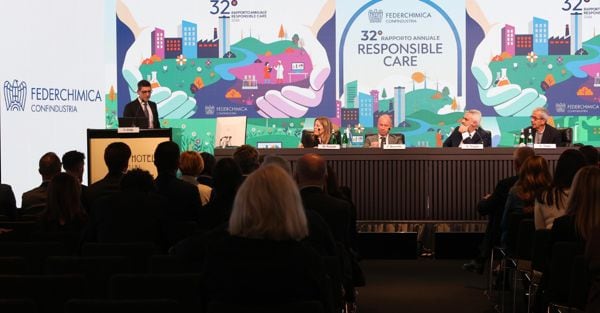
For years, the Italian chemical industry has held a leading position in workplace health and safety: the accident rate is 36 per cent lower than the manufacturing sector average. The number of accidents, based on the same number of hours worked, has fallen by 44 per cent since 2010 and by 80 per cent compared with 1990. Speaking at the presentation, the president of INAIL, Fabrizio D’Ascenzo, explained that ‘the long-standing collaboration between INAIL and Federchimica, dating back to 2006, is a concrete example of how it is possible to recognise companies’ commitment to safety through a joint effort to promote a culture of prevention and to implement activities and projects aimed at reducing accidents. The new challenges in the world of work must be tackled responsibly, in line with the approach of collaboration and continuous improvement on which, amongst other values, the Responsible Care Programme is based’. The Report clearly shows that safety, health and a high standard of wellbeing in the workplace “are distinctive features of the chemical sector,” added Buzzella. This achievement is also due to the commitment of the sector’s social partners: Responsible Care, in fact, provides for the active involvement of workers and their representatives on issues of safety, health and the environment, through the participatory model of the employment contract.” According to Sebastiano Tripoli, general secretary of Femca Cisl, “the transition of the chemical industry must balance sustainability, competitiveness and quality of work. We need industrial policies, energy at sustainable costs and investments capable of securing a future for plants and local communities. For the trade union, collective bargaining and worker participation are crucial to strengthening safety, training and skills. Environmental progress must go hand in hand with the protection of jobs and industrial growth.’ Chicco Testa, speaking as an energy and environment expert, highlighted that ‘the two objectives of the European Green Deal have shown significant limitations. The reduction in emissions has come partly at the expense of our industry: over half of the reduction stems from the closure and relocation of key sectors, shifting CO₂ elsewhere whilst continuing to import those products. Furthermore, green technological leadership has tragically failed: the European drive has created a market monopolised by China in solar, wind, batteries and critical raw materials’.
However virtuous the sector may be, it must nevertheless contend with a European context characterised ‘by over-regulation, unrealistic targets and rules that are difficult to interpret, as well as being inconsistent, sometimes unenforceable or associated with extremely high costs,’ emphasised Buzzella. “These conditions do not allow us to compete on a level playing field on the global stage,” he added.
For chemical companies to maintain their competitiveness, a political and legislative framework that supports the sector’s development rather than penalising it is essential. Whilst sustainability must remain the guiding principle of industrial strategies, the green transition cannot proceed without the vital contribution of the chemical industry. “Europe and Italia face a strategic choice: to confirm their leadership in the sector and strengthen the continent’s strategic autonomy, or to resign themselves to a loss of competitiveness. To achieve this objective, institutions and policymakers are called upon to make an immediate shift in terms of the timeliness and effectiveness of their responses. The essential and indispensable condition today remains the need for a secure energy supply that is always available and at genuinely competitive costs,” concluded Buzzella, as he presented the Responsible Care Award to Bracco Imaging for the project “Innovation and process efficiency improvements at the iodine recovery plant”, Flamma for the ‘Safety Culture’ project, Kenvue Italia for the project ‘Simulator for employee training in LOTO procedures’, Nippon Sanso Italia for the project ‘Applications of Artificial Intelligence to safety, health and the environment’ and Nuova Solmine for the project ‘Innovative HSE training in work-study programmes’.

